

The automotive world has already begun writing the Bugatti W16’s obituary. Production of the W16 Mistral has ended, the Chiron has bowed out, and the V16-powered Tourbillon represents Molsheim’s future. Yet Bugatti’s extraordinary 8.0-litre engine refuses to leave the stage quietly.
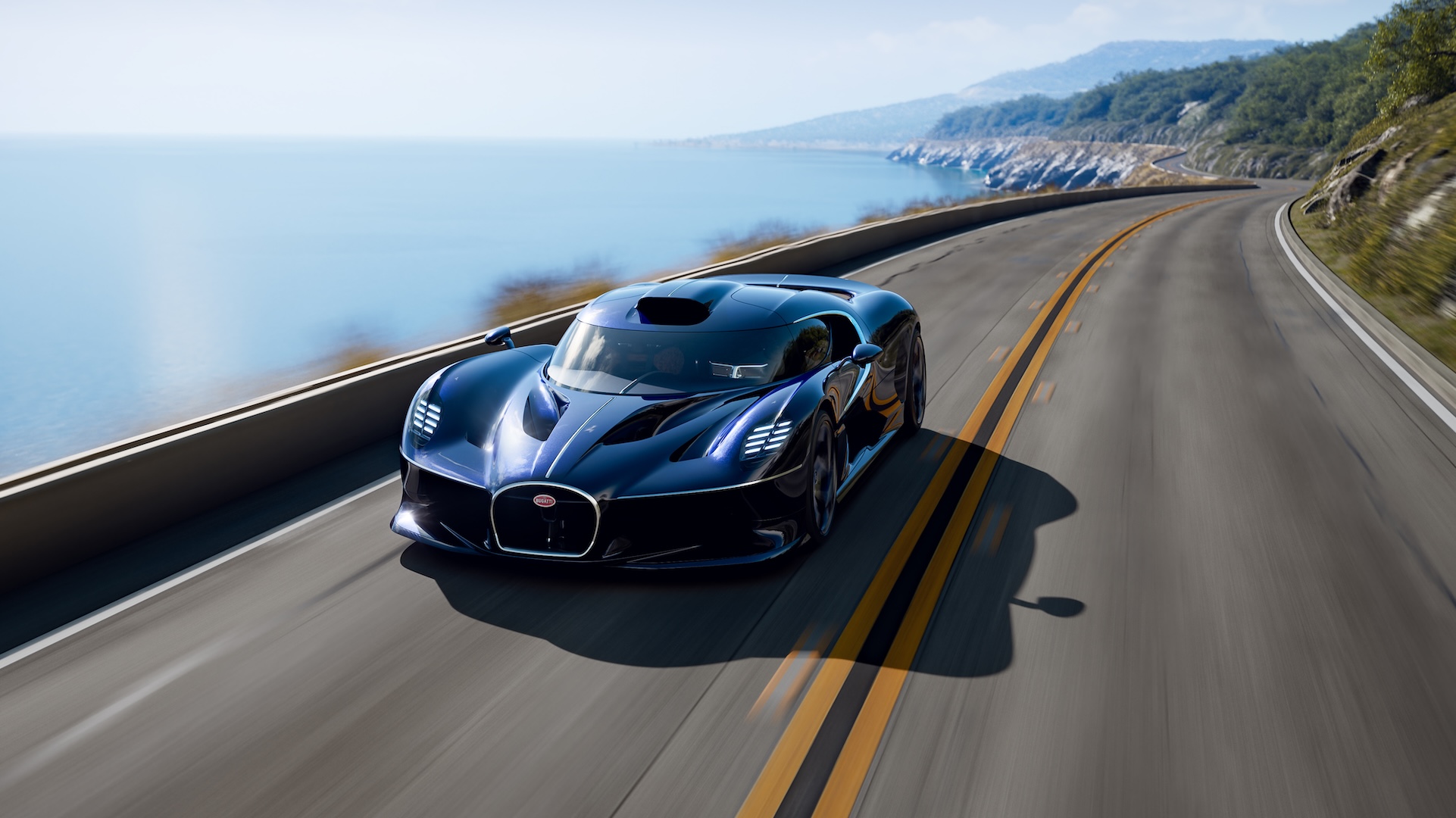
Its latest encore is the Bugatti Destrier, a one-off hypercar that has now made its public debut at The Quail during Monterey Car Week, just a few days after its digital debut. Producing 1,578hp and standing barely one metre tall or under 40 inches, the Destrier transforms the circuit-devouring Bolide into something altogether more graceful.

This is Bugatti proving that the same mechanical foundation can create either a track weapon or a concours masterpiece. Given Bugatti’s history, it should surprise absolutely nobody.
From Bolide To Beauty
The Destrier is the third creation from Programme Solitaire, following the Brouillard and F.K.P. Hommage. Sitting above Bugatti Sur Mesure, Programme Solitaire is effectively Molsheim’s modern coachbuilding atelier, producing deeply bespoke one-off cars for exceedingly fortunate customers.
Its name refers to the finest and strongest warhorses ridden by medieval knights. The engineering underneath is suitably formidable: the Destrier uses the Bolide’s carbon fibre monocoque and complete quad-turbocharged 8.0-litre W16 powertrain, developing 1,578hp.

However, Bugatti’s designers removed the Bolide’s towering wings, exposed ducts and relentless aerodynamic appendages. What remains is the astonishing underlying proportion of that track car, allowed to breathe without looking perpetually ready to attack Eau Rouge.
At just 1,000mm tall, this is the lowest Bugatti ever created. Its 20-inch front and 21-inch rear wheels also dwarf the Bolide’s 18-inch items, exaggerating an already theatrical stance.
The body narrows sharply behind the doors before swelling over the rear wheels. It possesses the sort of waist-to-hip ratio designers usually sketch before engineers arrive carrying packaging diagrams and bad news.
Also Read:
– Final Bugatti W16 Mistral Produced, Ending A 20-Year Hypercar Era
– Bugatti F.K.P. Hommage: The Definitive Veyron, Rewritten For 2026
– Spyker C8 Preliator XXV Debuts At Monterey With An 800hp V8 And Manual Gearbox
A New Bugatti Design Language
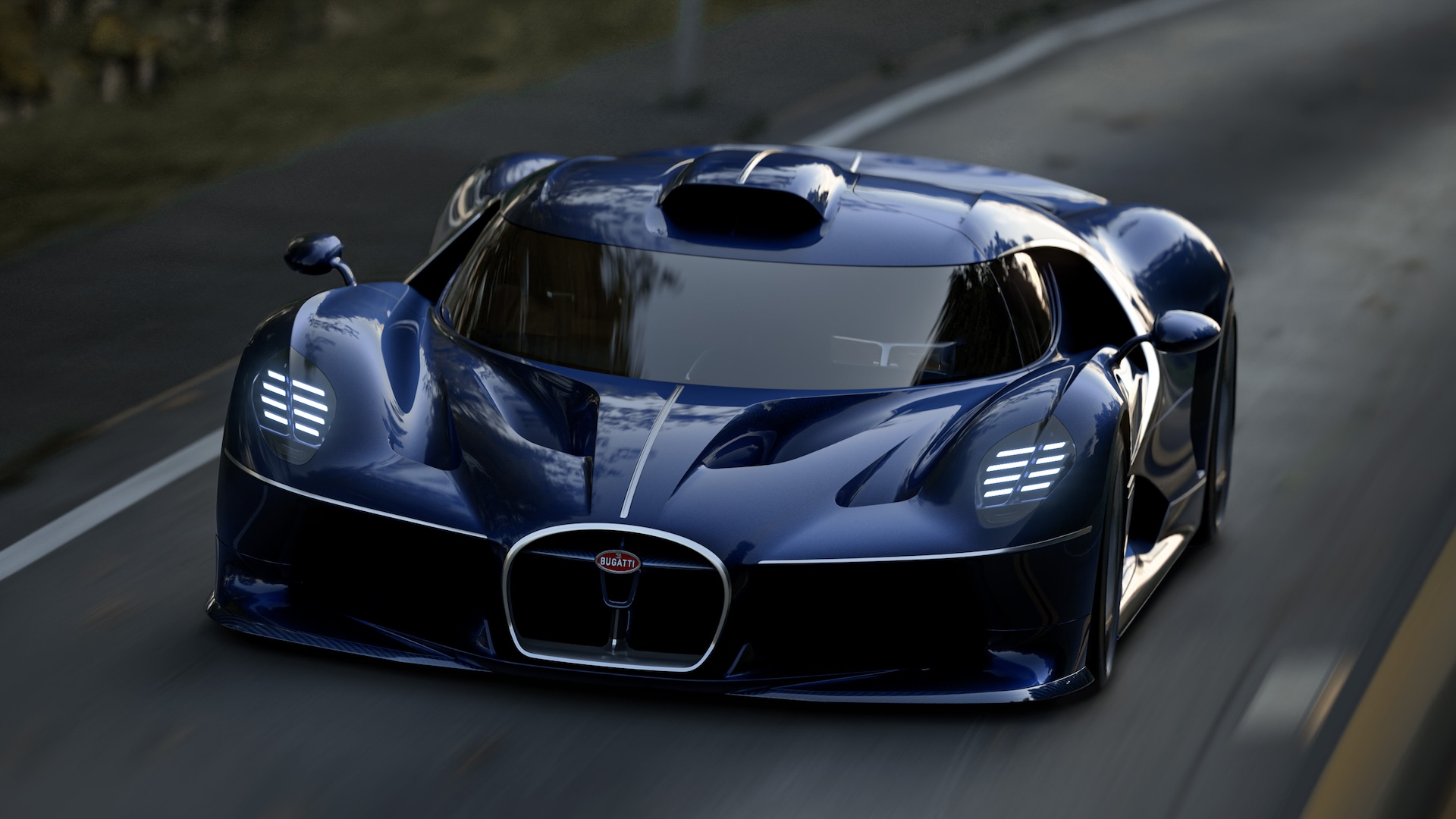
The Destrier introduces a different interpretation of Bugatti’s familiar design signatures. Its polished-aluminium C-line pauses ahead of the front wheel, exposes a section of bodywork and then continues towards the wider horseshoe grille.
At the rear, a smoothly integrated wing recalls the exceptionally elegant Chiron Profilée. Parametric patterns feature inside the headlamps and tail lamps, while exposed carbon fibre has been restricted to the splitter and diffuser.

The body is finished in Sapphire Celeste, a bespoke multi-layer blue containing diamond-inspired particles. It is complemented by polished aluminium and colour-tinted carbon fibre.
There is historical significance behind that blue. Bugatti Type 57SC Atlantic chassis 57591, commonly known as the “Pope” Atlantic, originally wore blue before its current owner repainted it black.
That Type 57 connection runs deeper. The same basic chassis once underpinned the beautiful Atlantic and the Type 57G and 57C “Tank” racers that won Le Mans in 1937 and 1939. One platform produced both rolling sculpture and victorious competition machinery.
The Bolide and Destrier now repeat the trick. A hand-laser-engraved plate above the windscreen depicting the Atlantic and Tank makes the relationship permanent.
A Tailor’s Atelier With 1,578hp
Where the Bolide’s cockpit feels ready for helmets, harnesses and serious conversations about braking points and apexes, the Destrier resembles a luxury tailor’s atelier.
Ambre Voyageur leather and nubuck are paired with an advanced seamless 3D-knitted textile. Copper yarn forms a halo-like pattern around the cabin, with contrasting stitching tracing the geometry of individual components.
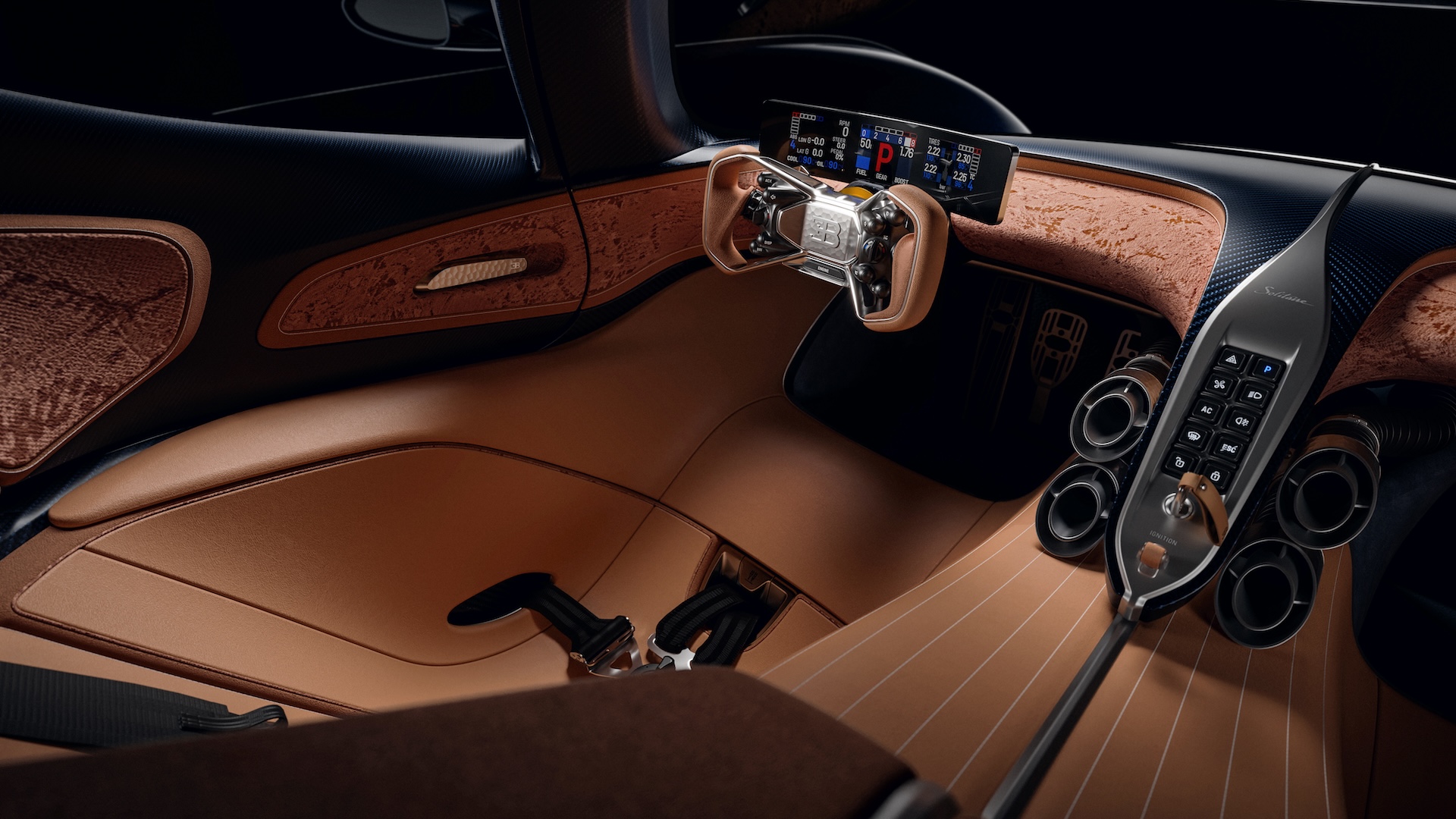
Hammered brightwork appears on the door releases, air vents, steering-wheel hub and entry plates, referencing the hand-beaten armour associated with the car’s medieval name. A small French flag provides a discreet reminder of Bugatti’s origins, while the oil filler cap bears the Destrier emblem and its deeply satisfying “1/1” designation.
The W16’s Exquisite Encore
Bugatti has not disclosed the Destrier’s price, performance figures or whether its owner intends to exercise all 1,578hp regularly. Those numbers almost feel secondary here.
The Destrier demonstrates why Bugatti occupies such an unusual corner of the hypercar world. Plenty of manufacturers can produce extraordinary speed. Far fewer can place one of history’s most outrageous engines beneath a coachbuilt body and create something worthy of a concours lawn decades later.
Its public debut at Monterey was therefore entirely appropriate. The W16 may be approaching the end of its production story, but in the Destrier, it has found another way to become immortal.