

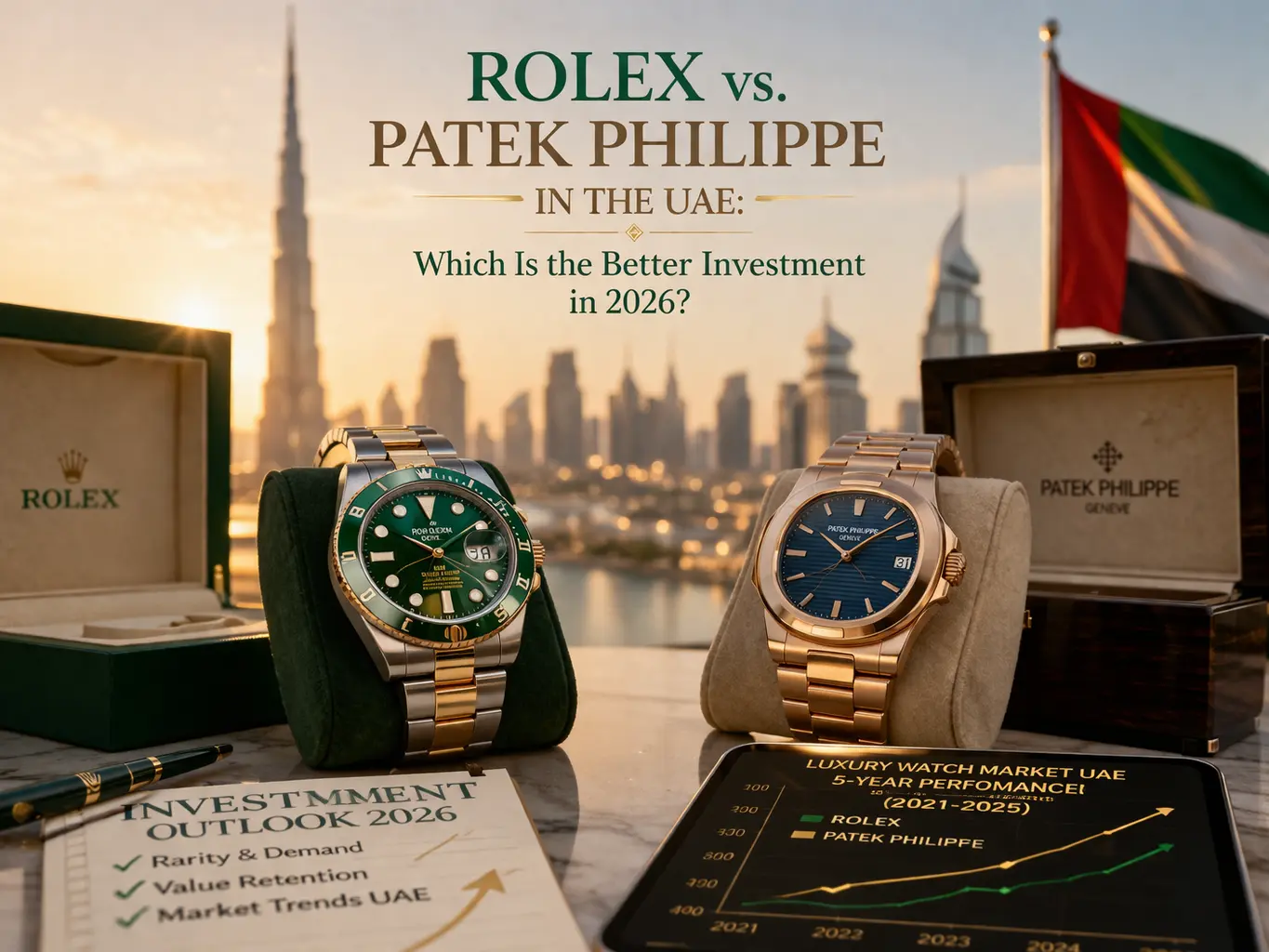
Both Rolex and Patek Philippe are exceptional at holding and growing value – but they serve fundamentally different investment strategies. Rolex is the more liquid, lower-risk, and more accessible investment, with steel sports models regularly trading above retail. Patek Philippe offers higher ceilings on its rarest pieces, but requires more capital, more patience, and deeper market knowledge to unlock those gains. For UAE buyers specifically, the tax-free purchasing advantage, the strength of Dubai’s watch resale ecosystem, and the post-Dubai Watch Week market momentum make this the most interesting time in years to buy either.
Here is everything you need to know before spending a dirham.
Why the UAE Is One of the Best Places in the World to Buy Rolex or Patek Philippe
Before diving into the investment comparison, it is worth understanding why the UAE – Dubai specifically – has become a global reference point for luxury watch buying and investing.
The headline advantage is structural: the UAE charges no VAT on watches purchased at Dubai Duty Free and no federal watch tax at the retail level that buyers in Europe, the UK, or much of Asia face. The UAE Luxury Watch Market was valued at around USD 1.61 billion in 2024 and is projected to reach USD 2.21 billion by 2030, growing at a CAGR of around 5.21%. That is a market growing with real conviction, not hype.
The import picture confirms this: the quantity of Swiss watches imported into the UAE increased by approximately 11.8% in 2024 compared to the previous year, according to the International Trade Council.
And then there is Dubai Watch Week – the event that has fundamentally repositioned the UAE on the global horology map. According to Swiss export data from the Federation of the Swiss Watch Industry, the UAE consistently ranks among the top 10 global destinations for Swiss timepieces by value, with Dubai accounting for a large share of that total. Beyond sheer volume, the region is notable for its appetite for independent watchmaking, bespoke pieces, and high complications – a contrast to the mainstream-dominated preferences seen in other major markets.
Dubai Watch Week returned for its seventh edition from 19th to 23rd November 2025, at a new and expanded venue in Dubai Mall, Burj Park. Doubling its footprint to 200,000 square feet, the event welcomed 90+ brands, speakers, and experiences, under the patronage of Sheikha Latifa bint Mohammed bin Rashid Al Maktoum.
When it comes to the luxury watch industry’s global markets, industry leaders note that while America is the centre for turnover and power, the buzz is entirely about the Middle East. For Rolex and Patek Philippe buyers in the region, that energy translates into a deep, active, and increasingly sophisticated secondary market that makes buying smart – and selling when the time is right – genuinely achievable.
Understanding the Two Brands: What You Are Actually Buying
Rolex: The World’s Most Recognised Watch Investment
Founded in 1905 by Hans Wilsdorf, Rolex has spent over a century perfecting the art of making watches that are simultaneously beloved by collectors, accessible to aspirational buyers, and practically indestructible. In the UAE, Rolex is not merely a watch – it is a universal cultural shorthand for success, precision, and permanence.
From an investment standpoint, Rolex’s power lies in two things: scale and scarcity management. Rolex produces approximately one million watches annually, making its watches more accessible yet still retaining high demand due to the brand’s prestige and quality. But the company strategically manages which watches reach which markets in what quantities – and that is what creates the secondary market premiums that have made steel sports Rolexes into one of the most reliably appreciating consumer goods of the past two decades.
The brand’s character is defined by purpose-built tool watches with timeless design. The Submariner was made for divers. The Daytona was built for racing drivers. The GMT-Master II was designed for pilots. Each one transcended its original purpose and became a cultural icon – and that transcendence is what drives long-term collector demand.
Patek Philippe: The Pinnacle of Swiss Watchmaking
Patek Philippe was founded in Geneva in 1839 and remains entirely family-owned – a distinction that matters in an industry increasingly dominated by luxury conglomerates. It holds the distinction of being the only major watch manufacture to have produced watches in every single year since its founding, without interruption, including through two World Wars.
Patek Philippe manufactures far fewer watches – estimates suggest around 62,000 annually – enhancing their exclusivity and desirability among collectors.
The brand’s character is defined by its complications – horological achievements like perpetual calendars, minute repeaters, split-seconds chronographs, and world time displays that require thousands of hand-finished components assembled by craftsmen who spend years mastering individual skills. Its most famous advertising line – “You never actually own a Patek Philippe, you merely look after it for the next generation” – is not marketing. It is an accurate description of how the world’s most serious collectors treat these watches.
Patek Philippe is considered the gold standard in watch investments, with significant appreciation potential for rare and complicated models.
The Investment Case: Head-to-Head
Production Numbers and Scarcity
The production gap between the two brands creates fundamentally different investment dynamics. This production disparity creates fundamentally different supply-demand dynamics in the secondary market. When a Patek Philippe owner decides to sell, they’re offering one of the relatively few pieces available at any given time. Collectors and enthusiasts who missed retail availability often turn to the secondary market as their only acquisition path. This scarcity supports price stability and, for sought-after references, price appreciation.
Rolex achieves its own scarcity differently – through demand massively outstripping supply on key references. Models like the Daytona and GMT-Master II “Pepsi” have waiting lists at authorised dealers that can run to two to three years. That supply pressure pushes secondary market prices well above retail, which is where Rolex investors make their money.
Value Retention and Appreciation: The Honest Numbers
Both Rolex and Patek Philippe are exceptional at retaining value, but they serve different investment strategies. Rolex is generally a safer, more liquid, and more consistent investment, with high-demand steel sports models often appreciating. Patek Philippe holds superior value for rare, high-complication, or specific models like the Nautilus.
The ceiling versus floor dynamic is the critical distinction. One analysis found that while Rolex investors saw an average profit of around £7,000 on premium models, Patek investors saw average gains of about £44,000 on their high-end pieces. In other words, Rolex might give a higher percentage return on many models, but Patek can deliver jaw-dropping absolute returns on the most coveted references.
Recent market data adds important context. Both Rolex and Patek prices surged in 2021–2022 due to heightened demand and speculation, then saw a correction in 2022–2023. By early 2025, the market appeared to be stabilising for both brands. Rolex resale prices actually ticked up slightly for the first time in many months in February 2025, while Patek prices were down a modest 0.8% that month and about 6.5% year on year – indicating a levelling off after the earlier cooling. Crucially, even through the correction, core models from both brands held much of their value. Neither Rolex nor Patek crashed the way lesser-known brands did.
Liquidity: Which Sells Faster?
Rolex is easier to sell due to universal brand recognition and a larger buyer pool. A Rolex Submariner can sell within days, while a Patek Philippe may require more time to find the right buyer willing to pay premium prices.
In the UAE specifically, this liquidity gap is pronounced. Dubai’s grey market and pre-owned dealer network is built significantly around Rolex – watch boutiques along DIFC, specialist dealers in Gold Souk areas, and platforms like Chrono24’s UAE listings are saturated with Rolex demand. Patek Philippe requires more specialist buyers, but the community of serious collectors in Dubai and Abu Dhabi has grown meaningfully since Dubai Watch Week established the UAE as a centre of horological gravity.
Current Prices in the UAE: What You Will Actually Pay in 2026
Rolex Prices in the UAE (March 2026)
Rolex implemented a price increase across its catalogue in January 2026. The average increase across steel and gold models was 6% to 10%. The price of the steel Daytona is now AED 67,450, while the Submariner No-Date reached AED 40,350. Gold models have experienced the biggest jump in prices.
The price of 24k gold increased by 66% in 2025, which is the biggest factor behind the increase, as it costs much more to produce an 18ct yellow gold or Everose gold case today than it did in 2024.
Key Rolex models and their approximate UAE retail prices as of March 2026:
| Model | Reference | UAE Retail (AED) | Secondary Market (AED) |
| Submariner No-Date | 124060 | ~40,350 | 47,000–58,000 |
| Submariner Date (Black) | 126610LN | ~47,900 | 60,000–75,000 |
| GMT-Master II “Pepsi” | 126710BLRO | ~51,900 | 70,000–90,000 |
| Cosmograph Daytona (Steel) | 126500LN | ~67,450 | 110,000–145,000 |
| Day-Date 40 (Yellow Gold) | 228238 | ~210,000 | 195,000–230,000 |
| Sky-Dweller (Steel) | 336934 | ~95,600 | 105,000–125,000 |
Retail prices are authorised dealer MSRP. Secondary market prices reflect March 2026 UAE grey market and pre-owned dealer listings. Steel sports models typically trade above retail; gold dress models trade closer to or below retail.
Patek Philippe Prices in the UAE (March 2026)
Patek Philippe’s sole authorised UAE retailer is Ahmed Seddiqi & Sons, with locations in Dubai Mall, Mall of the Emirates, and DIFC. Buying from the boutique typically requires an established client relationship and, for the most sought-after models, a multi-year wait. Pre-owned and grey market options are available from specialist dealers including Dubai Luxury Watch and WatchMaestro.
Key Patek Philippe models and their approximate UAE market prices as of March 2026:
| Model | Reference | Entry Retail (AED) | Secondary Market (AED) |
| Calatrava (Manual Wind) | 5196G-001 | ~73,000 | 75,000–90,000 |
| Aquanaut (Steel) | 5167A-001 | ~86,000 | 145,000–185,000 |
| World Time | 5230G-010 | ~150,000 | 175,000–210,000 |
| Nautilus (Three-Hander) | 5711/1A-011 (disc.) | N/A (discontinued) | 370,000–480,000 |
| Annual Calendar | 5396G-011 | ~250,000 | 240,000–290,000 |
| Grand Complications | Various | 500,000+ | 550,000–1,500,000+ |
The Patek Philippe Nautilus 5711/1A was discontinued in 2021. Its secondary market price in the UAE has stabilised significantly above its original retail following the discontinuation-driven surge.
The Models That Actually Make Money: A UAE Buyer’s Guide
Rolex: The Watches Worth Buying as Investments
Not every Rolex appreciates. Understanding which models deliver returns – and which sit at or below retail – is the difference between a savvy purchase and an expensive wardrobe addition.
The Cosmograph Daytona (Steel) remains the most compelling steel Rolex investment. As of 2025–2026, the Daytona trades 50–100% above MSRP in secondary markets. The demand is structural – Rolex produces fewer Daytona watches than any other major reference, making it chronically undersupplied. In the UAE, a steel Daytona at AED 67,450 retail is regularly trading between AED 110,000 and AED 145,000 on the secondary market.
The GMT-Master II family – particularly the “Pepsi” (blue/red bezel, Ref. 126710BLRO) and “Batman” (blue/black bezel, Ref. 126710BLNR) – has demonstrated consistent secondary market premiums. The Pepsi remains the more liquid and more culturally recognised choice; the Batman attracts serious collectors willing to pay a modest premium for the harder-to-source reference.
The Submariner Date in standard steel configuration is the entry point that makes sense for first-time watch investors in Dubai. It is not a spectacular appreciator, but it is the most liquid Rolex on the secondary market, carries global recognition, and provides a stable floor even in market corrections.
What to avoid: Two-tone and gold dress models outside the Day-Date collection typically trade at or below retail. Two-tone and dressier models often sell at or below retail price on the secondary market. The Cellini line, while beautifully made, attracts minimal collector demand. The Sky-Dweller is a technically impressive watch but has struggled to build the secondary market premium its retail price warrants.
Patek Philippe: The Watches Worth Buying as Investments
The Nautilus, despite the premium it now commands on the secondary market following the discontinuation of the iconic 5711/1A, remains the single most recognised Patek investment. Rarity fuels its appeal, as waitlists for new models can extend for years, driving up resale prices significantly. The discontinuation of certain popular models, like the 5711/1A, has led to a surge in demand and value, illustrating the potential for substantial financial appreciation. The 5726A Nautilus Annual Calendar is increasingly favoured by UAE collectors for combining complication prestige with the Nautilus design language.
The Aquanaut (5167A) has emerged as the accessible entry to Patek’s sports watch universe following the Nautilus 5711’s discontinuation. In the UAE, it trades at meaningful premiums above its AED 86,000 retail price and attracts buyers who want Nautilus adjacency at a lower entry point.
Grand Complications – perpetual calendars, minute repeaters, and the Grandmaster Chime – are where Patek’s appreciation ceiling exists. These are not entry-level investments; a serious grand complication starts above AED 500,000. But for high-net-worth UAE collectors building a multi-generational portfolio, the historical appreciation of rare Patek complications is unmatched in watchmaking.
The Calatrava is the honest choice for collectors who want a Patek that holds value with dignity but is not chasing grand complication returns. It sits close to retail on the secondary market – a modest appreciation, but exceptional craftsmanship for the money.
The UAE Advantage: Buying Smarter Than Anyone Else
Tax-Free Pricing – A Real and Quantifiable Edge
The UAE’s 0% luxury goods tax on watches (no VAT equivalent for watch purchases at authorised retailers in the UAE) creates a structural price advantage over the UK (20% VAT), EU markets (generally 19–25% VAT), and much of Southeast Asia. When you buy a Rolex Daytona in Dubai at AED 67,450 versus the equivalent price in London after VAT, the difference is meaningful – and it compounds when the watch is sold through Dubai’s secondary market at a later date.
Dubai’s Secondary Market Is Maturing Fast
The city’s ecosystem of authorised dealers, grey market specialists, and private collectors has grown substantially. Ahmed Seddiqi & Sons – the exclusive authorised retailer for both Rolex and Patek Philippe in the UAE – celebrated its 75th anniversary in 2025, and its influence in shaping a sophisticated regional buyer community is real.
Beyond authorised retail, specialist pre-owned dealers like WatchMaestro, Timepiece360, Big Moe Watches, and Dubai Luxury Watch offer depth and liquidity that did not exist five years ago. Chrono24 UAE listings now run into the thousands. This infrastructure makes buying, selling, and valuing watches in Dubai as straightforward as in any major European watch market.
The Dubai Watch Week Effect
At Dubai Watch Week 2025, Rolex CEO Jean-Frédéric Dufour – perhaps the most media-shy figure in luxury watchmaking – appeared alongside Abdul Hamied Seddiqi, chairman of Seddiqi Holding, for an opening keynote titled “The Time to Act Is Now.” Dufour spoke about industry collaboration with unusual candor: “It’s very important we all gather together to talk loudly to the world that the watch industry exists, that we are a creative industry, that we offer wonderful products which will last forever.”
The CEO of Rolex opening the world’s most attended watch event in Dubai is not a ceremonial gesture. It is a statement about where the brand’s most important market relationships are being cultivated.
Dubai Watch Week has transitioned from a biennial event to a year-round global platform, launching an advisory committee, a design competition, and a collector-focused white paper. For UAE watch investors, this evolving institutional presence means market intelligence, collector community, and brand relationships are now accessible at a quality previously available only in Geneva or New York.
The Things the Investment Guides Won’t Tell You
Documentation adds 15–20% to resale value – without exception. Having the original box, papers, warranty cards, and service records increases value by approximately 15–20% for both brands. Complete documentation provides authenticity verification and provenance that buyers pay premium prices for. This is not a suggestion – it is a fundamental rule of watch investment. Every Rolex or Patek Philippe you consider buying without box and papers is a watch you are accepting a structurally lower resale price for.
Condition is not just cosmetic – it is financial. A Patek Philippe in poor condition with missing documentation will underperform a pristine Rolex with a complete box and papers. Polish marks, replaced bracelets, and non-original service parts all reduce value. Watches that have been serviced by authorised service centres (Rolex Service Centre in Dubai, or the Patek Philippe service network via Seddiqi) retain value; watches with unknown service histories are penalised.
Not all Rolex appreciates. The narrative that every Rolex is an investment is false and harmful to first-time buyers. Entry-level references like the Oyster Perpetual and Datejust in standard steel configurations are excellent watches but trade broadly at or near retail. They are not bad purchases – they are just not appreciation vehicles in the same category as the Daytona or steel GMT.
Patek’s correction was real but not catastrophic. The 2022–2023 secondary market pullback affected Patek Philippe more sharply than Rolex – prices on some Nautilus references came down 25–35% from their speculative 2021 peaks. By early 2026, those prices have largely stabilised. The correction was a reset from irrational exuberance, not a structural change in the brand’s investment fundamentals.
Grey market vs. authorised dealer – the tradeoffs. Buying from an authorised dealer (Seddiqi for both brands) provides warranty, authenticity guarantee, and boutique relationship that can help with future allocations. Grey market and pre-owned dealers offer immediate access to waitlisted models, often at a premium over retail but without the relationship-building requirement. For investment purposes, documented authorised dealer purchases carry better provenance.
Head-to-Head: Rolex vs. Patek Philippe for UAE Buyers
| Factor | Rolex | Patek Philippe |
| Entry Price (UAE) | AED 40,000–67,000 (steel sports) | AED 73,000–86,000 (entry complications) |
| Annual Production | ~1,000,000 watches | ~62,000 watches |
| Liquidity in UAE | Excellent – sells within days | Good – requires specialist buyers |
| Typical Appreciation (Steel Sports) | 20–80% above retail on top models | Highly variable; 20–500%+ on rare refs |
| Investment Ceiling | Moderate | Extremely high on rare complications |
| Risk Level | Lower | Higher (requires model knowledge) |
| Best Strategy | Steady value, easy to liquidate | Long-term hold on right references |
| UAE Market Presence | Dominant | Growing – DWW has elevated profile |
| Authorised UAE Retailer | Ahmed Seddiqi & Sons (exclusive) | Ahmed Seddiqi & Sons (exclusive) |
The Verdict: Which Is the Better Investment for UAE Buyers in 2026?
Faced with inflation and economic uncertainty, many savers are looking for alternatives to traditional investments. Luxury watches, particularly Rolex and Patek Philippe, are attracting more and more investors in 2026.
For most UAE buyers – including those buying their first serious investment watch – Rolex is the more sensible starting point. The entry price is lower, the liquidity is exceptional, the secondary market in Dubai is deep and active, and the steel sports models (particularly the Daytona and GMT-Master II) have demonstrated consistent appreciation across multiple market cycles. You can sell a Rolex Submariner in Dubai on a Tuesday afternoon. That liquidity is real value.
Patek Philippe is the better long-term investment if you choose correctly and hold with patience. The Aquanaut and discontinued Nautilus references have delivered returns that no Rolex reference has matched in absolute dirham terms. A carefully chosen Patek grand complication, held for a decade or more, can compound in value in ways that few investment-grade assets can match. But “if you choose correctly” is doing significant work in that sentence – the Calatrava sitting near retail tells a different story to the Nautilus 5711 trading at four times its original price.
Many savvy investors actually hold both: Rolex for stability and liquidity, Patek for the long-haul appreciation on special pieces. In the UAE – with tax-free purchasing, a maturing pre-owned market, and the cultural gravity of Dubai Watch Week reinforcing the region’s position as a global horology hub – that dual strategy has never made more geographic sense.
Frequently Asked Questions
Is Rolex or Patek Philippe a better investment in 2026?
Rolex is the safer, more liquid investment with consistent returns on steel sports models. Patek Philippe offers higher appreciation potential on rare and complicated references but requires deeper knowledge and longer holding periods. For first-time watch investors in the UAE, Rolex is the more practical starting point.
What is the price of a Rolex in Dubai in 2026?
Following the January 2026 price adjustment, key UAE retail prices include: Submariner No-Date at AED 40,350, Submariner Date at approximately AED 47,900, GMT-Master II “Pepsi” at approximately AED 51,900, and Cosmograph Daytona in steel at AED 67,450. Secondary market prices for sports models trade 30–100% above these retail figures.
Where can I buy Rolex or Patek Philippe in Dubai?
Ahmed Seddiqi & Sons is the sole authorised retailer for both Rolex and Patek Philippe in the UAE, with boutiques in Dubai Mall, Mall of the Emirates, and DIFC. Pre-owned and grey market watches are available from specialist dealers including WatchMaestro, Timepiece360, Big Moe Watches, and Dubai Luxury Watch. International platforms including Chrono24 have extensive UAE listings.
Is it cheaper to buy a Rolex in Dubai than in the UK or Europe?
Yes, in most cases. The UAE does not charge a VAT-equivalent luxury goods tax on watches at the retail level, creating a meaningful price advantage over UK (20% VAT) and European (19–25% VAT) markets. Dubai Duty Free offers additional tax advantages for travellers purchasing at the airport.
What is the most valuable Patek Philippe watch?
The Patek Philippe Grandmaster Chime Ref. 6300A-010 – made in stainless steel for the 2019 Only Watch charity auction – sold for approximately AED 113 million (CHF 31 million), making it the most expensive wristwatch ever sold at auction.
Did Rolex prices increase in 2026?
Yes. Rolex increased retail prices across its catalogue in January 2026, with an average rise of 6–10% across steel and gold models. The increase was attributed primarily to the 66% rise in gold prices during 2025 and global currency adjustments. Steel sports models saw smaller increases; gold models saw the largest price adjustments.
What Rolex holds its value best in the UAE?
The Cosmograph Daytona in steel (Ref. 126500LN), the GMT-Master II “Pepsi” (Ref. 126710BLRO), and the Submariner Date in steel (Ref. 126610LN) demonstrate the strongest value retention and secondary market premiums in the UAE market. Complete box and papers documentation increases resale value by approximately 15–20%.