

Ferrari has revealed the energy system behind the Ferrari Hypersail, its 100-foot flying monohull. The boat carries no fuel-burning generator. Instead, it draws every watt from renewable sources and the crew while under sail, so it can race across oceans without refuelling.
What is the Ferrari Hypersail?
The Ferrari Hypersail is the first fully foiling monohull built for offshore racing, engineered for complete energy autonomy. It measures roughly 30 metres and rises clear of the water on foils. Because it sails long distances alone, the Maranello Hypersail Tech Team treated power as a core design problem, so energy shapes almost every choice on board. Ferrari first revealed the boat’s Giallo Fly and Grigio Hypersail livery at Milan Design Week in April 2026, and the energy concept now takes the project further.
How does the Ferrari Hypersail energy system work?
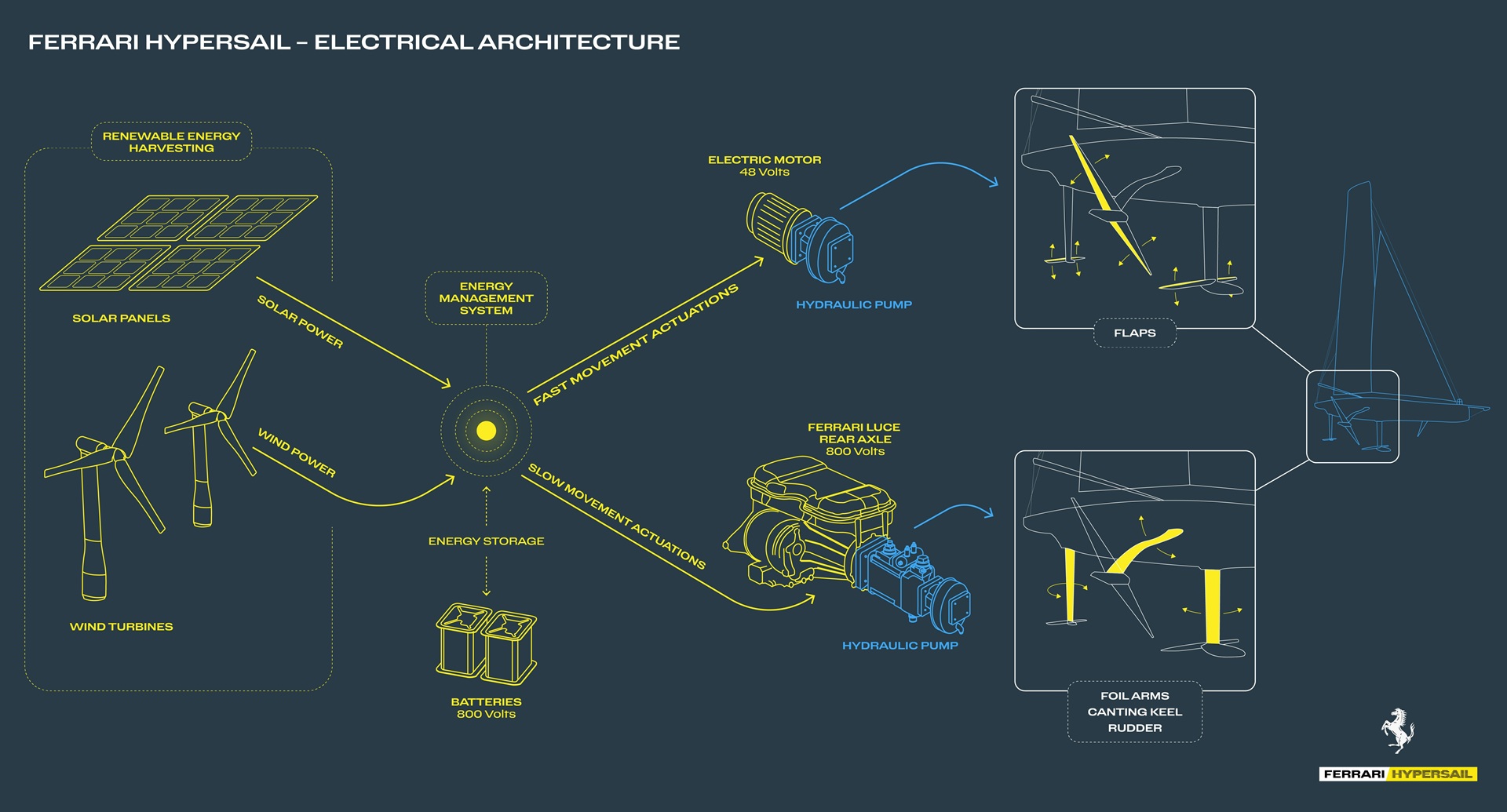
The Ferrari Hypersail energy system targets peak efficiency and full integration across all onboard systems. It is all-electric, so it harvests as much solar and wind energy as it can. Above deck, the crew feeds power in through Winch by Wire; below deck, renewable energy runs the active-flight systems while batteries manage the flow. According to team leader Marco Guglielmo Ribigini, it is the first ocean-racing foiling monohull to reach complete energy autonomy, powered entirely by energy made underway.
How does Winch by Wire generate power?
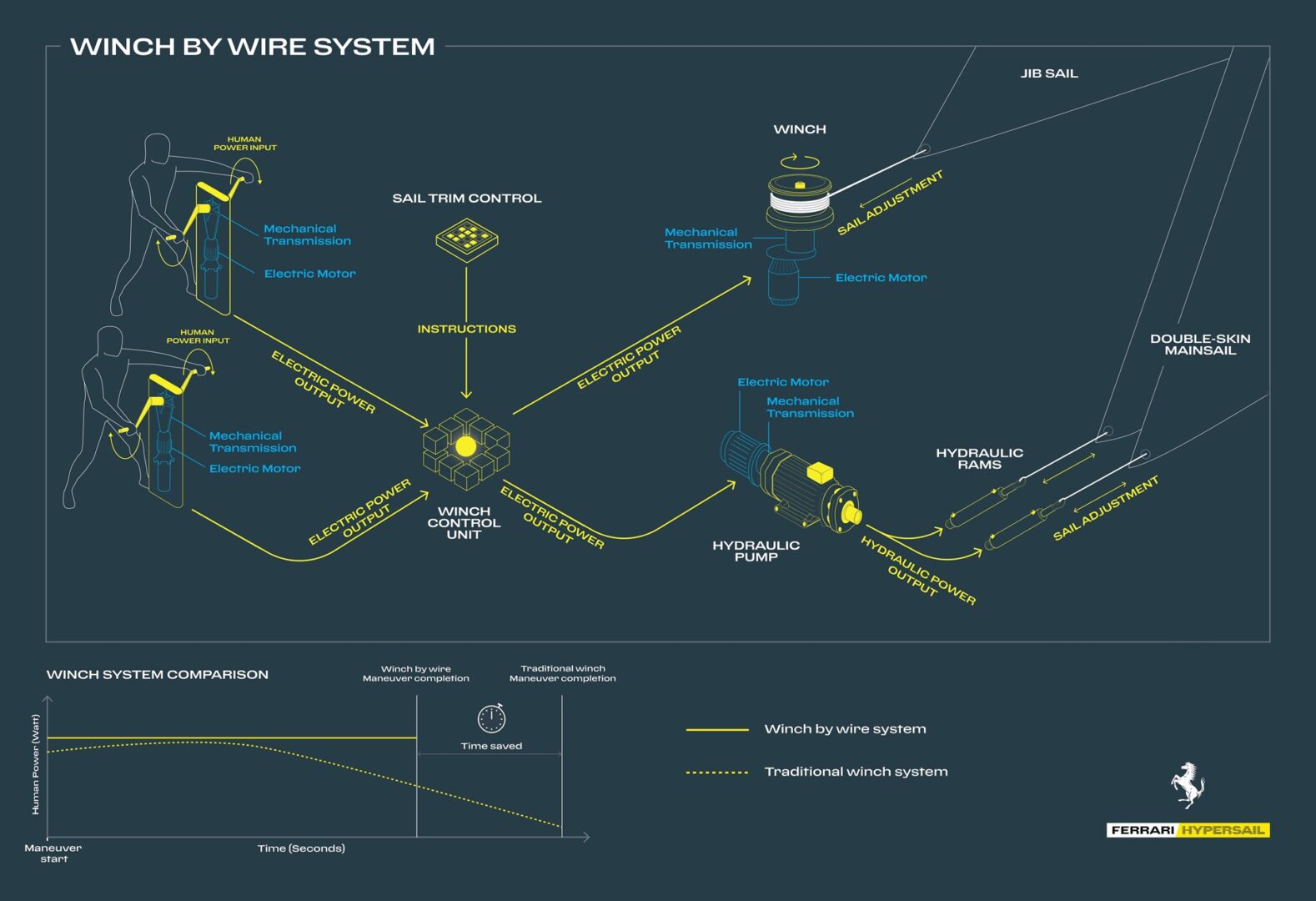
Winch by Wire reimagines the traditional winch. Instead of driving gears directly, the crew’s muscle becomes electricity, which is centralised and shared across the sail plan in real time. In a conventional winch, effort climbs sharply as resistance rises. Winch by Wire instead keeps the grinder at the peak of both machine efficiency and human output. So, cadence stays steady, and one crew member can manage up to 9 tonnes. Fittingly, the motors come straight from the road, matching those in the active suspension of the Ferrari Purosangue and F80, while the by-wire logic echoes the Ferrari 12Cilindri Manuale.
How does the boat manage flight below deck?
Below deck sits the technical core. It’s largely borrowed from Ferrari’s cars and tested the same way, running at four voltage levels ranging from 12V to 800V. An active Flight Controller then works in two modes. Slow Movements shift the foil arms and canting keel on the 800V rear e-axle from the Ferrari Luce. Meanwhile, Fast Movements drive the flaps through two smaller 48V pumps. As a result, the split delivers efficiency and the redundancy that maritime conditions demand.
Where does the renewable energy come from?
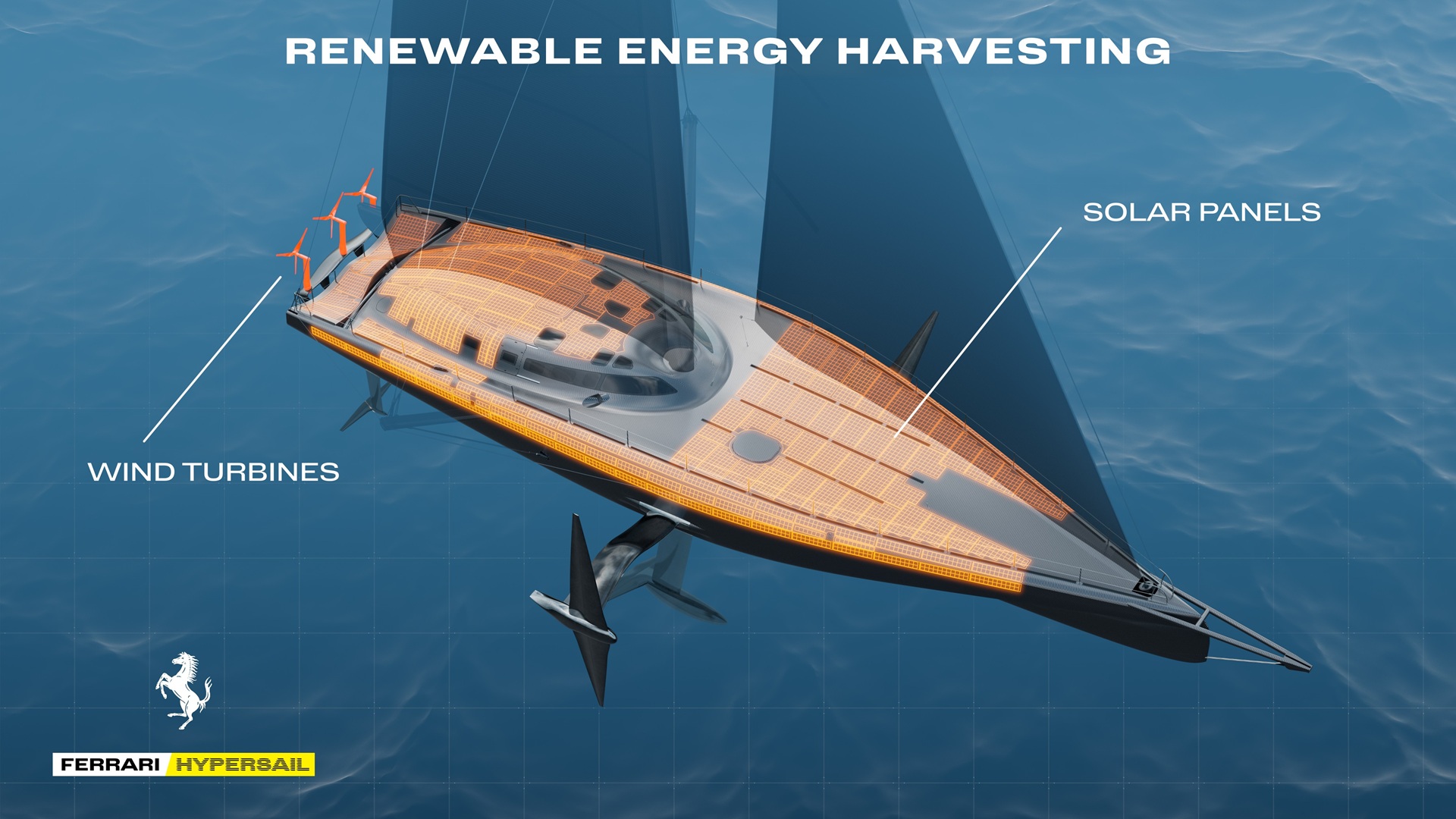
Power comes from three streams: sun, wind and crew. Walkable non-slip solar panels cover 100 square metres of deck and topsides, placed only where sun exposure is highest to keep weight low. Meanwhile, removable wind turbines at the stern balance output against drag. Any surplus then feeds two identical 800V batteries, ready to release power as demand shifts.
Why does energy autonomy matter?
Ocean racing punishes any pause for fuel, so a self-powered boat holds a real edge. Moreover, dropping the generator cuts weight. Above all, the Ferrari Hypersail carries proven road know-how to sea: the Purosangue and F80 motors, the Luce e-axle and the 12Cilindri by-wire logic all reappear on the water. In effect, the sun, wind, and muscle become the only power plants the boat needs.
Also Read: Rarest Ferrari 365 GTC/4 in Verde Blenheim to be Shown at Salon Privé 2026