

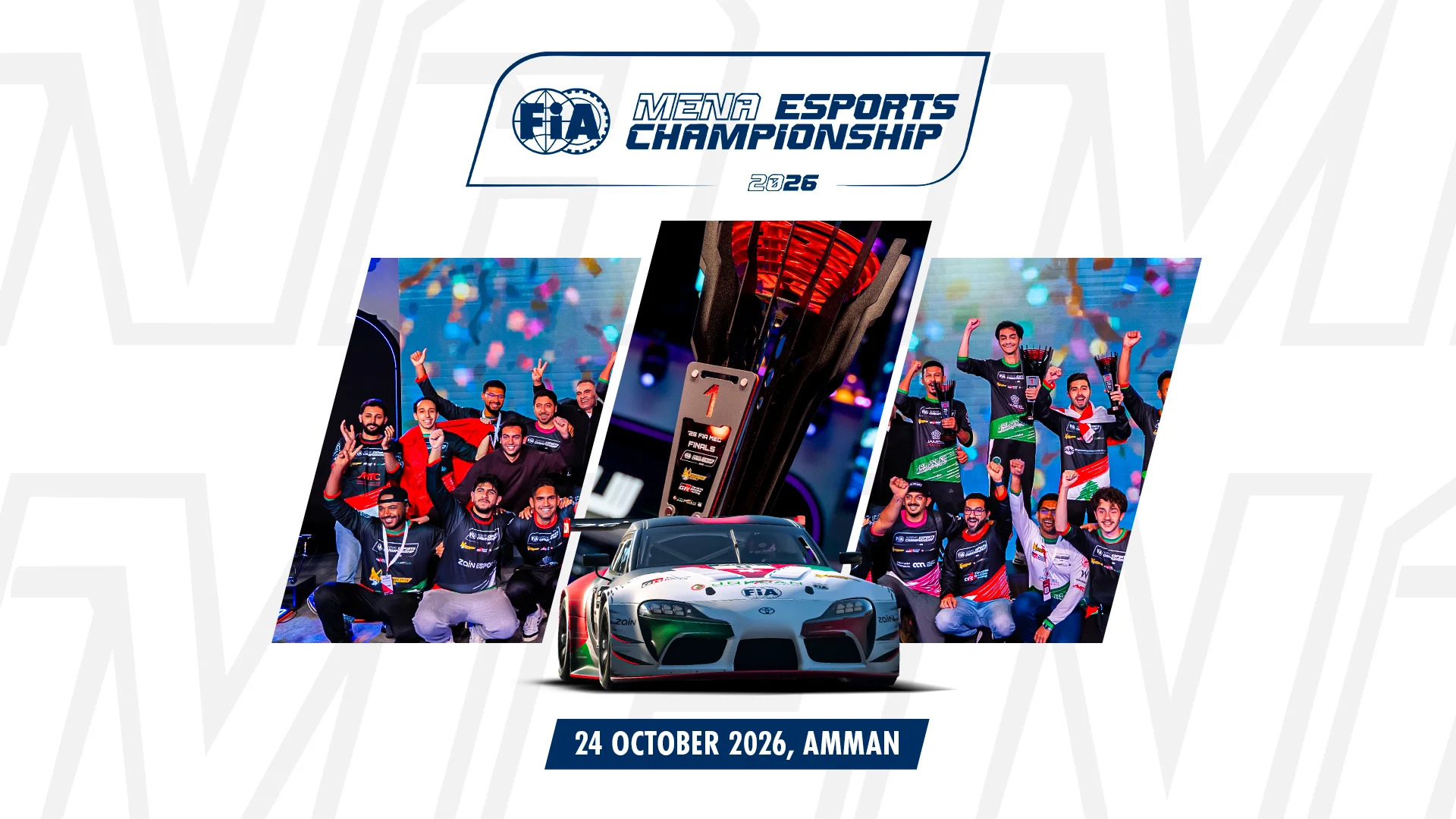
The announcement follows a strong inaugural edition that attracted more than 735 competitors representing 20 countries. More importantly, it established an FIA-sanctioned competitive platform capable of connecting sim racers from across the MENA region under one championship.
Now, that platform is becoming a longer-term fixture.
More Than 735 Competitors Put the Championship on the Map
The numbers behind the inaugural FIA MENA Esports Championship tell an important part of the story.
More than 735 competitors entered from 20 countries, giving the championship significant regional reach from its first edition.
For a relatively new motorsport discipline in the region, that level of participation matters. Esports removes many of the traditional barriers associated with entering motorsport, allowing competitors to demonstrate their pace without first needing access to a kart, race car or substantial racing budget.
The result is a much wider talent pool, particularly across a region where sim racing and motorsport are both developing rapidly.
FIA Commits to Two More MENA Esports Championship Editions
Rather than treating the inaugural championship as a standalone project, the FIA has now confirmed editions for two consecutive years.
The FIA MENA Esports Championship will return in 2026 before another edition follows in 2027.
That continuity is arguably more important than simply increasing entry numbers.
A recurring championship gives competitors something tangible to work towards and gives national sporting authorities across the Middle East and North Africa a defined esports pathway around which they can develop local programmes and identify emerging talent.
It also places esports more firmly within the FIA’s wider motorsport ecosystem rather than positioning it purely as an extension of gaming.
Sim Racing Is Becoming a Serious Entry Point Into Motorsport
The timing is significant.
Sim racing has developed rapidly beyond its gaming origins. Professional teams operate dedicated esports programmes, manufacturers have invested in both drivers and hardware partnerships, while racing simulators have become increasingly sophisticated tools for driver development.
For the MENA region, the accessibility of esports creates another opportunity.
Traditional motorsport demands circuits, machinery, transportation, engineering support and considerable financial investment. Competitive sim racing dramatically reduces that initial barrier while retaining many of the skills that define racing: consistency, racecraft, concentration, strategy and outright speed.
It does not replace physical motorsport, but it creates another door into it.
And with hundreds of competitors already entering the FIA MENA championship, there is clearly an audience ready to walk through that door.
MENA’s Esports Motorsport Scene Is Building Momentum
The Middle East has become increasingly important to international motorsport over the past decade, with major circuit racing, rally-raid and karting events now established throughout the region.
Esports gives that growth a digital counterpart.
Its reach is not restricted by the number of available circuit seats or race cars, allowing competitors across the wider MENA region to participate within the same ecosystem.
The first FIA MENA Esports Championship demonstrated that potential with 735-plus entries from 20 nations. Confirming both the 2026 and 2027 editions gives the project something equally important: continuity.
The next question is no longer whether the region has an esports racing audience. The numbers have already answered that.
Now it is about how far that talent pool can grow.