

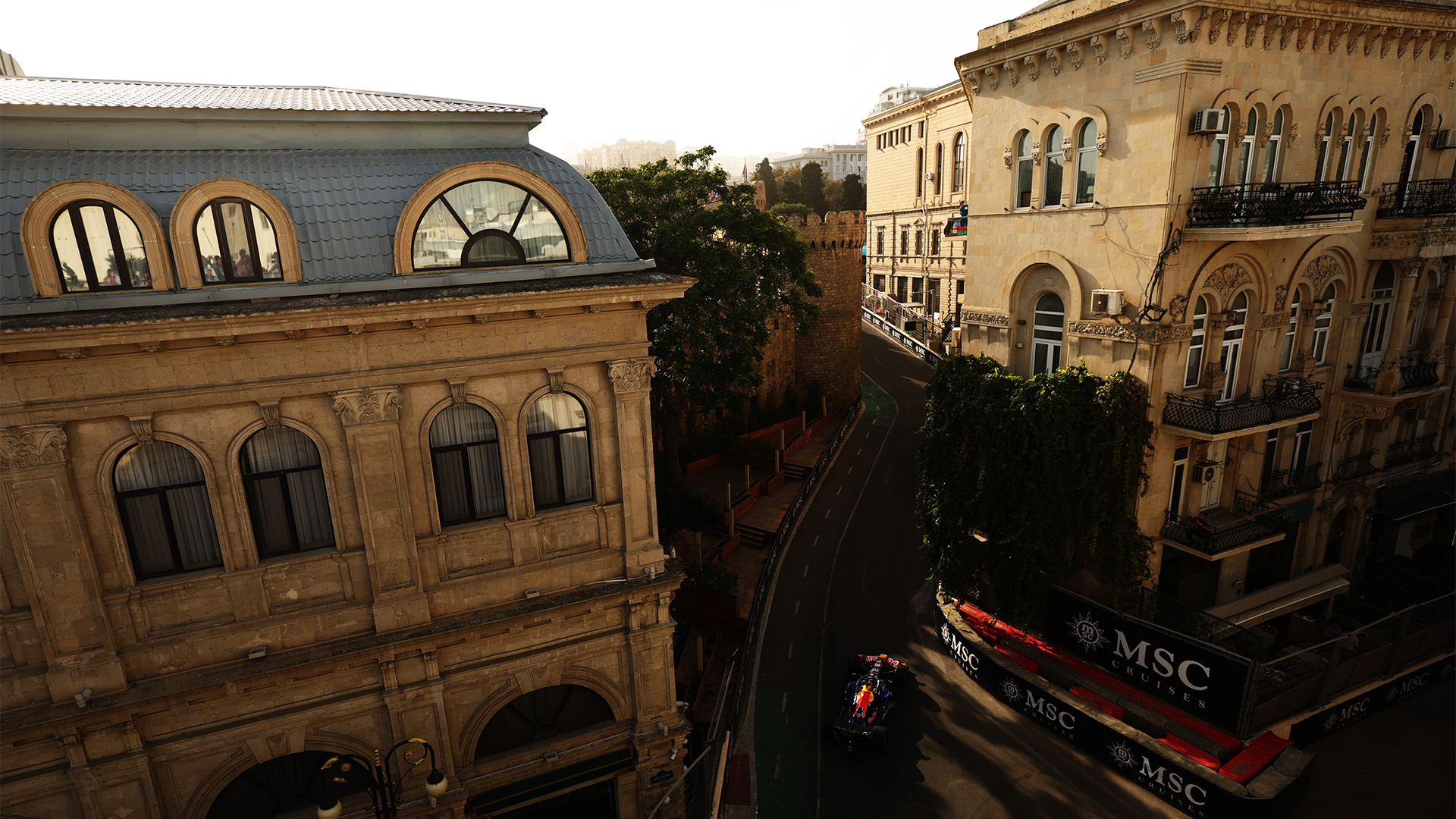
Baku City Circuit combines extreme straight-line speed, one of Formula 1’s narrowest passages and a racing history that has rarely followed a predictable pattern.
Formula 1 has been racing through the streets of Azerbaijan’s capital since 2016, yet Baku has already developed an identity unlike almost anywhere else on the calendar. The lap stretches beyond six kilometres, passes alongside centuries-old architecture and includes a flat-out section long enough for Formula 1 cars to reach some of the highest speeds ever recorded during a Grand Prix weekend.
Ahead of the 2026 Azerbaijan Grand Prix, these are nine facts that explain why Baku has become one of Formula 1’s most distinctive modern venues.
1. Baku’s First Formula 1 Race Was the European Grand Prix
Formula 1 first arrived in Baku in 2016, but there was no Azerbaijan Grand Prix on the calendar that year.
Instead, the inaugural race was officially staged as the European Grand Prix, reviving a title previously used at several different circuits across Europe.
Nico Rosberg won that first race for Mercedes, taking pole position, fastest lap and leading every lap on his way to victory.
The event was renamed the Azerbaijan Grand Prix for 2017 and has carried that identity ever since.
2. Seven Different Drivers Have Won in Baku
Predictability has rarely been part of Baku’s character.
Across the first nine Formula 1 races held at the circuit between 2016 and 2025, seven different drivers reached the top step of the podium.
Rosberg, Daniel Ricciardo, Lewis Hamilton, Valtteri Bottas, Sergio Pérez, Max Verstappen and Oscar Piastri have all won in Azerbaijan.
Only Pérez and Verstappen have managed multiple victories, with two each. Heading into the 2026 race, nobody has won three times in Baku.
That diversity reflects a circuit where outright car performance has frequently shared the result with strategy, Safety Cars, reliability and the small margins of street-circuit racing.
3. Baku City Circuit Is 6.003km Long
At 6.003km, Baku is one of the longest circuits on the Formula 1 calendar. The 2026 Grand Prix will cover 51 laps around the street layout.
The distance only tells part of the story.
The circuit changes character repeatedly across a single lap. Long straights and heavy braking zones dominate the opening section before the cars enter the much tighter old city. They then emerge onto another rapid sequence that eventually feeds into the extended run towards the start-finish line.
That contrast forces teams to search for aerodynamic efficiency without leaving the car too vulnerable through the slower corners.
Baku rewards speed, but it also punishes the compromises required to create it.
4. Formula 1 Races Beside a UNESCO World Heritage Site
One of Baku’s defining images has little to do with modern motorsport.
The circuit runs beside Icherisheher, Baku’s historic walled inner city. The Walled City of Baku, together with the Shirvanshahs’ Palace and Maiden Tower, was inscribed on UNESCO’s World Heritage List in 2000.
Parts of its defensive walls date to the 12th century, while the area reflects centuries of Persian, Ottoman, Russian and other cultural influences.
Formula 1 cars therefore pass within metres of architecture that predates the sport by centuries.
Few circuits place the technological extremes of contemporary Formula 1 against a historical setting quite so directly.
5. The Castle Section Narrows to Just 7.6 Metres
The approach to Baku’s old city produces one of the most recognisable pieces of racetrack in Formula 1.
Around Turns 8 and 9, the circuit narrows to approximately 7.6 metres at its tightest point. Formula 1 itself describes it as one of the defining characteristics of the venue.
That leaves virtually no realistic opportunity for conventional side-by-side racing.
Drivers instead need to position the car precisely between the walls while maintaining enough momentum to avoid losing time through the climbing sequence.
There is little margin for correction. Get the line wrong by a fraction, and the barriers are immediately involved.
6. Sergio Pérez Has Five Baku Podiums
Few drivers have built a relationship with Baku comparable to Sergio Pérez.
The Mexican has collected five podium finishes at the circuit, more than any other driver, including victories in 2021 and 2023.
His other Baku podiums include third place in the inaugural 2016 European Grand Prix and another third in 2018.
Two of Pérez’s six career Formula 1 victories have therefore come on the same street circuit, helping establish his informal reputation as Baku’s specialist.
It is an unusual record at a venue that has otherwise resisted sustained individual dominance.
7. The 2026 Azerbaijan Grand Prix Takes Place on Saturday
The 2026 Azerbaijan Grand Prix breaks with Formula 1’s usual Friday-to-Sunday structure.
Practice begins on Thursday 24 September, qualifying takes place on Friday 25 September and the Grand Prix starts at 15:00 local time on Saturday 26 September.
The altered schedule places the race one day earlier than Formula 1’s traditional Sunday slot, with Azerbaijan’s Remembrance Day falling on Sunday 27 September.
It makes Baku one of the relatively rare modern Formula 1 races to be held on a Saturday.
8. Valtteri Bottas Reached an Unofficial 378 km/h in 2016
Baku’s straight-line potential became obvious during Formula 1’s first visit.
Valtteri Bottas was recorded at an unofficial 378 km/h during the 2016 weekend, an extraordinary figure made possible by the circuit’s extended flat-out section. Formula 1 has previously described the run as stretching for more than two kilometres.
The number was not an official Formula 1 speed record, but it remains one of Baku’s most striking statistics.
The challenge is what surrounds it.
Teams cannot simply strip every degree of downforce from the car in pursuit of terminal speed because the same setup still has to negotiate the slow corners, heavy braking zones and narrow old city section.
Baku demands both extremes within the same lap.
9. Charles Leclerc Is Baku’s Qualifying Specialist
Charles Leclerc has built a very different Baku record.
The Ferrari driver holds the circuit record for pole positions with four, making him the most successful qualifier in the event’s history heading into the 2026 weekend.
That record carries particular weight at Baku.
A qualifying lap requires commitment under braking, precision through the old city and confidence to exploit the walls without leaving a margin that costs lap time.
Leclerc has repeatedly found that balance.
Victory, however, has remained elusive. His best result in Baku came with second place in 2024, meaning one of the circuit’s strongest qualifiers is still chasing his first Azerbaijan Grand Prix win.
Baku’s appeal lies in contradictions that Formula 1 rarely finds within one circuit.
A car can approach extreme speed along one section of the lap, then moments later squeeze through a 7.6-metre corridor beside medieval walls. Pole position matters, yet has never guaranteed control of the race. Some drivers have repeatedly mastered individual parts of the challenge, while sustained dominance has proved far harder.
Ten years after Formula 1 first arrived in Azerbaijan, that combination still gives Baku an identity entirely of its own.