

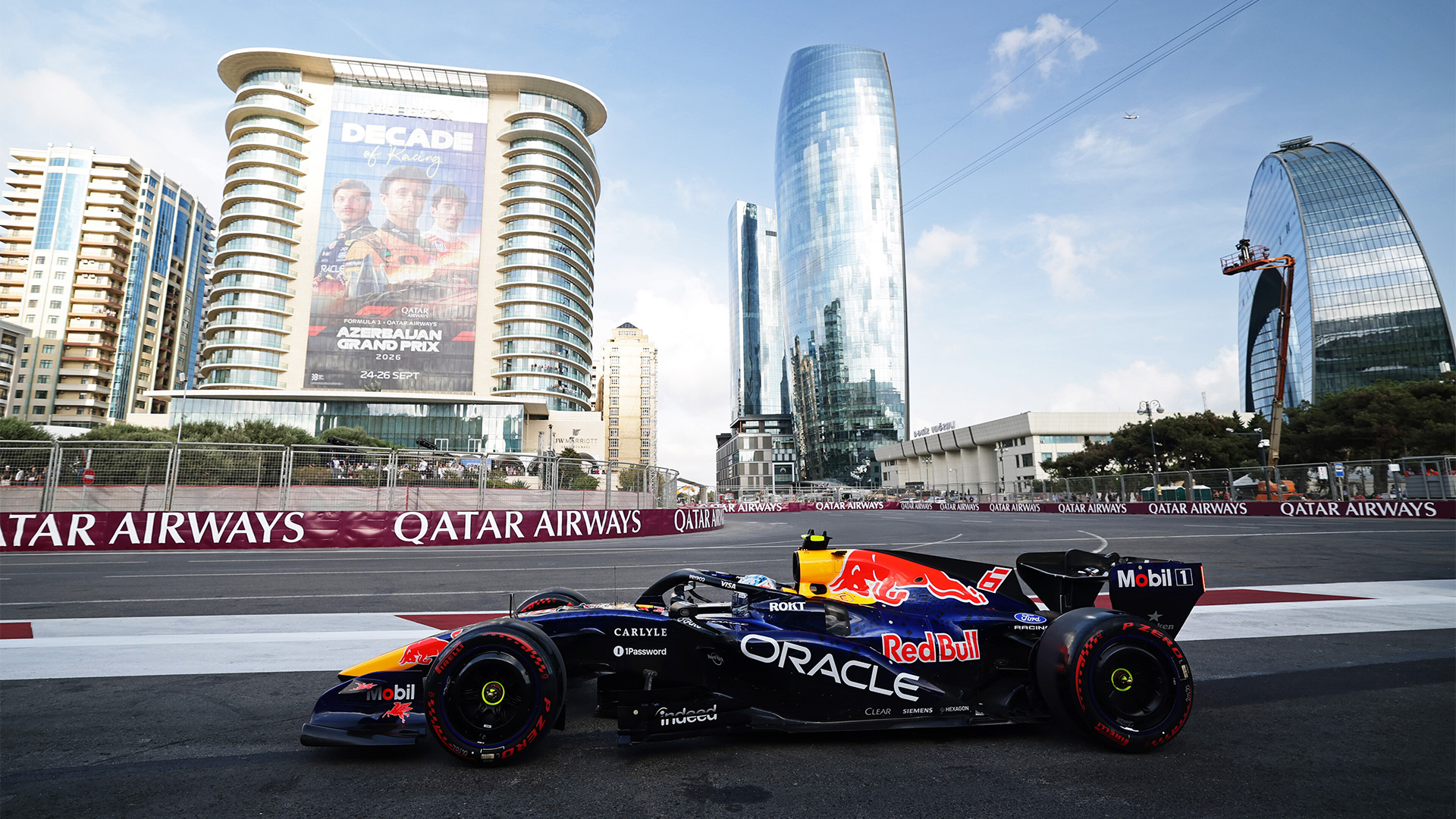
The 6.003km Baku City Circuit combines some of Formula 1’s slowest corners with its longest flat-out section, forcing teams to extract performance from two very different versions of the same car within a single lap.
That challenge has changed with the current generation of machinery.
Active aerodynamic configurations give teams greater freedom to retain cornering performance without carrying the same drag penalty along Baku’s straights. The traditional decision between protecting the technical middle sector or committing fully to straight-line speed is therefore less severe than before.
Instead, the greater question is how effectively each car can connect those sections.
Electrical deployment, traction from Baku’s numerous 90-degree corners and stability under some of the season’s heaviest braking loads could separate the leading teams. Mercedes arrives with a package particularly well suited to those demands, while Red Bull, McLaren and Ferrari each offer different routes to performance around the streets of Azerbaijan.
Why Baku Is a Different Challenge
Baku has never fitted neatly into one circuit category.
The opening sector is dominated by straights linked by short, predominantly right-angle corners. The lap then tightens dramatically around the old city before opening into the rapid final sequence and the long run towards Turn 1.
It demands low-speed traction without compromising stability, strong braking performance without excessive tyre locking and enough straight-line efficiency to avoid becoming vulnerable over the final section.
Energy management adds another dimension.
The electrical contribution of the current power units means drivers must manage substantial torque on corner exit. On a circuit containing repeated low-speed acceleration zones, poor deployment can translate directly into rear-wheel slip, tyre temperature and lost momentum.
The fastest package may therefore not be the car with the greatest outright output, but the one capable of deploying that performance most efficiently across the complete lap.
Over qualifying distance, teams can be aggressive with their energy usage. Sustaining the same approach over a Grand Prix becomes more complicated, as battery state has to be recovered repeatedly without giving away too much performance elsewhere.
That balance could become one of the defining technical themes of the weekend.
Mercedes Has a Strong Case in Baku
Mercedes enters Azerbaijan with several characteristics that should translate naturally to the circuit.
Strong energy deployment is only part of the equation. Its combination of traction and performance through acceleration zones could become particularly valuable through Baku’s fragmented layout, where the car is repeatedly slowed before being asked to deliver power again.
The final section should also matter.
Drivers need a clean exit from the last sequence before committing to the extended full-throttle run towards the line. Any weakness in traction or deployment can remain visible for several seconds afterwards.
Mercedes should be capable of exploiting that section without surrendering too much time through the slower corners beforehand.
Kimi Antonelli’s recent form further strengthens the team’s position heading into the weekend. Mercedes has already established itself at the front of the 2026 championship, but Baku offers a specific test of whether its power-unit and chassis strengths can combine on one of the calendar’s most demanding stop-start layouts.
If the car remains stable under braking while maintaining efficient deployment across the straights, Mercedes should have the tools to compete at the front.
Red Bull Could Be Dangerous Over One Lap
Red Bull approaches the same problem differently.
Straight-line performance should provide a useful foundation, while progress in low-speed behaviour and kerb riding could allow Max Verstappen to attack Baku’s first two sectors without sacrificing the speed required later in the lap.
Braking confidence will be especially important.
Several of Baku’s largest opportunities are created by how late a driver is prepared to brake into relatively slow corners after arriving at high speed. Small gains across those zones can accumulate quickly over a qualifying lap.
That makes Verstappen difficult to discount, particularly around a circuit where commitment and precision have traditionally carried a significant reward.
Baku has also been productive territory for Red Bull, which has won five Azerbaijan Grands Prix, including Verstappen’s victories in 2022 and 2025.
McLaren Brings Another Development Step
McLaren arrives with another important upgrade package as it continues to develop the MCL40.
The team has confirmed new aerodynamic components for Azerbaijan alongside the return of its H-Wing configuration, previously introduced at Monza. According to McLaren, the package is intended to improve aerodynamic performance while the H-Wing provides additional flexibility on a circuit where drag reduction carries considerable value.
The greater question is how effectively those developments broaden the car’s operating window.
McLaren’s strongest circuits have not always looked like Baku. Its traction should help through repeated slow-corner exits, but outright efficiency along the extended flat-out sections remains an important part of the equation.
The new floor could therefore be particularly significant if it allows McLaren to retain enough downforce through the technical sections without paying heavily for it later in the lap.
Tyres may also move the circuit closer to the team’s preferred territory.
Pirelli has selected the C3, C4 and C5 compounds, its softest available trio, with the street surface expected to begin the weekend relatively low in grip before improving significantly as rubber builds up.
That progression could make setup decisions particularly important between practice, qualifying and the race.
Ferrari Faces a More Delicate Compromise
Ferrari’s route to the front appears less straightforward.
The car has shown some of its strongest qualities through longer and faster corners, where stability allows the drivers to maintain minimum speed. Baku offers relatively few opportunities to exploit that characteristic.
Instead, much of the lap is built around heavy braking, short corners and acceleration.
That does not leave Ferrari without weapons.
Braking stability could become extremely valuable, particularly if Baku’s wind begins altering braking references between laps. A car that gives its drivers confidence on entry can recover meaningful time through the opening and middle sectors.
The difficulty comes afterwards.
Every gain Ferrari pursues through the technical section has to be measured against the demands of the long straights and the amount of electrical energy available for deployment.
A team can spend heavily from the battery early in the lap, recover through the slower middle sector and deploy again on the final straight. The compromise is that a rival capable of continuing to use electrical energy through shorter acceleration zones may recover time before either car reaches the long run to Turn 1.
Over one lap, Ferrari may be able to manage that trade-off aggressively. Maintaining it across an entire race is more difficult.
Charles Leclerc nevertheless remains an important factor.
Baku has repeatedly suited his qualifying approach, and starting position has added value on a circuit where cars with different strengths can be extremely difficult to pass once their deployment and straight-line speed are aligned.
Wind Could Change Baku by the Lap
The Caspian wind remains one of Baku’s least predictable variables.
A headwind can effectively shorten a braking zone by increasing aerodynamic resistance. A tailwind can do the opposite, leaving drivers arriving at the same corner with less assistance from the air and a substantially different braking reference.
On a permanent circuit, that might cost a small amount of lap time.
Between Baku’s walls, it can decide whether a driver makes the apex at all.
The problem becomes particularly acute in qualifying, when even a modest shift in conditions between runs can change corner-entry balance enough to separate cars that are otherwise closely matched.
It also places additional value on predictable braking behaviour.
Ferrari could benefit there, while Mercedes and Red Bull will need to ensure that their strengths in deployment are not undermined by instability at the other end of the straight.
Softer Tyres Add Another Strategic Variable
Pirelli’s move to the C3, C4 and C5 range adds another element to the race.
The compounds are the softest available in the 2026 range, while sections of asphalt around Turns 2, 3 and 4 have been resurfaced ahead of the event. Pirelli expects initial grip to be relatively low before significant track evolution across the weekend.
Baku has not traditionally been defined by extreme tyre degradation, but the softer selection increases the possibility of a wider strategic window.
Rear-tyre condition will be particularly relevant.
Every compromised corner exit carries a double penalty: lost acceleration immediately and additional stress on the rear tyres when the driver asks for more torque than the available grip can support.
That could make race management considerably more important than the circuit’s long straights initially suggest.
What to Expect From the 2026 Azerbaijan GP
Baku has earned its reputation through safety cars, late restarts and unexpected results, but the underlying contest this weekend could be unusually technical.
Mercedes appears well positioned because the circuit rewards several areas in which its package has been particularly effective: energy deployment, traction and the ability to maintain performance through repeated acceleration zones.
Red Bull should remain dangerous through its straight-line efficiency and Verstappen’s ability to exploit the braking zones, while McLaren’s latest development package gives Baku particular importance as a measure of how far the MCL40 has progressed.
Ferrari faces a more difficult balancing act, although strong braking performance and Leclerc’s history of qualifying speed in Azerbaijan ensure it cannot be dismissed.
Baku will still leave room for the unpredictability that has defined it for a decade. Yet before safety cars, strategy calls or street-circuit mistakes enter the equation, there is a more fundamental contest to solve.
The car that can brake late, put its power down cleanly and still arrive on the final straight with enough electrical energy left to attack will have solved the Baku problem better than the rest.