

A Formula 1 career is unusually intense and unusually short. Drivers spend much of their lives working towards one of 20 seats, operating inside teams employing hundreds or thousands of people and living to a calendar dictated by grands prix, testing, simulator work and relentless travel. Then, sometimes almost overnight, it stops.
That transition can be more complicated than the word ‘retirement’ suggests. For some drivers, Formula 1 is simply one chapter of a much longer racing career. Others deliberately distance themselves from the paddock, while a select few have built second careers that became almost as significant as their first.
Sebastian Vettel once summarised the problem neatly: “Naturally you will be like 30, 35, 40, 45 depending on your sport and then what? There’s a lot of life left.”
The careers of Vettel, Kimi Räikkönen, Robert Kubica, Niki Lauda and others show just how differently that question can be answered.
Sebastian Vettel: Life beyond the F1 paddock
Vettel stepped away from Formula 1 at the end of 2022 after 299 grands prix, 53 victories and four consecutive world championships with Red Bull between 2010 and 2013.
His departure was striking partly because Vettel had spent years keeping his private life away from the machinery of modern celebrity. He even created an Instagram account specifically around the time he announced his retirement.
Since leaving full-time competition, Vettel has increasingly devoted his attention to environmental and sustainability projects. His ‘Race Without Trace’ initiative has explored ways of reducing motorsport’s environmental footprint, while he has also become involved with Germany’s SailGP operation.
Beekeeping has become another highly visible interest. Vettel has repeatedly used biodiversity projects around racing events to draw attention to declining insect populations, making his post-F1 identity markedly different from the conventional retired racing driver role.
Yet the connection with racing has never disappeared entirely. Vettel has continued to drive significant machinery in demonstrations and tests, ensuring speculation about a competitive comeback has periodically followed him.
Kimi Räikkönen chose distance
If Vettel has used retirement to amplify causes he cares about, Räikkönen has largely done what anyone familiar with his Formula 1 persona might have expected: reduced his public exposure.
The 2007 world champion retired after the 2021 Abu Dhabi Grand Prix with 349 F1 starts, having raced for Sauber, McLaren, Ferrari and Lotus during a career spanning two decades.
Räikkönen has not completely abandoned competition. He made NASCAR Cup Series appearances with Trackhouse Racing’s Project91 programme, including at Watkins Glen in 2022 and Circuit of the Americas in 2023.
But there has been no attempt to replace Formula 1 with another relentless full-season campaign. Away from occasional racing appearances, Räikkönen has largely maintained the privacy he guarded throughout his F1 career, spending considerably more time around his family and motocross interests.
For a driver who famously treated the circus surrounding Formula 1 with considerably less enthusiasm than the driving itself, it was perhaps the most predictable retirement of all.
Robert Kubica proved there can be another summit
Robert Kubica’s career provides a very different definition of life after Formula 1.
The Polish driver suffered severe injuries in a rally accident in February 2011, including major damage to his right arm, just as he was established among the most highly rated drivers on the F1 grid.
What followed was an extraordinary reconstruction of a professional racing career. Kubica competed in rallying, including the World Rally Championship, before completing his return to Formula 1 with Williams in 2019 – eight years after the accident that had appeared to end his grand prix career.
After his second period in F1, Kubica shifted his focus towards endurance racing, where his experience and adaptability proved particularly valuable.
That path eventually produced one of the biggest victories of his career: overall victory at the 2025 24 Hours of Le Mans with AF Corse’s Ferrari 499P, sharing the car with Yifei Ye and Phil Hanson.
It was a reminder that Formula 1 does not have to represent the final competitive peak of a driver’s career. For Kubica, one of motorsport’s greatest prizes arrived long after his permanent place on the F1 grid had gone.
Niki Lauda left, built an airline, then came back and won
Few Formula 1 retirements have been as unconventional as Niki Lauda’s.
Already a two-time world champion, Lauda abruptly walked away during the 1979 Canadian Grand Prix weekend. His attention increasingly turned towards aviation and the airline business he was building away from racing.
Three years later, McLaren brought him back.
The comeback eventually produced one of Formula 1’s most famous championship contests. Lauda defeated McLaren team-mate Alain Prost to the 1984 drivers’ title by just half a point — still the smallest championship-winning margin in F1 history.
After retiring permanently at the end of 1985, Lauda remained heavily involved in aviation but eventually returned to Formula 1 in senior roles. His later work as Mercedes’ non-executive chairman made him an influential figure in the project that would become the dominant force of the turbo-hybrid era.
Lauda therefore managed something particularly rare: leaving Formula 1, succeeding outside it, returning to win another world championship, leaving again and eventually helping build another championship dynasty from the management side.
Mark Webber: From Formula 1 to endurance racing
Mark Webber’s departure from Formula 1 did not mean retirement from top-level motorsport.
After 215 grands prix, nine victories and a long spell with Red Bull, Webber left F1 at the end of 2013 and immediately moved into the World Endurance Championship with Porsche.
It proved to be far more than a post-F1 farewell tour. Driving the Porsche 919 Hybrid alongside Timo Bernhard and Brendon Hartley, Webber became WEC world champion in 2015, helping establish Porsche as the benchmark of the LMP1 era.
Webber retired from professional racing at the end of 2016, but remained closely connected to motorsport. He subsequently became a television pundit and commentator while also taking on a management role in Oscar Piastri’s career.
His trajectory demonstrated that leaving Formula 1 can open another elite competitive chapter rather than close one.
Nico Rosberg walked away at the very top
Few drivers have controlled the timing of their Formula 1 exit quite like Nico Rosberg.
Rosberg defeated Mercedes team-mate Lewis Hamilton to win the 2016 Formula 1 World Championship, securing the title at the season-ending Abu Dhabi Grand Prix after an intense year-long battle.
Five days later, he announced his retirement.
He was just 31.
Unlike many former F1 drivers, Rosberg resisted the temptation to pursue another major racing programme. Instead, he moved towards business, investment and sustainability projects while maintaining a presence around Formula 1 through television work and occasional paddock appearances.
That makes Rosberg’s story unusual. There was no gradual decline, loss of a competitive seat or attempt to rediscover the same intensity elsewhere.
He reached the objective that had defined his career and decided that was enough.
Martin Brundle built a second career behind the microphone
Martin Brundle offers another answer to what happens when the driving stops.
Brundle competed in 158 Formula 1 grands prix between 1984 and 1996, racing for teams including Tyrrell, Benetton, McLaren and Jordan. His career never produced an F1 victory, but his abilities extended well beyond grand prix racing.
Alongside his Formula 1 career, Brundle became a major force in sportscar competition. He won the 1988 World Sportscar Championship and took overall victory at the 1990 24 Hours of Le Mans with Jaguar.
Yet for an entire generation of Formula 1 fans, Brundle became even more recognisable after leaving the cockpit.
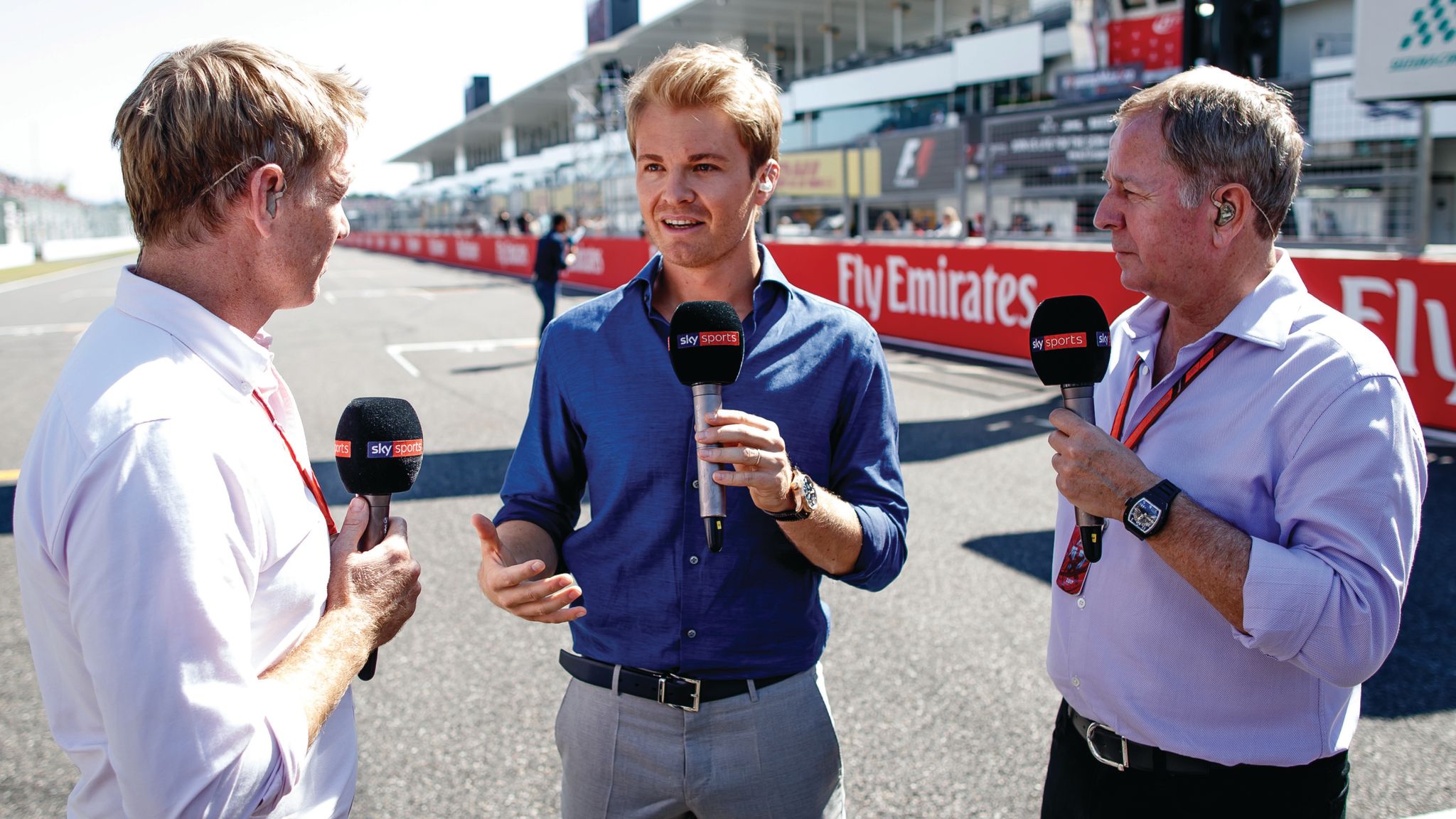
He moved into broadcasting following his F1 career and developed into one of the championship’s most prominent television analysts. His combination of driving experience, technical understanding and direct analysis gave him a second career that has lasted considerably longer than his time as an F1 driver.
His famous pre-race grid walks also became a fixture of Formula 1 broadcasting.
Brundle’s story illustrates another route available to retired drivers: translating the knowledge accumulated inside the cockpit into an ability to explain the sport from outside it.
Taken together, these careers make the word “retirement” unusually difficult to apply to Formula 1 drivers.
Drivers can leave the championship while still possessing the speed, fitness and competitive instinct required to operate at an elite level, but they no longer have to define themselves by one of its 20 seats.
The final Formula 1 race may end a driver’s grand prix career. It rarely ends the story.