

Formula 1’s new Madrid circuit has revealed the thinking behind the names assigned to some of Madring’s most distinctive corners, with the 5.4 kilometre, 22-corner layout drawing heavily on the neighbourhoods, landmarks and geography surrounding the Spanish Grand Prix venue.
Rather than relying solely on numbered turns, Madring has attached identities to key sections of the lap. Hortaleza, Subida de las Cárcavas, El Búnker, La Chicane, La Monumental, Las Enlazadas de Valdebebas, Norte and El Parque each reference either the area around the circuit or a defining characteristic of the corner itself.
The result is a circuit whose terminology is closely connected to Madrid, while several of those names are also likely to become important reference points once Formula 1 drivers begin racing around the new venue.
Hortaleza, Turn 3
Turn 3 takes its name from Hortaleza, the Madrid district located close to the circuit.
The corner itself is a fast right-hand sweeper that feeds drivers onto Madring’s longest straight, which measures approximately 837 metres. Speeds on the straight are expected to reach around 340km/h, exiting Hortaleza particularly important for lap time and overtaking opportunities.
A poor exit could leave a driver vulnerable for much of the following acceleration zone, while strong traction through Turn 3 should provide an opportunity to attack.
Subida de las Cárcavas, Turns 6 and 7
The Subida de las Cárcavas section takes drivers uphill towards the neighbourhood from which it gets its name.
The climb gains approximately 10 metres in elevation before reaching Turn 7, a blind corner positioned at the highest point of the circuit.
That combination of elevation and restricted visibility should make the section considerably more demanding than its basic corner geometry suggests. Drivers will need confidence in the car on approach, particularly as they build speed and begin using the full width of the circuit.
El Búnker, Turn 8
Turn 8 is known as El Búnker, a reference to its proximity to Spanish Civil War fortifications.
It also marks the beginning of a faster and more technical part of Madring.
The corner takes drivers into the Valdebebas section and incorporates a 5% downhill gradient, adding another change in elevation to a circuit that has sometimes been characterised primarily by its urban layout.
Its historical reference also gives El Búnker one of the more distinctive identities among Madring’s named corners.
La Chicane, Turns 10 and 11
Turns 10 and 11 form La Chicane, a sequence designed around what comes immediately afterwards.
The opening right-hand corner measures approximately 57 degrees, followed by a 78-degree left-hander.
The purpose is to reduce speed before drivers enter La Monumental, potentially allowing them to approach the following corner flat out.
That makes La Chicane more important than its relatively simple layout might suggest. A mistake through the sequence could compromise the entry to one of Madring’s signature sections.
La Monumental, Turn 12
No corner is likely to become more closely associated with Madring than La Monumental.
Turn 12 takes its name from its bullring-inspired shape and stretches for approximately 548 metres, making it the longest corner on the Formula 1 calendar according to the circuit information presented ahead of the event.
Its defining feature is the banking.
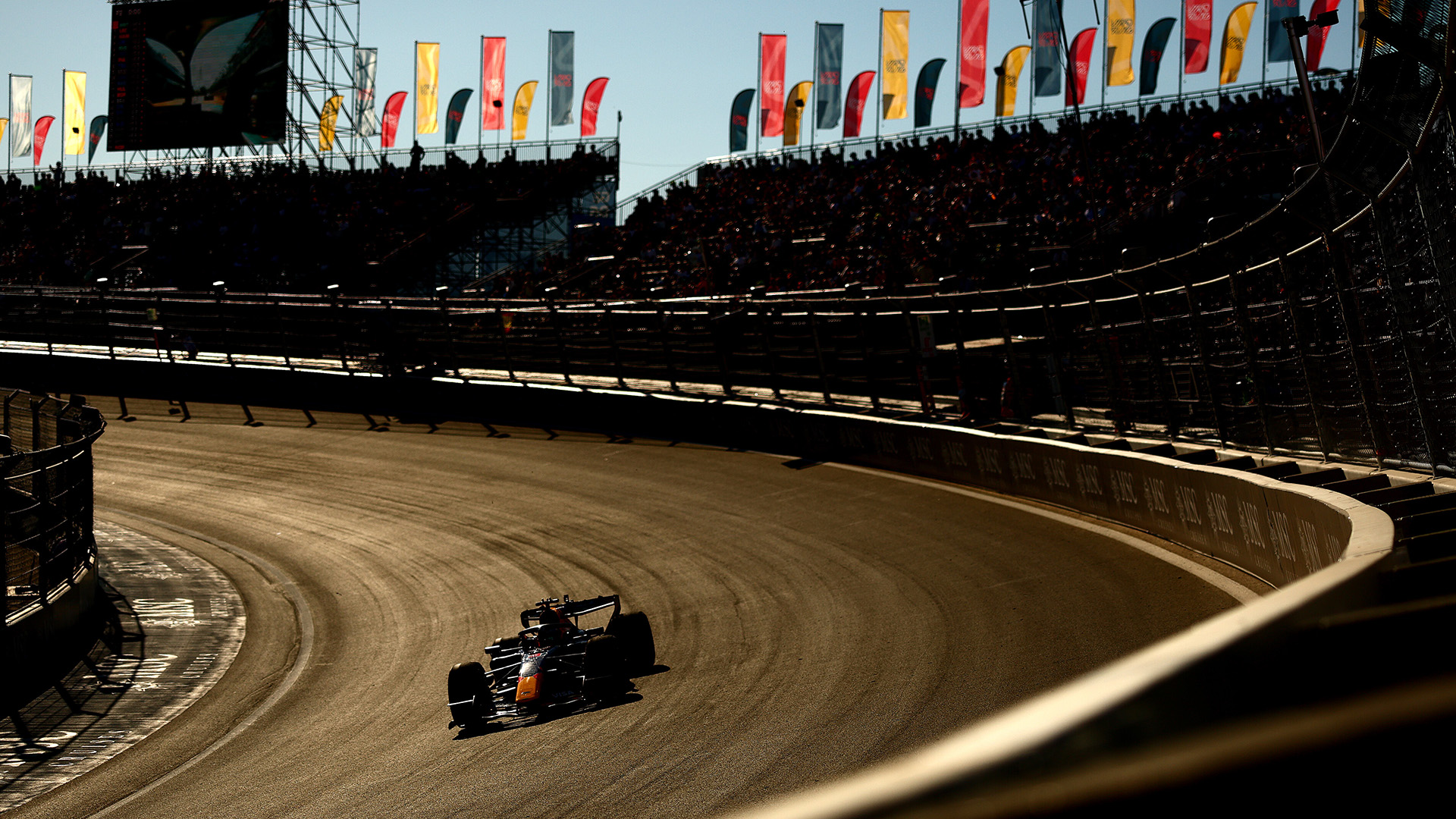
La Monumental reaches 24% banking, creating a sustained loaded corner that stands apart from the sharper turns elsewhere around the lap. Only Zandvoort features steeper banked corners on the Formula 1 calendar.
Its unusual geometry, length and speed make Turn 12 the obvious candidate to become Madring’s visual signature, but its real significance will depend on whether drivers can use different lines and how much commitment the corner demands in Formula 1 machinery.
Las Enlazadas de Valdebebas, Turns 14 to 16
The lap then moves into Las Enlazadas de Valdebebas, covering Turns 14, 15 and 16.
Named after the Valdebebas area through which the circuit passes, the sequence is designed as a high-speed combination before a heavy braking zone at Turn 17.
That makes the final part of the sequence particularly significant for racing.
Drivers carrying momentum through Turns 14 to 16 will need to position the car correctly for the braking zone that follows, creating a potential opportunity for an attack if a rival makes a mistake through the preceding corners.
Norte, Turn 18
Turn 18 is named Norte after the North Convention Centre situated on the inside of the corner.
Unlike several of Madring’s slower 90-degree sections, Norte is expected to be a high-speed left-hander.
Projected speeds of approximately 235km/h should make it one of the quicker individual corners around the circuit and another test of aerodynamic stability.
Its position after the braking zone at Turn 17 also means drivers must quickly transition from heavy deceleration back into a high-speed loaded corner.
El Parque, Turn 22
The final corner is El Parque, named after the nearby Parque Juan Carlos I.
Turn 22 is a 90-degree right-hander that leads directly onto the start-finish straight, giving it strategic importance beyond its place as the final corner of the lap.
Traction will be critical.
Any mistake on exit will carry all the way down the straight, affecting both lap time and a driver’s ability to defend or attack into the opening sequence.
Madring’s corner names give Formula 1’s newest circuit an identity before its first Grand Prix has even established which parts of the lap will become its genuine landmarks.
La Monumental is the obvious headline feature, but the 837 metre straight after Hortaleza, the blind climb through Subida de las Cárcavas, the fast Valdebebas sequence and the 235km/h Norte could prove just as important once the circuit moves from drawings and simulations to Formula 1 competition.