

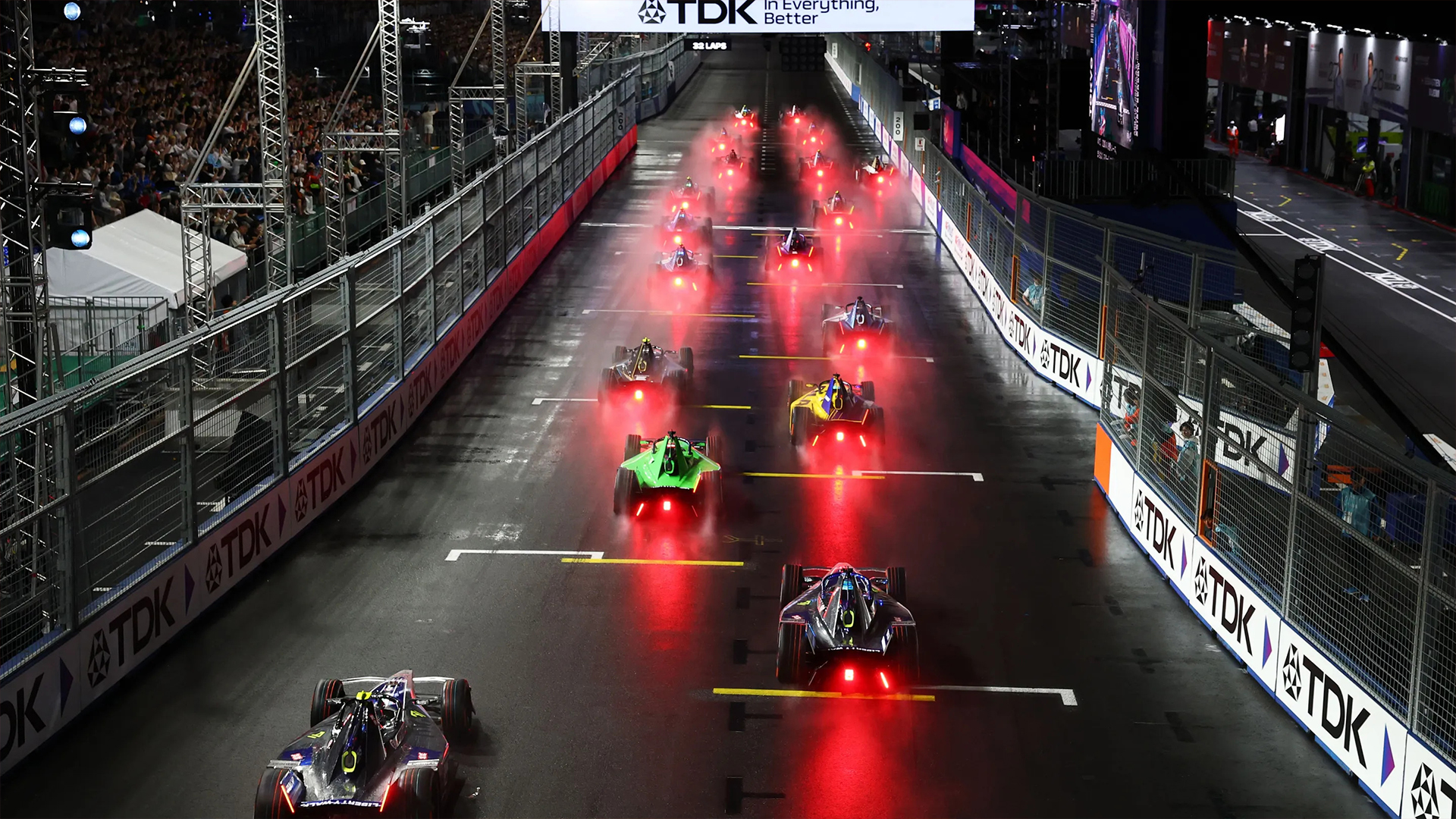
Nyck de Vries won the second 2026 Tokyo E-Prix after one of the most unpredictable races of the Formula E season, holding off Nick Cassidy and Jake Dennis through a final-lap sprint to the flag.
The Mahindra driver started fifth and built his race around patience rather than outright attack. That approach became crucial as a wet Tokyo street circuit gradually dried under the lights, changing the competitive picture almost lap by lap.
A late red flag then compressed the field and created one final opportunity for the drivers behind. De Vries needed to defend for just one racing lap. He did exactly that.
The Dutchman crossed the line ahead of Cassidy and Dennis to claim his second Formula E victory of the season, while Dennis’ third place proved enough to move him to the top of the Drivers’ Championship ahead of the London finale. Formula E confirmed De Vries had targeted a drying-track set-up and used a well-timed Attack Mode on lap 28 to move into contention for victory.
Tokyo’s Wet Track Changes the Race
The rain had stopped by the time the race began, but the damage had already been done.
Tokyo’s street circuit remained soaked from the earlier downpour, and the night-time conditions meant the surface dried slowly. Drivers began the race with grip levels changing from one corner to the next, making set-up compromises and energy management particularly important.
António Félix da Costa initially appeared to have read the conditions perfectly.
The Jaguar driver attacked early and built a useful advantage while the circuit remained wet. But as a dry line began to form, the balance shifted.
Cars configured more aggressively for the opening conditions gradually lost their advantage, while drivers who had preserved energy and prepared for a drying circuit moved forward. De Vries was one of them.
Mahindra had committed to a set-up designed around improving conditions, a gamble that became increasingly valuable as the race developed.
De Vries Moves Into the Fight
De Vries had not looked like the obvious winner during the opening phase. His race came alive as conditions evolved. A well-timed Attack Mode activation allowed him to move through the leading group, eventually bringing him into direct contention with reigning champion Oliver Rowland.
Rowland delayed taking his remaining Attack Mode while leading, and De Vries used the additional power to make his move through the middle sector. Once ahead, however, the Mahindra driver faced a different problem. His pace was beginning to fade.
The drivers behind had preserved more for the closing stages, and the advantage De Vries had worked to build was disappearing quickly. Then the race stopped.
Late Red Flag Sets Up One-Lap Shootout
An incident involving Joel Eriksson, Edoardo Mortara, António Félix da Costa and Zane Maloney triggered a red flag with only a handful of laps remaining. For De Vries, the timing could hardly have been better. The stoppage removed the immediate pressure of defending on fading pace and reset the field behind him.
After the cars returned behind the Safety Car, Race Control allowed a single lap of green-flag racing before the chequered flag. One lap. De Vries leading. Cassidy and Dennis directly behind. There was no room left for tyre conservation or long-term energy planning.
Cassidy stayed close, while Dennis searched for a way past both cars as the pack attacked through the final lap. Neither found enough. De Vries held the lead to complete a race shaped as much by changing conditions and strategic restraint as outright speed.
Dennis Takes the Championship Lead
Jake Dennis did not win in Tokyo, but third place may prove even more important. The Andretti driver approached the early wet phase conservatively, keeping energy available for later rather than forcing his way forward while conditions were at their worst. That decision paid off.
Dennis reached the closing laps with enough performance to fight for victory and ultimately finished third behind De Vries and Cassidy. More importantly, his biggest championship rivals endured far more difficult afternoons.
Pascal Wehrlein finished outside the points after slipping backwards during the second half of the race, having committed heavily during the wet opening stages.
The result dropped the Porsche driver to third in the standings. Dennis instead leaves Tokyo at the top. With only the London double-header remaining, Formula E’s title fight has been reset once again.
Rowland Keeps His Title Defence Alive
Oliver Rowland finished fourth and remains mathematically involved in the championship battle.
The Nissan driver led during the closing phase before De Vries used Attack Mode to move past him, but fourth place keeps the reigning champion within reach heading to London. He now sits fourth in the standings, 14 points behind Dennis.
Nick Cassidy’s second place also ensures another major contender leaves Japan with momentum, meaning the title is far from a two-driver fight.
The final two races will decide everything.
Porsche Secures the Manufacturers’ Championship
Pascal Wehrlein’s difficult race meant Porsche lost ground in the Drivers’ Championship, but the weekend still delivered silverware.
The German manufacturer secured the Formula E Manufacturers’ Championship with two rounds remaining, completing one of its major objectives before the season reaches London.
Porsche had arrived in Tokyo with a substantial advantage over Jaguar in the manufacturers’ standings, and the results from Sunday made that gap mathematically impossible to overturn.
For the factory team, Wehrlein’s fall from the championship lead will still sting.
For Porsche as a manufacturer, the title is already secured.
Two races remain. After Tokyo, there is still no clear favourite.