
There is something wonderfully irrational about a land speed record. Thousands of engineering hours, an arrow-shaped machine, an expanse of salt and a driver brave enough to keep the throttle buried while the horizon arrives rather more quickly than nature intended.
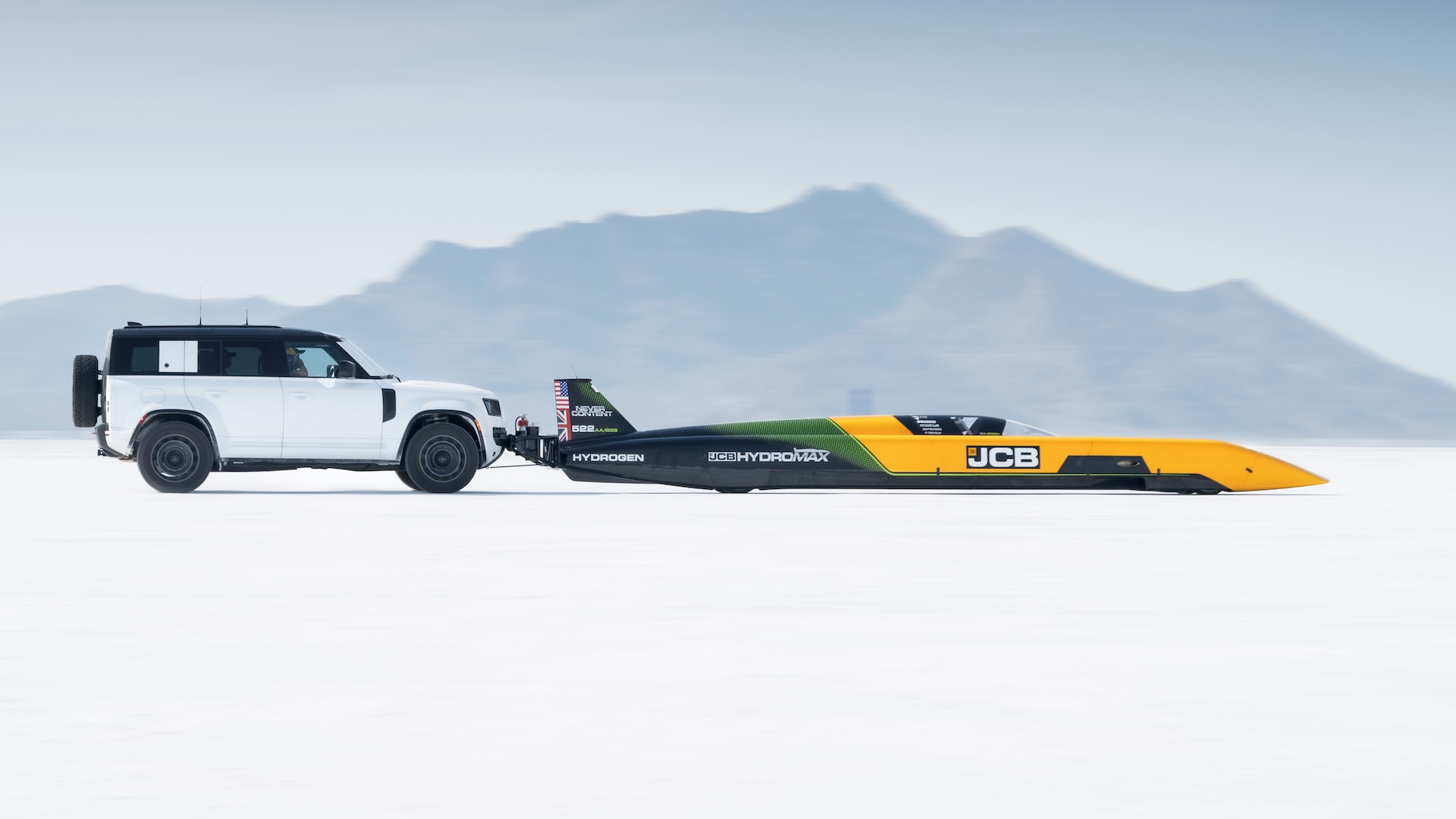
JCB has now added hydrogen combustion to that story. Its Hydromax land speed record vehicle recorded an average speed of 406.320mph (653.909km/h) at the Bonneville Salt Flats, becoming the fastest hydrogen-powered vehicle of any kind. Yet before its two 800hp engines could take over, the 2,550kg streamliner needed a shove from something almost equally outrageous: the Defender Octa.
Why Did The JCB Hydromax Need A Defender OCTA?
All land speed machines are geared for the other side of 500km/h, which makes setting off from rest rather inconvenient and unnecessary. Regulations permitted the Hydromax to receive a push for the first 300 metres of each run, during which it needed to reach 60mph.
That’s where the fastest and most powerful production Defender yet enters the picture. The OCTA’s 4.4-litre twin-turbocharged V8 produces 626hp and 750Nm, rising temporarily to 800Nm in Dynamic Launch Mode. Its 48V mild-hybrid system sharpens response, while four-wheel drive provided the traction required on Bonneville’s loose salt.
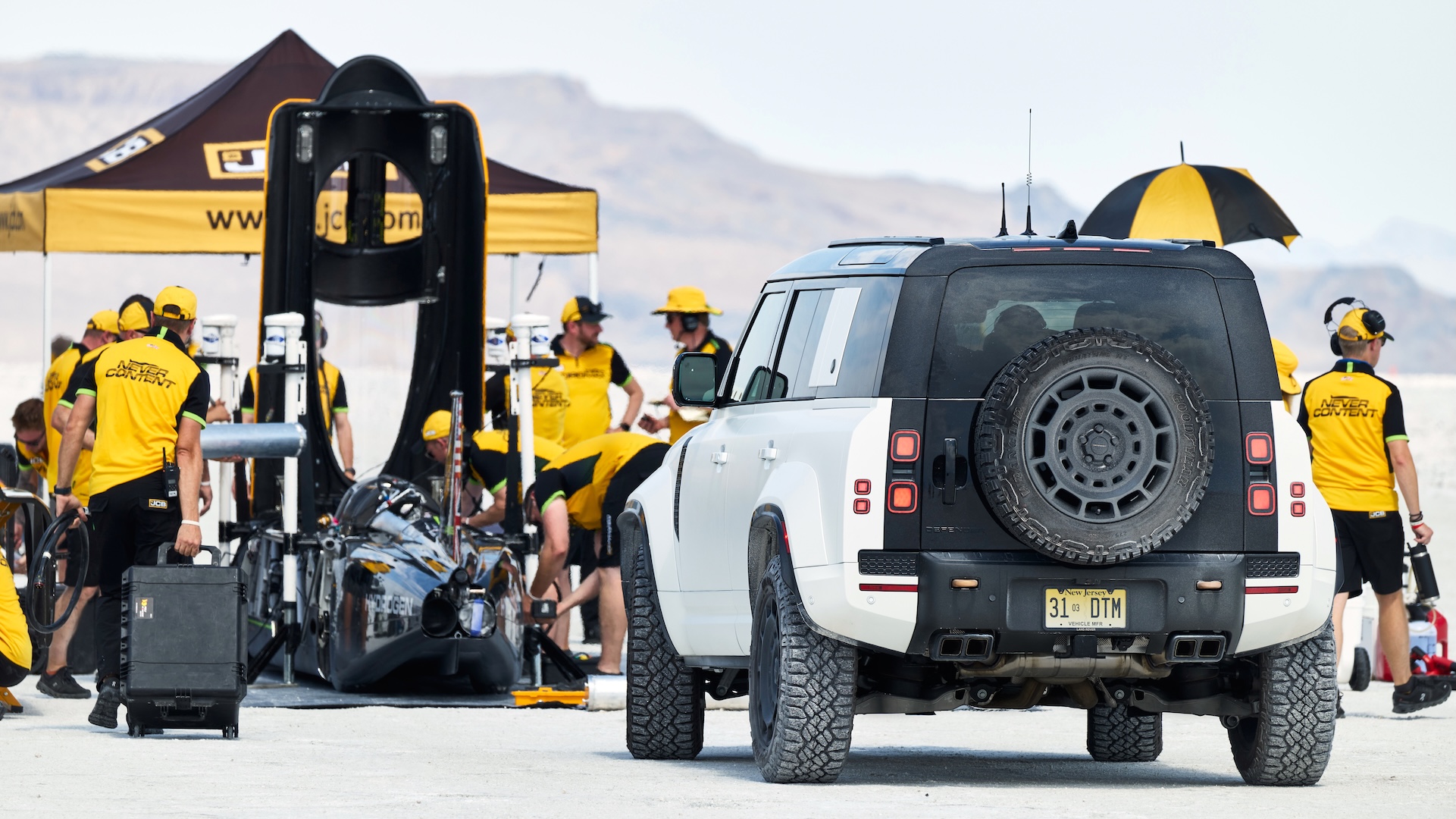
This was no gentle nudge around a paddock. The Defender had to accelerate hard while pushing the Hydromax’s entire mass through its nose, at density altitudes equivalent to 2,244 metres above sea level. Thin air and naturally aspirated engines rarely enjoy one another’s company, making the Octa’s twin-turbocharged powertrain particularly useful.
Also Read
- Defender Dakar: Street-Legal 4×4 Derived From The Dakar-Winning D7X-R
- New BMW X5 Debuts With Hydrogen Power On The Horizon
- Indian Challenger Sets A New World Speed Record At Bonneville
What Modifications Were Made To The Defender Octa For This Feat?
A bespoke push plate was attached to its integrated winch mount. Engineers disabled the mount’s deformable crumple zone, added extra fixing points and installed a brace connected to the front recovery point.
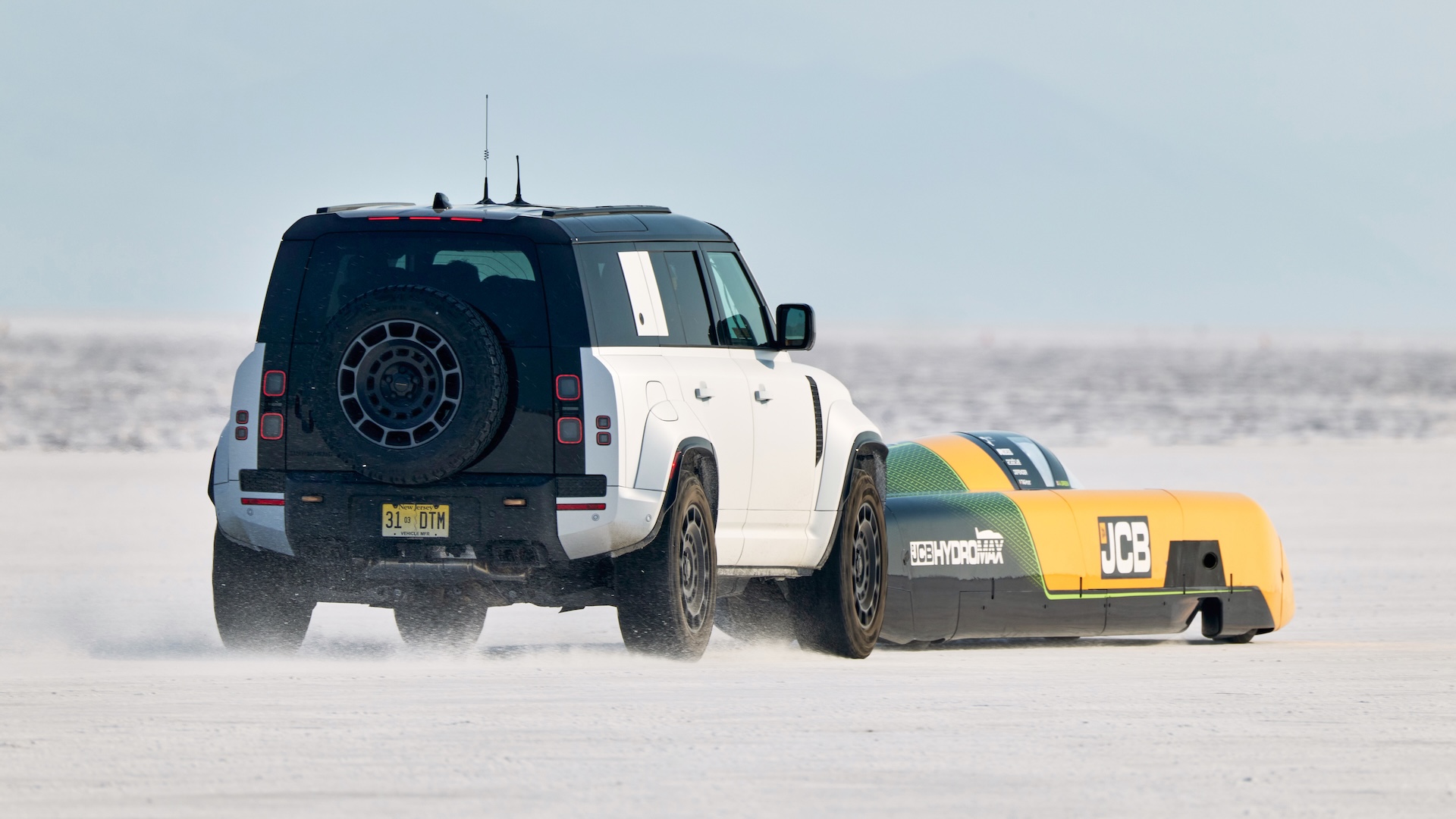
The Octa’s 6D Dynamics suspension was equally important. Its hydraulically interlinked semi-active dampers suppress pitch and body roll, keeping the push plate level as both vehicles accelerated. Engineers initially considered adding ballast but found the suspension maintained the required composure without it.
The Speed Run
Once the Hydromax passed 60mph, the Defender peeled away. The streamliner then accelerated under its own power, recording 644.740km/h in one direction and 663.266km/h on the return. Under FIA rules, the two runs had to be completed in opposite directions within an hour. That led to an average speed of 653.908km/h, and a world speed record.
Why Is A Digger Company Chasing Speed Records?
Simply because JCB is selling engineering, not merely excavators. The 32-foot Hydromax uses two production-based hydrogen combustion engines derived from units powering JCB machinery, tuned to a combined 1,600hp.
The record is the most spectacular demonstration yet of the company’s £100 million hydrogen-engine programme and its belief that combustion hydrogen could decarbonise heavy equipment where battery weight, charging time and remote-site infrastructure pose serious challenges.
In other words, 653km/h attracts a lot more attention than a PowerPoint presentation about industrial powertrains.
JCB’s Land Speed Records
This is familiar territory for JCB. In 2006, Andy Green drove the twin-engined Dieselmax to 563.418km/h at Bonneville, establishing a diesel land speed record that still stands. The JCB GT became the world’s fastest backhoe loader at 116.80km/h in 2014, while a modified Fastrac tractor reached 217.56km/h in 2019.
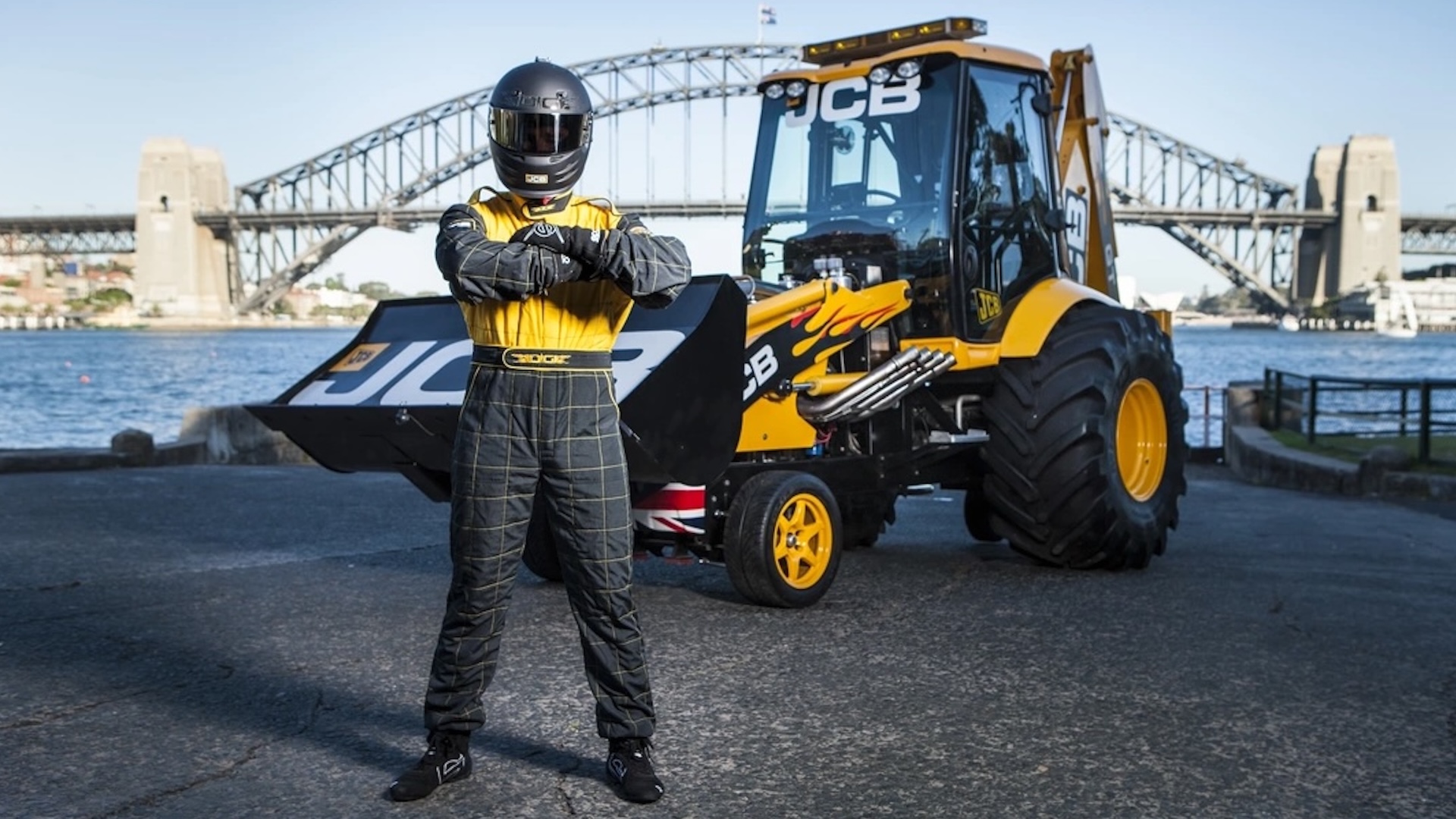
Green was once again behind the wheel of the Hydromax. He also holds the outright land speed record after driving ThrustSSC to 1,227.985km/h in 1997, becoming the first person to break the sound barrier on land. If anybody can make high speeds appear reassuringly routine, it is him.
Twenty years after Dieselmax, JCB has returned to Bonneville and beaten its own diesel benchmark with engines producing no CO₂ at the tailpipe. The Defender OCTA did not cross the timing beam, but every great record attempt relies on a supporting cast. On this occasion, the world’s fastest hydrogen car began its historic run with Britain’s most unhinged luxury off-roader pressed firmly against its tail.