

For 40 years, Turn 1 was simply Turn 1. That was enough.
The Hungaroring had built its identity around the races that happened on its asphalt rather than famous names attached to individual corners.
In 2026, that changed.
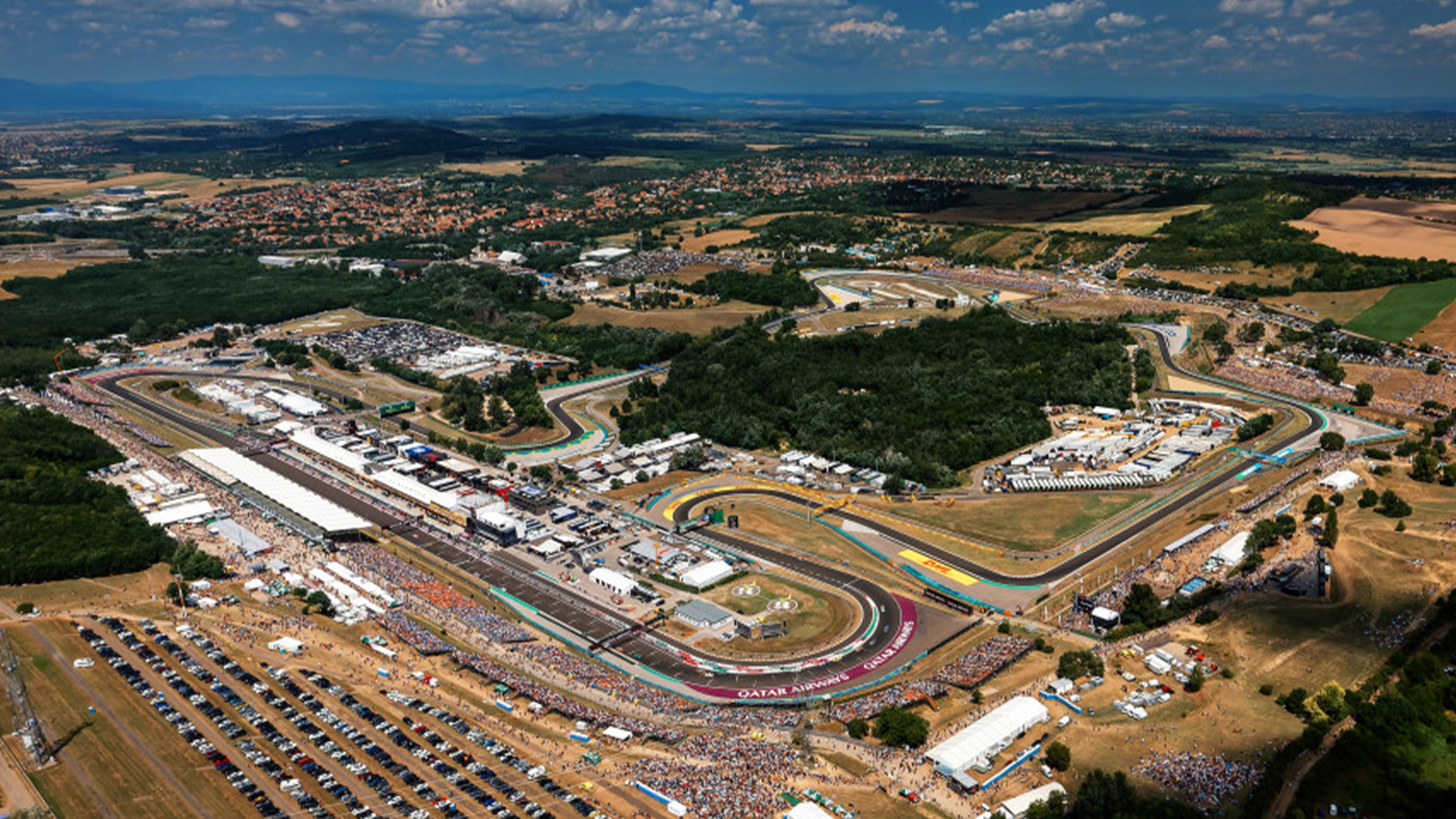
As part of the circuit’s 40th anniversary celebrations, all 14 corners of the Hungarian Grand Prix venue have received official names for the first time. Some honour drivers responsible for defining moments in Formula 1 history. Others look beyond the championship towards Hungary itself, its geography and the origins of Grand Prix racing.
The result is a lap that now tells several stories at once.
Turn 1 — Piquet
There was probably only one place Nelson Piquet’s name could go.
The Brazilian won the first two Formula 1 races held at the Hungaroring in 1986 and 1987, but his connection to the opening corner goes far deeper than the results sheet.
During that inaugural Hungarian Grand Prix, Piquet attacked Ayrton Senna around the outside of Turn 1. His Williams broke into a slide as he completed the move, producing one of the defining images of 1980s Formula 1.
The Hungaroring’s first corner now carries the name of the driver responsible for perhaps its most famous overtake.
Turn 2 — Hamilton
Eight victories. Nine pole positions.
No Formula 1 driver has achieved more at the Hungaroring than Lewis Hamilton.
His first Hungarian victory came with McLaren in 2007, before he added another seven across his McLaren and Mercedes years. Hungary also delivered his first victory for Mercedes in 2013.
Hamilton had previously said that Turn 2 would be his choice should the Hungaroring ever name a corner after him.
Forty years into the circuit’s Formula 1 history, that is exactly where his name has landed.
Turn 3 — Spring
Not every name looks towards Formula 1.
The Hungaroring was built in the “Valley of the Three Springs”, and Turn 3 takes its name directly from the landscape surrounding the circuit.
It is one of the simplest additions to the new map, but an important one. Before Formula 1 arrived, before the grandstands and garages were built, the valley was already there.
Turn 4 — Mansell
Few drivers have experienced the extremes of the Hungaroring quite like Nigel Mansell.
In 1987, he was leading with only five laps remaining when a loose right-rear wheel nut ended his race.
Two years later, he returned with Ferrari, started 12th and drove through the field to win. His pass on Ayrton Senna remains one of the signature moments of his career.
Then came 1992.
Mansell finished second in Hungary and secured the Formula 1 World Championship with five races still remaining.
Retirement while leading, victory from the midfield and a world title. Turn 4 now carries all three pieces of that history.
Turn 5 — Mogyoród
The Hungarian Grand Prix is sold internationally through Budapest, but the Hungaroring itself sits within the municipality of Mogyoród, around 20 kilometres from the capital.
Turn 5 is the point on the circuit closest to the village.
After hosting Formula 1 on its doorstep every year since 1986, Mogyoród now has its name permanently written into the lap.
Turns 6 and 7 — Driving Center
The Hungaroring does not fall silent when Formula 1 leaves.
The Turn 6–7 chicane is named after the Hungaroring Driving Center, Hungary’s first driver-training facility, opened in 1998.
It gives the circuit map a reference to the wider role the venue plays beyond Grand Prix racing, from training and education to everyday road safety.
Turns 8 and 9 — Buda/Pest
Budapest is two cities with a river running between them.
Buda sits on the western bank of the Danube, Pest on the eastern side. Together, they form the Hungarian capital that has become inseparable from the country’s Formula 1 weekend.
The Hungaroring has mirrored that relationship at Turns 8 and 9.
One corner is Buda. The other is Pest.
Two corners for the two halves of the city Formula 1 takes over every Hungarian Grand Prix weekend.
Turn 10 — Danube
After Buda and Pest comes the river between them.
Turn 10 is named after the Danube, the waterway running through the centre of Budapest and one of Hungary’s defining geographical landmarks.
It also completes a neat sequence around this part of the circuit: Buda, Pest, Danube.
The Grand Prix may take place outside the city, but three consecutive corners now carry Budapest directly onto the track map.
Turn 11 — Alesi
Jean Alesi did not need the Hungaroring to officially name Turn 11 after him.
Fans had already done it.
The corner became informally associated with Alesi following his accident there during practice for the 1995 Hungarian Grand Prix. The nickname remained in use among Hungarian fans, media and the local motorsport community for decades.
Now the circuit has made it permanent.
Turn 11 may be the best example of how corner names are really created. Sometimes they are chosen. Sometimes enough people use them for long enough that the map eventually has to catch up.
Turn 12 — Schumacher
Michael Schumacher won four Hungarian Grands Prix, but his 2001 visit carried much greater significance.
He took pole, won the race and secured his fourth Formula 1 World Championship at the Hungaroring. The result also delivered Ferrari the Constructors’ Championship.
Schumacher’s success made him one of the circuit’s defining drivers during Ferrari’s dominant era around the turn of the millennium.
Turn 12 now bears his name.
Turn 13 — Senna
Ayrton Senna was on pole when Formula 1 raced at the Hungaroring for the first time in 1986.
He lost that race to Piquet after the now-famous Turn 1 battle, but his own Hungarian story was only beginning.
Senna went on to win here three times, in 1988, 1991 and 1992, establishing himself as one of the most successful drivers of the circuit’s early years.
There is something fitting about the positioning of the two Brazilian names.
A lap begins at Piquet, the driver who won Hungary’s first Grand Prix after passing Senna.
Thirteen corners later, Senna gets his own place on the circuit.
Turn 14 — Szisz
The last name on the lap takes the story much further back than Formula 1.
Ferenc Szisz was a Hungarian-born engineer who worked for Renault and eventually became head of the manufacturer’s testing department.
In June 1906, he entered the French Grand Prix.
This was not simply another early motor race. The two-day event is widely recognised as the first race carrying the Grand Prix designation in the format that established the lineage of modern Grand Prix competition.
Szisz won it.
The race covered more than 1,200 kilometres, and when it was over, a Hungarian engineer had become the first Grand Prix winner in motorsport history.
It makes Turn 14 one of the most significant choices on the new map.
After a lap through Piquet, Hamilton, Mansell, Schumacher and Senna, the Hungaroring finishes with the man whose victory predates the Formula 1 World Championship by 44 years.
One Lap, 40 Years of Formula 1
The Hungaroring has spent four decades collecting stories without needing names for the corners where they happened. Now those stories are part of the circuit itself.
The Hungaroring still has the same 14 corners, but now they are reviving the history.