

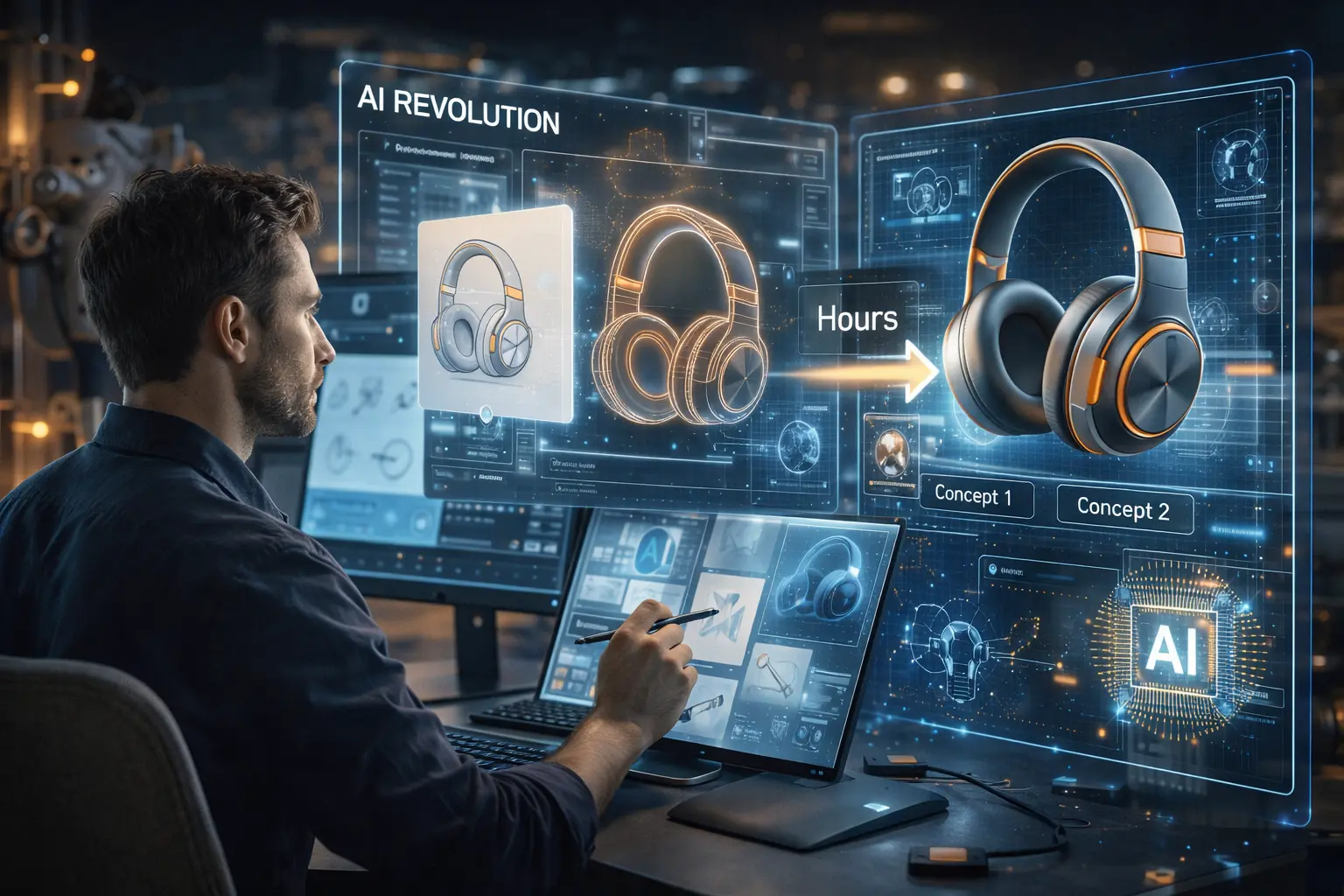
The design process that once took months now happens in mere hours. Welcome to the era where artificial intelligence is rewriting the rules of product development.
The Traditional Design Bottleneck
For decades, bringing a product from concept to physical prototype has been a marathon of iteration. Automotive designers would spend months sketching, modeling, and testing. Watch manufacturers would labor over intricate movement designs. Aviation engineers would run countless simulations before ever building a component.
The process was slow, expensive, and limited by human capacity to explore design variations.
Then AI arrived-and everything changed.
How AI is Transforming the Design Timeline
From Weeks to Hours: The New Reality
Modern AI-powered design tools are collapsing timelines that seemed immovable just years ago. What’s driving this revolution?
Generative Design Algorithms can explore thousands of design variations simultaneously. Feed the AI your parameters-weight limits, material constraints, stress requirements, aesthetic preferences-and watch it generate hundreds of optimized solutions in hours.
Computational Creativity means AI doesn’t just optimize existing designs; it discovers solutions human designers might never imagine. The results often look organic, almost alien, yet they’re mathematically proven to be superior.
Instant Simulation and Testing allows designers to validate concepts virtually before building a single prototype. AI can predict how a component will perform under real-world conditions, saving months of physical testing.
Real-World Applications Across Industries
Automotive: Designing Tomorrow’s Supercars
Luxury automakers are embracing AI design tools to push performance boundaries:
Generative Chassis Design: Companies like General Motors use AI to create lighter, stronger chassis components. The algorithm considers crash safety, weight distribution, manufacturing constraints, and aerodynamics simultaneously-producing designs that shave crucial kilograms while maintaining structural integrity.
Aerodynamic Optimization: Hypercar manufacturers now use AI to refine body shapes for minimal drag. What once required weeks in wind tunnels now happens in computational fluid dynamics simulations, with AI exploring millions of micro-variations to find the optimal form.
Interior Ergonomics: AI analyzes human body dimensions and movement patterns to create cabin layouts that maximize comfort and usability. The technology considers everything from seat positioning to control placement, optimizing for diverse body types.
Luxury Watches: Precision Meets Algorithm
The traditionally conservative world of horology is cautiously adopting AI:
Movement Optimization: Swiss manufacturers use AI to design watch movements with improved accuracy and power reserve. The algorithms can optimize gear train configurations and escapement geometry in ways that would take master watchmakers years to discover.
Case Design: Generative algorithms create watch cases that balance aesthetics, weight, and structural integrity. The AI considers how light reflects off surfaces, how the piece sits on the wrist, and manufacturing feasibility.
Material Selection: AI analyzes thousands of material combinations to recommend optimal alloys for specific components-balancing durability, weight, magnetic resistance, and cost.
Aviation: Lighter, Stronger, Faster
Private aviation benefits enormously from AI-driven design:
Wing Optimization: AI designs wing profiles that maximize lift while minimizing drag and weight. Bombardier and Gulfstream use these tools to improve fuel efficiency without compromising performance.
Cabin Layout: Generative algorithms create bespoke cabin configurations that maximize space utilization while maintaining luxury and comfort. The AI considers passenger flow, storage optimization, and aesthetic cohesion.
Component Design: Engine mounts, structural members, and interior fixtures benefit from AI optimization-often resulting in 30-40% weight reductions while maintaining or improving strength.
The Tools Powering the Revolution
Leading AI Design Platforms
Autodesk Fusion 360 with Generative Design: Integrates CAD with AI-powered generative algorithms. Designers set goals and constraints; the AI proposes optimized solutions.
NVIDIA Omniverse: A collaborative platform where AI assists in real-time 3D design, simulation, and visualization. Multiple designers can work simultaneously while AI optimizes in the background.
Siemens NX with AI-Enhanced Design: Combines traditional CAD with machine learning that learns from previous designs to suggest improvements and catch potential issues early.
Dassault Systèmes CATIA: Used by aerospace and automotive giants, now incorporating AI for topology optimization and predictive performance analysis.
Adobe Firefly for Product Visualization: Generative AI creates photorealistic product renders and marketing materials in minutes, not days.
The Process: From Idea to Prototype
Step 1: Define Parameters (Minutes)
Designers input requirements into the AI system:
- Functional specifications (load capacity, dimensions, performance targets)
- Material constraints (budget, availability, properties)
- Manufacturing limitations (equipment capabilities, production volume)
- Aesthetic guidelines (brand identity, style requirements)
Step 2: AI Generation (Hours)
The algorithm explores the design space:
- Generates hundreds or thousands of viable solutions
- Tests each virtually against performance criteria
- Ranks options by optimization goals
- Presents top candidates with performance metrics
Step 3: Human Refinement (Hours to Days)
Designers review AI proposals:
- Select promising candidates
- Make aesthetic adjustments
- Combine elements from multiple AI solutions
- Validate against brand standards and user experience
Step 4: Rapid Prototyping (Days)
Advanced manufacturing brings designs to life:
- 3D printing creates physical prototypes directly from AI-generated models
- CNC machining produces functional parts for testing
- Virtual reality allows stakeholders to experience designs before manufacturing
Total timeline: What once took 3-6 months now happens in 1-2 weeks.
The Luxury Paradox: Automation in Artisanal Industries
Here’s where it gets interesting for luxury brands: How do you maintain the prestige of craftsmanship while embracing automation?
Balancing Heritage and Innovation
The Hybrid Approach: Leading luxury brands use AI for the science-structural optimization, material analysis, performance prediction-while preserving human creativity for the art: aesthetic refinement, brand storytelling, and emotional design.
Enhanced Craftsmanship: AI doesn’t replace master craftspeople; it empowers them. A watchmaker can now test 100 movement configurations virtually before committing to building one. A car designer can explore forms impossible to sketch by hand.
Transparency Matters: Brands like Pagani and Czapek openly discuss their use of technology while emphasizing the human decisions that give products soul. The AI suggests; humans curate and perfect.
Challenges and Limitations
What AI Can’t (Yet) Do
Emotional Resonance: AI can optimize for metrics, but it doesn’t understand why a Ferrari makes hearts race or why a Patek Philippe evokes longing. Human designers still own the emotional dimension.
Cultural Context: Algorithms lack the cultural sensitivity and brand heritage understanding that inform luxury design decisions.
Manufacturing Reality: AI-generated designs sometimes propose solutions that are theoretically optimal but practically impossible or prohibitively expensive to manufacture.
Innovation Leaps: AI excels at optimization but struggles with paradigm-shifting innovation. Breakthrough concepts still emerge from human creativity.
The Economics: Speed Equals Savings
Cost Implications
Reduced Prototyping: Virtual testing eliminates 60-80% of physical prototypes, saving hundreds of thousands in materials and labor.
Faster Time-to-Market: Products reach customers months earlier, capturing market opportunities and generating revenue sooner.
Lower Development Risk: Identifying design flaws virtually prevents costly post-production modifications.
Democratized Innovation: Smaller brands and startups can now afford design capabilities previously available only to giants with massive R&D budgets.
Looking Forward: The Next 5 Years
Emerging Trends
AI-Human Collaborative Design: Real-time systems where AI suggests improvements as designers work, creating a fluid partnership.
Personalization at Scale: AI enabling mass customization-each customer gets a product optimized for their specific preferences and needs.
Sustainable Design Optimization: Algorithms that prioritize environmental impact, suggesting materials and processes with minimal ecological footprint.
Cross-Industry Learning: AI trained on aerospace designs informing automotive solutions; watchmaking precision influencing medical device design.
Autonomous Design Systems: AI that doesn’t just assist but independently manages entire design projects, with humans providing strategic direction.
The Verdict: Revolution or Evolution?
The transformation is real, but it’s not about AI replacing designers-it’s about radically amplifying their capabilities.
The best products of the future will emerge from the synergy between human creativity and machine intelligence. AI handles the computational heavy lifting, exploring design possibilities at superhuman speed. Humans provide vision, emotional intelligence, and the cultural context that makes products meaningful.
For luxury industries, this is particularly crucial. The story behind a product-the craftsmanship, the heritage, the human touch-remains as important as the object itself. AI is simply a more powerful chisel in the sculptor’s hand.
The designers who thrive will be those who master this new toolset while preserving the artistry that makes products desirable. The revolution isn’t coming-it’s here. And it’s creating products better than we’ve ever imagined, in timeframes we once thought impossible.
Key Takeaways
- AI-powered design tools compress months-long processes into days or hours
- Generative algorithms explore thousands of design variations simultaneously
- Leading luxury brands use AI for optimization while preserving human creativity
- The technology democratizes advanced design capabilities for smaller players
- The future belongs to designers who blend human artistry with AI capabilities
- Physical prototyping costs drop 60-80% through virtual testing
- AI excels at optimization but still requires human judgment for emotional and cultural resonance