

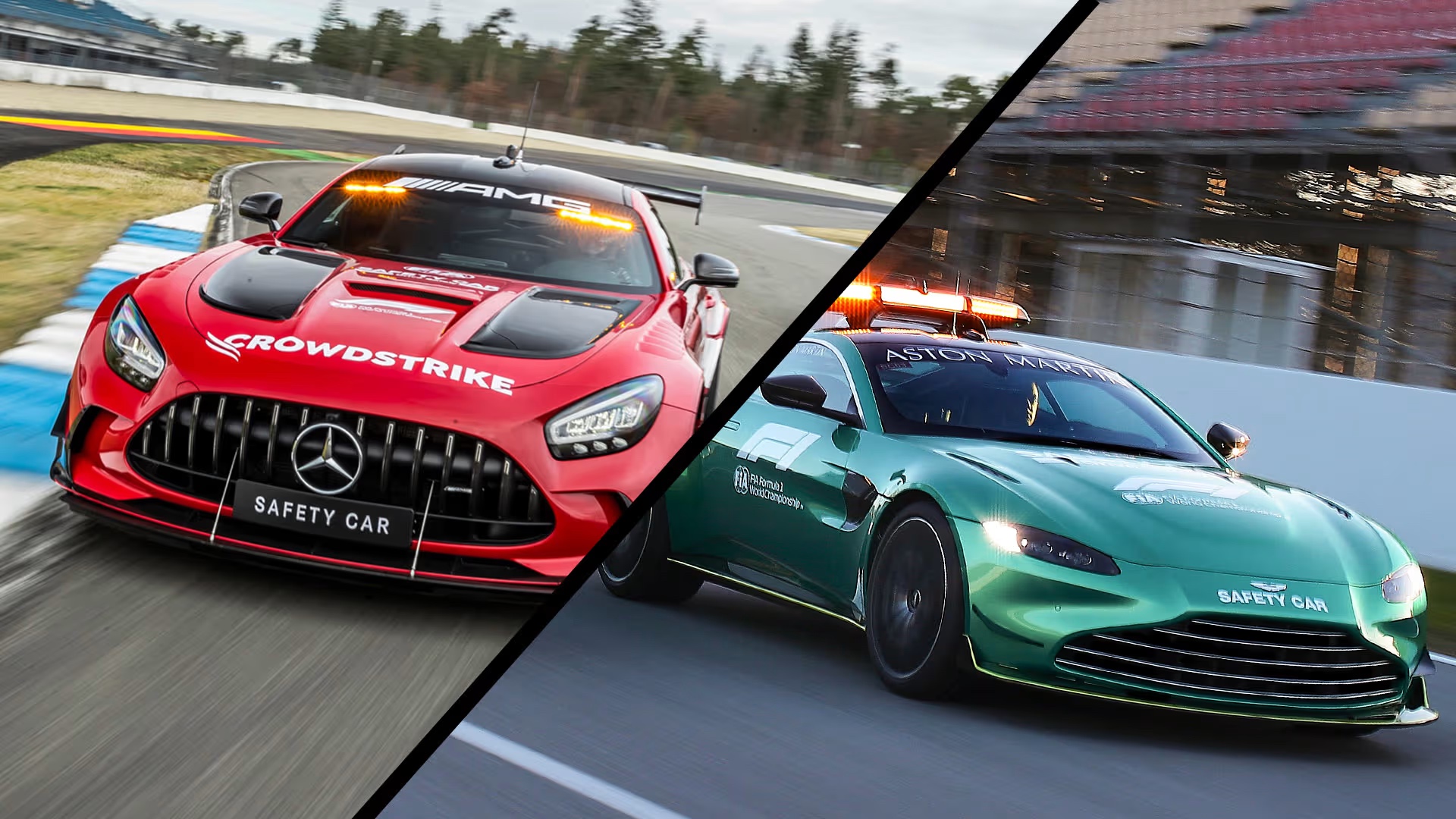
Formula 1 uses three different intervention vehicles and systems to control incidents without automatically stopping a Grand Prix: the full Safety Car, the Virtual Safety Car and the Medical Car.
Each has a different role. One physically controls the field, another slows drivers while preserving the gaps between them, and the third is designed to deliver medical support as quickly as possible.
The Safety Car Had a Chaotic Debut
Formula 1 first used a Safety Car at the 1973 Canadian Grand Prix, held in wet and difficult conditions.
Officials deployed a Porsche 914 to control the field after incidents on track. The introduction did not go smoothly. The Safety Car picked up the wrong driver instead of the race leader, creating confusion over the running order and leaving the field queued behind the wrong car.
It was an imperfect beginning for a system that would later become one of race control’s most important tools.
Type 1: The Full Safety Car
A full Safety Car is deployed when competitors, marshals or recovery crews face an immediate risk that cannot be managed under normal racing conditions.
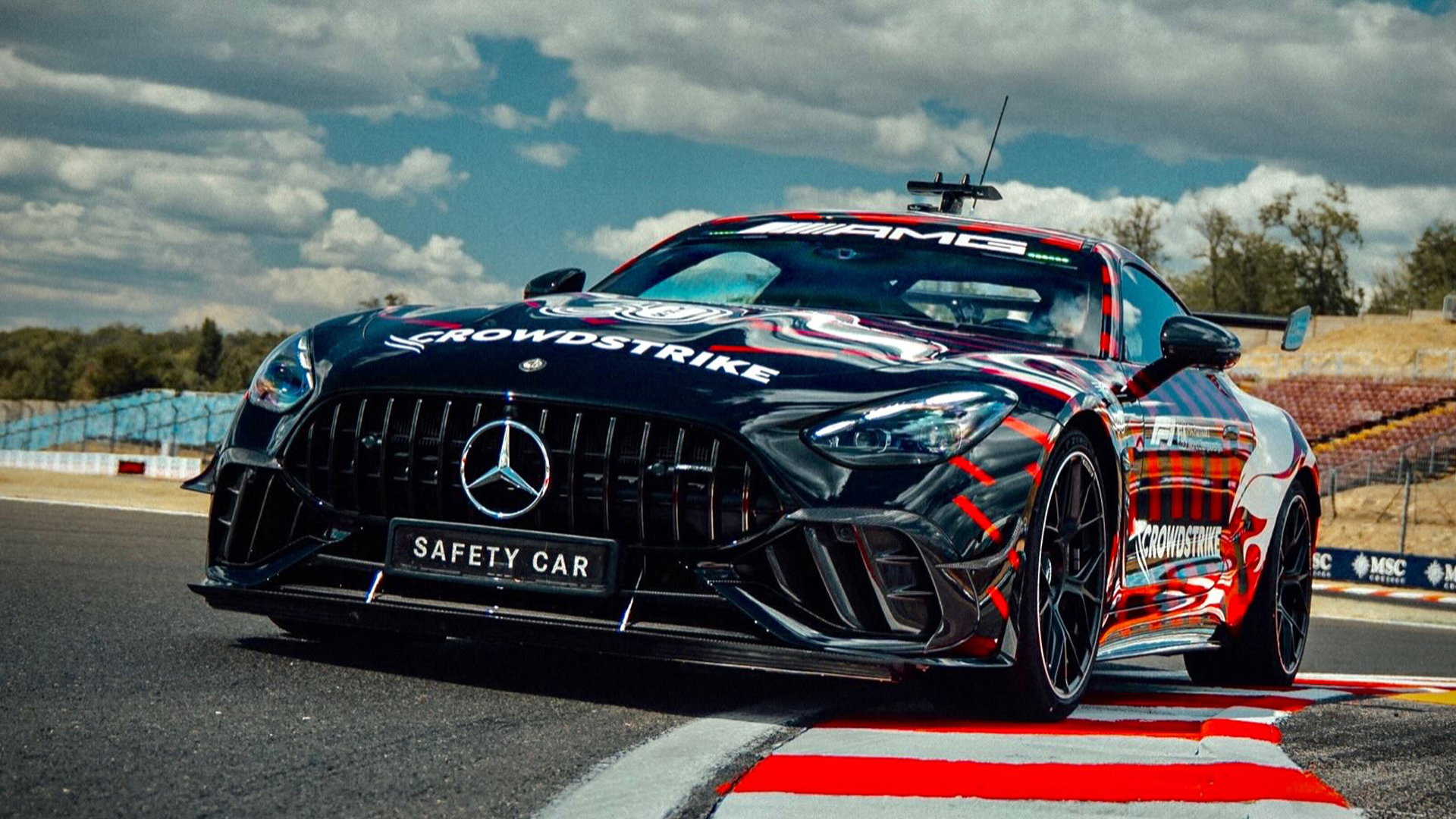
That can include a major crash, debris on the racing line or visibility becoming too poor for drivers to continue safely at racing speed. In 2026, Mercedes supplies both Formula 1’s Safety Car and Medical Car.
What Happens When the Safety Car Is Deployed?
Once race control calls for the Safety Car, teams receive the message “SAFETY CAR DEPLOYED”.
“SC” appears on FIA light panels around the circuit and yellow flags are shown.
The Safety Car then joins the track with its roof lights activated.
Drivers must reduce their speed, form a queue and are not permitted to overtake unless specifically instructed by race control.
The Field Bunches Together
One of the biggest consequences of a full Safety Car is the disappearance of the gaps built up during the race.
The field forms a single-file queue behind the Safety Car, effectively resetting the spacing between drivers. Lapped cars may also be allowed to un-lap themselves before the restart.
That can transform a race. A driver who had built a large lead can suddenly find the entire field directly behind, while competitors further back are given another opportunity to attack.
Safety Cars Can Transform Pit Strategy
A Safety Car period also changes the strategic value of a pit stop.
Because the field is circulating more slowly, the relative time lost by entering the pit lane is reduced.
That can make a tyre change far more attractive, especially if a restart is approaching and fresh rubber offers a significant performance advantage. Teams therefore react quickly when the Safety Car appears, particularly when tyre age and track position are already finely balanced.
The Leader Controls the Restart
When the Safety Car prepares to return to the pit lane, control of the field effectively passes to the race leader.
The leader decides when to accelerate and resume racing. Drivers behind cannot overtake before the designated restart point, which gives the leader an opportunity to control the pace of the pack and choose the moment to go.
The objective is simple.The leader wants to create separation before the first braking zone. The drivers behind want to remain as close as possible.
Type 2: The Virtual Safety Car
The Virtual Safety Car was introduced in 2015 following the death of Jules Bianchi after his accident at the 2014 Japanese Grand Prix.
It is used when an incident requires the field to slow down, but not enough to justify physically sending a Safety Car onto the circuit.
Under the VSC, drivers must stay above a prescribed minimum lap-time delta, reducing their speed significantly compared with normal racing conditions.
Full Safety Car vs Virtual Safety Car
The main difference is what happens to the gaps. A full Safety Car physically bunches the field together.
Under the VSC, every driver slows to the required delta, but the gaps between cars remain broadly similar. A 40-second lead can disappear under a full Safety Car. Under a VSC, it should remain much closer to what it was before the neutralisation.
That distinction can have a major impact on both track position and strategy.
How Race Control Chooses Between Them
The race director decides whether an incident requires a VSC, full Safety Car or red flag.
A VSC is generally used when the problem can be controlled quickly without bringing the cars together.
A full Safety Car becomes more appropriate when marshals need additional time on track, debris is spread across the circuit or visibility has deteriorated significantly.
A red flag is used when the circuit cannot be made safe while the cars continue circulating.
Type 3: The Medical Car
The Medical Car has a completely different purpose. Its role is not to control the race, but to deliver medical support to an incident as quickly as possible.
In 2026, the Mercedes-AMG GT 63 S Medical Car carries FIA Medical Delegate Dr Ian Roberts alongside driver Alan van der Merwe.
Why the Medical Car Follows the Start
Before the race begins, the Medical Car lines up behind the grid.
When the lights go out, it follows the field through the opening section of the lap.
The reason is straightforward. First-lap accidents can involve a large number of cars travelling in close proximity, and the Medical Car needs to be positioned close enough to respond immediately.
Starting behind the field places the medical team much nearer to any serious opening-lap incident than if it remained stationary in the pit lane.
The 30-Second Response Target
Formula 1 circuits are designed with access routes that allow the Medical Car to reach incidents quickly.
The target is to reach a driver within approximately 30 seconds after a serious high-speed crash.
One of the clearest examples came at the 2020 Bahrain Grand Prix. Romain Grosjean’s Haas pierced the barriers and caught fire after a violent first-lap impact.
The Medical Car was already moving behind the field, allowing Alan van der Merwe and Dr Ian Roberts to reach the scene almost immediately. Roberts arrived at the wreckage around 28 seconds after the impact and assisted as Grosjean escaped the fire.
Grosjean survived with burns to his hands.
Why Formula 1 Needs All Three Systems
The Safety Car, VSC and Medical Car solve different problems.
The full Safety Car creates a controlled field when a major incident requires marshals or recovery crews to work on track. The VSC slows the race without erasing the gaps between drivers. The Medical Car exists for one purpose: reaching an injured driver as quickly as possible.
Together, they allow race control to respond proportionally rather than stopping the Grand Prix every time something goes wrong.
In a sport where cars can exceed 300km/h and incidents develop within seconds, that flexibility is essential.