

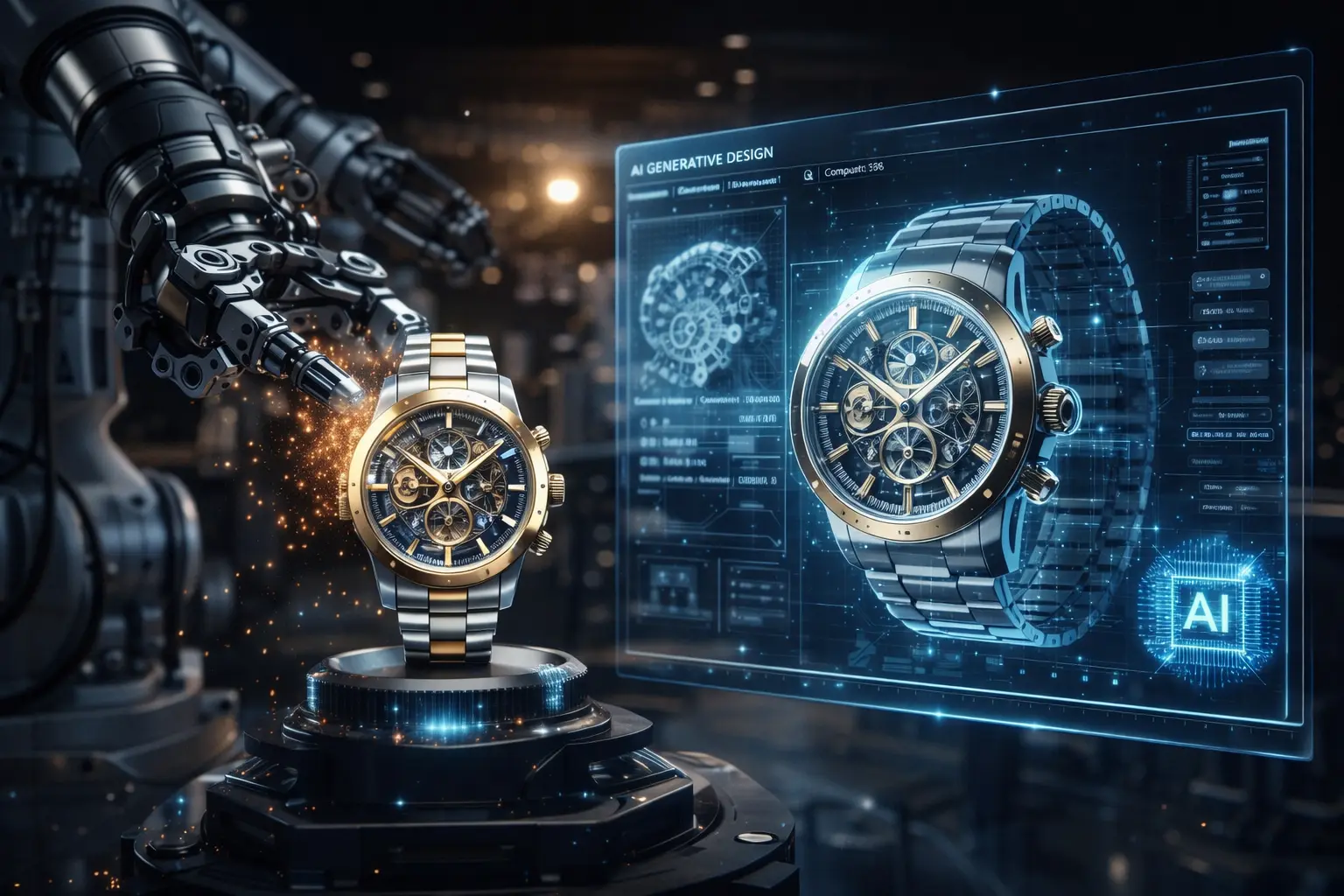
The Nautilus. The Royal Oak. The Submariner. These designs didn’t emerge from algorithms-they came from the minds of Gérald Genta, Georges Golay, and René-Paul Jeanneret. Could an AI have created them? More importantly: could AI create the next icon?
The Provocation
Imagine this scenario:
A major Swiss manufacture announces a new flagship model. The case design is revolutionary-instantly recognizable, perfectly proportioned, technologically sophisticated. The movement architecture represents a genuine advancement in chronometric performance. Critics call it a masterpiece.
Then the brand reveals: an AI designed 70% of it.
Does your perception change? Does the watch become less desirable? Less valuable? Less… real?
This isn’t hypothetical. It’s happening right now, quietly, behind the maisons of Geneva, Neuchâtel, and the Vallée de Joux.
What Generative Design Actually Means in Watchmaking
Beyond Simple CAD
Most people think “computer-designed watches” means using CAD software. That’s been standard since the 1990s. Generative AI is something entirely different.
Traditional CAD Process:
- Designer sketches concept
- Engineer translates to 3D model
- Prototype is built
- Testing reveals flaws
- Back to step 1 Repeat 20-50 times over 18-36 months
Generative AI Process:
- Define parameters (size, materials, performance targets, constraints)
- AI generates thousands of design variations
- Virtual testing eliminates non-viable options
- Human designers select and refine top candidates
- Physical prototype built First viable design in 3-6 months
What AI Can Actually Do
Movement Architecture:
- Optimize gear train layouts for efficiency and accuracy
- Design balance wheel geometries for enhanced performance
- Calculate optimal spring characteristics
- Simulate thousands of years of wear in hours
- Identify failure modes before manufacturing
Case Design:
- Generate forms that balance aesthetics with ergonomics
- Optimize thickness while maintaining water resistance
- Design bracelet integration that flows naturally
- Create entirely novel visual languages
- Test how light interacts with surfaces
Material Selection:
- Analyze thousands of alloy combinations
- Predict long-term durability and aging characteristics
- Optimize for weight, strength, and corrosion resistance
- Suggest unexpected material pairings
What AI Cannot Do (Yet)
Emotional Resonance: AI doesn’t understand why the Speedmaster’s asymmetric case makes hearts race. It can’t grasp the emotional power of art deco proportions or the nostalgia of vintage design cues.
Cultural Context: An algorithm doesn’t know that integrated bracelets evoke 1970s luxury, or that small seconds at 9 o’clock has historical watchmaking significance, or that certain design elements carry specific brand DNA.
Taste and Restraint: AI tends toward optimization, which often means complexity. Human designers know when to simplify, when “less” communicates “more,” when imperfection creates character.
The Intangible “It” Factor: Great designs have soul. They tell stories. They connect with something primal in human perception. AI generates solutions; humans create meaning.
Real Applications: What’s Actually Happening
Case Study 1: Movement Optimization at Zenith
The Challenge: Create a high-frequency movement (36,000 vph) with extended power reserve-goals that traditionally conflict.
The AI Approach: Zenith’s engineers used generative algorithms to redesign the gear train and barrel configuration. The AI explored millions of geometric arrangements, optimizing for:
- Minimal friction
- Maximum energy storage
- Reduced wear
- Improved accuracy
The Result: A movement configuration no human designer had conceived in decades of high-frequency watchmaking. Power reserve increased 40% while maintaining chronometric performance.
The Human Element: Engineers validated the AI’s solution, refined aesthetics, and ensured manufacturability. The silicon components required were then finished by hand to Zenith standards.
Is it still a “Zenith”? The brand argues yes-the AI served as an advanced tool, but human watchmakers retained creative control and executed the vision.
Case Study 2: Case Topology at Richard Mille
The Challenge: Design the lightest possible case maintaining 50m water resistance and housing a complex movement.
The AI Approach: Richard Mille employed topology optimization-AI that removes material wherever possible while maintaining structural requirements. Feed it:
- Maximum external dimensions
- Minimum wall thickness zones
- Stress load requirements
- Vibration resistance targets
The Result: Organic, skeletal case structures that look almost biological. The RM 27-03 Rafael Nadal used AI-optimized carbon TPT case architecture, creating a watch that weighs 34 grams total yet survives 10,000g shocks.
The Human Element: Designers made aesthetic refinements, ensuring the organic forms still “read” as a Richard Mille. The avant-garde appearance was intentional, not purely functional.
The Reception: Enthusiasts celebrated it as pushing boundaries. Critics called it overwrought. But no one questioned its technical achievement.
Case Study 3: Balance Wheel Geometry at Patek Philippe (Rumored)
The Rumor (unconfirmed by the manufacture): Patek Philippe allegedly used AI to optimize balance wheel designs for their Gyromax system, exploring geometries that improve isochronism across positions.
Why It’s Plausible: Patek’s recent movements show performance improvements beyond what iterative manual design typically achieves. The Caliber 240 Q evolution demonstrated chronometric advances suggesting computational optimization.
Why It Matters: If even ultra-traditional Patek Philippe uses AI (even if never publicly admitted), it signals industry-wide acceptance that computational design isn’t a betrayal of craft-it’s an evolution.
The Silence: That no manufacture openly discusses this speaks volumes about industry anxiety around these tools.
The Design Process: Human + AI Collaboration
How It Actually Works
Step 1: Human Vision Designer establishes creative direction:
- Brand identity requirements
- Emotional goals (“sporty,” “elegant,” “technical”)
- Historical references or departures
- Target market and use case
Step 2: Parameter Definition Engineers translate vision into constraints:
- Physical dimensions (case diameter, thickness, lug-to-lug)
- Performance targets (water resistance, power reserve, accuracy)
- Material limitations and cost boundaries
- Manufacturing capabilities
Step 3: AI Generation Algorithm produces design variations:
- Hundreds to thousands of options
- Each meeting technical requirements
- Varying in aesthetic approach
- Ranked by optimization goals
Step 4: Human Curation Design team reviews AI output:
- Selects promising directions
- Combines elements from multiple solutions
- Applies taste, brand identity, and market understanding
- Makes intuitive leaps AI can’t
Step 5: Refinement Loop Iterative collaboration:
- Human adjustments
- AI re-optimization
- Virtual prototyping
- Continuous refinement
Step 6: Physical Reality Master craftspeople execute:
- Prototype manufacturing
- Hand-finishing to brand standards
- Testing and validation
- Final human approval
The Key Insight: It’s not AI replacing humans. It’s humans augmented by AI, freed from computational drudgery to focus on creative and emotional dimensions.
The Philosophical Question: What Makes a Design “Iconic”?
Analyzing Past Icons
The Nautilus (1976)
- Revolutionary integrated bracelet
- Porthole-inspired octagonal bezel
- Horizontal embossed pattern
- Perfect proportions that “just work”
Could AI have designed it? Technical elements: Yes. AI could optimize the bracelet integration, calculate ideal case proportions, engineer the complex case construction. Emotional elements: No. The porthole metaphor, the bold departure from dress watch conventions, the confidence to make it large when Swiss watches were small-these required human audacity.
The Royal Oak (1972)
- Exposed octagonal bezel screws
- Integrated bracelet with tapering
- “Tapisserie” dial pattern
- Ultra-thin automatic movement
Could AI have designed it? Technical elements: Possibly. The movement architecture and case engineering could benefit from computational optimization. Emotional elements: No. Genta’s inspiration came from a diving helmet-a metaphorical leap no algorithm makes. The decision to put visible screws on a luxury watch was culturally transgressive, requiring human risk-taking.
The Speedmaster Professional (1957)
- Asymmetric case protecting crown
- High-contrast tachymeter bezel
- Three-register chronograph layout
- Hesalite crystal for NASA compliance
Could AI have designed it? Technical elements: Certainly. Chronograph optimization is computational. Emotional elements: No. The watch became iconic because humans wore it to the moon-context AI can’t predict or design for.
The Pattern
Icons emerge from:
- Technical excellence (AI can contribute)
- Cultural moment (AI cannot predict)
- Bold creative vision (AI cannot originate)
- Emotional resonance (AI cannot feel)
- Time and storytelling (AI cannot imagine)
AI might design a technically perfect watch. But iconic status requires human context, risk-taking, and the passage of time.
Industry Perspectives: What Watchmakers Actually Think
The Traditionalists
Philippe Dufour (Independent Watchmaker): “A watch is not an equation to be solved. It is a conversation between maker and wearer, conducted through metal and jewels. AI can calculate, but it cannot converse.”
Perspective: For artisanal independents, AI represents existential threat to their entire value proposition-the human hand, the individual maker’s soul in every piece.
The Pragmatists
Jean-Claude Biver (Former Hublot, TAG Heuer CEO): “If AI helps us make better watches that people love, why would we refuse? We didn’t reject electricity or computers. AI is another tool.”
Perspective: Business-minded watchmakers see AI as competitive advantage. Refusing it is like refusing CNC machines-foolish traditionalism.
The Futurists
Mate Rimac (Founder, Rimac Automobili-increasingly involved in luxury watches): “The best designs will come from human creativity amplified by AI. Not human alone, not AI alone, but the synthesis.”
Perspective: Tech entrepreneurs entering watchmaking view AI integration as obvious, necessary, and exciting.
The Silent Majority
Most Major Manufactures: Use AI extensively. Say nothing publicly.
Perspective: The Swiss watch industry is deeply conservative in messaging even while innovative in practice. Public discussion of AI risks brand mystique, so they keep quiet.
The Counterfeit Problem: AI as Double-Edged Sword
The Dark Side of Generative Design
The Threat: If AI can design watches, it can also design perfect counterfeits. Generative algorithms could:
- Reverse-engineer movements from photographs
- Create fake documentation indistinguishable from authentic
- Generate “Frankenwatch” configurations that seem plausible
- Design fantasy pieces that never existed but could have
Current Reality: High-end counterfeits increasingly use AI for:
- Movement design copying legitimate calibers
- Case proportion analysis from official images
- Dial printing and text reproduction
- Aging simulation for vintage fakes
Industry Response: Manufactures are fighting back with AI:
- Authentication algorithms trained on genuine pieces
- Blockchain certificates of authenticity
- Microscopic markers only detectable by AI
- Database systems tracking legitimate watches
The Arms Race: As AI improves forgery, it must also improve detection. This cycle will define watch authentication for decades.
Economic Implications: What AI Means for Value
Will AI-Designed Watches Be Worth Less?
Arguments for Devaluation:
- Reduced human labor input
- Loss of “artisanal” cachet
- Easier replication
- Diminished storytelling appeal
Arguments for Premium Value:
- Superior technical performance
- Innovative forms previously impossible
- Limited production maintaining scarcity
- Enhanced capability justifies cost
Early Market Data: Watches known to use AI design (like certain Richard Mille models) have not suffered value depreciation. The market cares about:
- Brand prestige
- Technical achievement
- Exclusivity
- Wearability
How something was designed matters less than the result and the story around it.
The Investment Angle
For Collectors Considering AI-Designed Pieces:
Pros:
- First-generation AI designs may become historically significant
- Technical innovations often appreciate long-term
- Brands at forefront of technology maintain relevance
Cons:
- Unknown long-term market sentiment
- Possible future backlash against AI involvement
- Traditionalist collectors may avoid
Neutral Reality: Most collectors don’t know (and brands don’t disclose) which watches used AI design assistance. The market prices watches on brand, rarity, condition, and provenance-not design methodology.
The Next Five Years: Predictions
What’s Coming
1. Fully AI-Generated Movement Architectures (2025-2026) Within two years, we’ll see a major brand release a movement where AI designed the entire gear train, escapement geometry, and energy management-with humans only doing finishing and assembly.
Likely candidates: Zenith, TAG Heuer, Seiko
2. Personalized Design on Demand (2026-2027) AI will enable true customization:
- Upload your wrist measurements, style preferences, lifestyle
- AI generates unique case design optimized for your proportions
- Movement selected and configured for your needs
- One-off piece manufactured with minimal human intervention
Early movers: Smaller independents and micro-brands will pioneer this before major manufactures adopt
3. Transparent AI Design (2027-2028) A prestigious brand will finally market AI involvement openly:
- “Designed by human creativity and artificial intelligence”
- Documentary showing the collaborative process
- Embrace rather than hide the technology
Prediction: Positive reception if executed with confidence and transparency
4. AI Design Competitions (2028+) Watch design competitions where:
- AI and human designers compete directly
- Public voting determines winners
- Best elements synthesized into production pieces
Impact: Legitimizes AI as creative partner rather than replacement
5. The Countermovement (Ongoing) Simultaneous rise of aggressively “AI-free” marketing:
- Certification programs for human-only design
- Premium pricing for verified traditional methods
- Nostalgic brands positioning against AI
Market: Both segments will coexist, serving different customer values
Practical Guide: Evaluating AI-Influenced Watches
Questions to Ask Before Buying
1. Disclosure Level
- Does the brand discuss their design process?
- Are they transparent about AI involvement?
- Do they celebrate or hide technological tools?
2. Technical Performance
- Does the watch perform measurably better than predecessors?
- Are improvements significant or incremental?
- Could these advances have happened without AI?
3. Aesthetic Success
- Does the design work emotionally?
- Does it fit within brand identity?
- Is it distinctive and memorable?
4. Manufacturing Quality
- Are finishing standards maintained?
- Does human craftsmanship remain evident?
- Is it obvious where machines dominate?
5. Long-Term Value
- How does the brand’s innovation history affect resale?
- Are early adopters of technology rewarded or punished?
- Does your collection benefit from diversity of design approaches?
Green Flags
- Brand is confident and transparent about methodology
- AI used for optimization, humans for creative direction
- Technical improvements are measurable and significant
- Finishing and assembly maintain traditional standards
- Design works emotionally, not just technically
- Limited production maintains exclusivity
Red Flags
- Marketing emphasizes “traditional” while silently using AI
- Design looks optimized but soulless
- No clear human creative vision evident
- Finishing quality compromised in favor of technical specs
- Design feels derivative or generic despite “innovation”
- Brand can’t articulate what makes it special beyond specifications
The Verdict: Can AI Design an Icon?
The Honest Answer: Not Alone
AI can design watches that are:
- Technically superior
- Mathematically optimized
- Aesthetically pleasing
- Functionally excellent
- Commercially successful
But iconic designs require something AI cannot provide: cultural resonance across time.
The Nautilus became iconic because:
- It broke rules at exactly the right moment (1970s luxury sports watch boom)
- It embodied a philosophy (luxury can be casual)
- Celebrities and tastemakers adopted it organically
- Time revealed its timelessness
No algorithm predicts that. No AI designs for a cultural moment it cannot perceive.
The Collaborative Future
The next iconic watch will likely involve AI-but as a tool wielded by human vision, not as autonomous creator.
The ideal process:
- Human designer has bold creative vision
- AI helps explore and optimize that vision
- Human refines, curates, and adds soul
- Master craftspeople execute with traditional skill
- Time and culture determine if it becomes iconic
The synthesis: AI provides the “intelligence,” humans provide the “wisdom.”
What This Means for Collectors
Embrace the ambiguity: You likely already own watches that used AI in their development. Does that change how they make you feel when you wear them? Probably not.
Focus on results: Judge watches by how they perform, look, and make you feel-not by which tools designed them.
Support transparency: Buy from brands honest about their processes, whatever those processes are.
Appreciate both: There’s room in your collection for traditional artisanal pieces AND technically advanced AI-assisted designs.
Remember what matters: You’re buying watches for yourself, not for methodology purists. If you love it, that’s enough.
Final Thought: The Human Element Endures
Here’s what AI will never replace in watchmaking:
- The thrill of opening a box for the first time
- The weight of history when you wear a vintage piece
- The connection to a master craftsperson’s vision
- The stories you’ll tell about your watches
- The emotional resonance of design that speaks to your soul
- The satisfaction of choosing something that reflects who you are
AI can design a watch. But only you can decide what it means.
And in the end, meaning is what makes a watch-or any creation-truly iconic.
Key Takeaways
- AI is already extensively used in watch design, though rarely discussed publicly
- Generative algorithms excel at technical optimization but cannot create emotional resonance
- Iconic designs require cultural moment, human audacity, and time-things AI cannot provide
- The future is human-AI collaboration, not AI replacement
- Major brands like Zenith and Richard Mille openly use AI for specific design challenges
- Market value depends on results and brand prestige, not design methodology
- Transparency about AI involvement is more ethical than hiding it
- Collectors should focus on whether they love the watch, not how it was designed
- The next five years will see increased AI integration and simultaneous “AI-free” countermovement
- Both traditional and AI-assisted watchmaking will coexist, serving different collector values
What matters more: how your watch was designed, or how it makes you feel? In the end, that’s the only question that matters-whether AI was involved or not.