

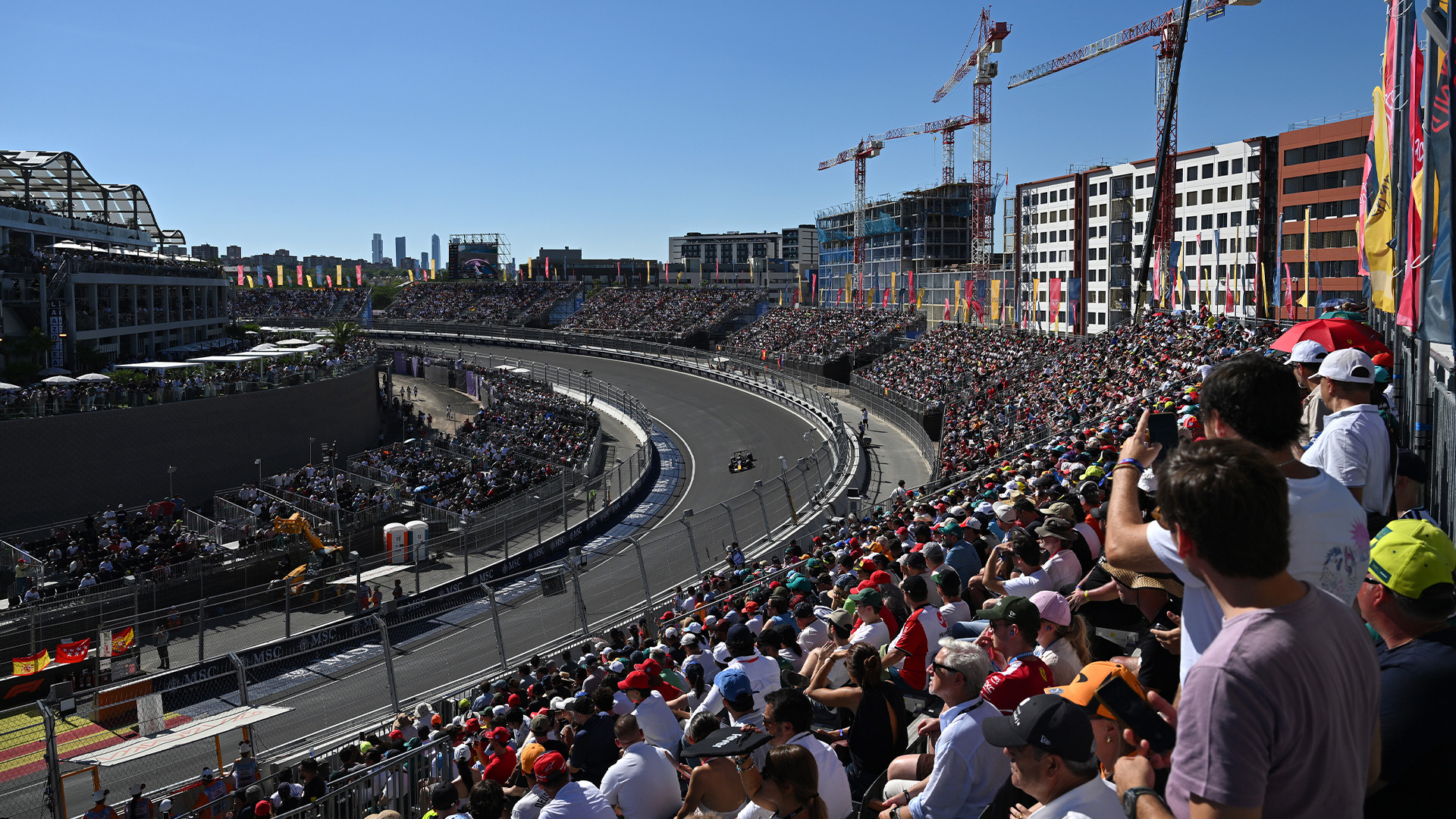
Formula 1’s first visit to Madrid’s new Madring circuit is shaping up as a weekend where adaptability could matter as much as outright pace, with low grip, significant bumps and restricted margins around the 5.416 kilometre layout creating one of the least familiar engineering exercises of the season.
The 22-corner circuit combines a street section around Madrid’s exhibition district with a permanent section, including the 550 metre Monumental corner with 24% banking. Barriers sit close to the racing line in several areas, while the lack of meaningful Formula 1 reference data means teams will begin
Friday with considerably more uncertainty than at an established venue.
Earlier Formula 3 running has already raised questions over the surface, with repeated interruptions and chassis damage cited as evidence of the potential severity of the bumps. Formula 1 cars will respond differently, but any requirement to raise ride heights or soften suspension settings could immediately affect aerodynamic performance.
That makes Madrid difficult to predict. The competitive order could shift significantly between Friday and Sunday as the circuit gains rubber, teams refine their mechanical settings and drivers establish how much commitment the walls will tolerate.
Low grip and bumps could dictate the weekend
The condition of the Madring surface is likely to become the first major engineering question.
Low initial grip should increase sliding, particularly during the opening sessions, while substantial bumping could prevent teams from running their cars as low or as stiff as their aerodynamic platforms would ideally demand.
Ride height is especially important with the current generation of Formula 1 machinery. Raising the car to protect the floor and improve compliance over bumps can provide greater mechanical security, but generally comes at the expense of aerodynamic load and platform control.
Suspension settings present a similar compromise. Teams need enough stiffness to maintain a stable aerodynamic platform without creating a car that skips across bumps or becomes unpredictable when the driver attacks the kerbs.
The barriers magnify every weakness.
The closing portion of the lap contains several 90-degree corners that Pirelli has compared with those found in Baku, while the broader circuit combines fast sections with medium and low speed turns. Rear axle confidence under braking and traction could therefore become particularly valuable.
Friday running carries unusual importance. Long runs will provide the first meaningful information on fuel effects, degradation and track evolution, while repeated red flags could leave teams entering qualifying with significant gaps in their understanding.
Madring creates a difficult setup compromise
The characteristics of the lap add another layer of complexity.
Pirelli describes the opening sector as very fast before the circuit moves into a second section containing several medium and low speed corners. The final part of the lap then returns to a series of sharper 90-degree turns.
Optimising one section could therefore compromise another.
A car configured heavily around traction and straight-line performance may gain time through the stop-start sections but lose performance through longer, sustained corners. A package carrying more aerodynamic load could reverse that advantage while becoming vulnerable elsewhere.
Mercedes and Red Bull have been tipped to benefit through the straighter sections, with Ferrari and McLaren potentially better placed through the more flowing portions of the lap. Those assessments remain predictions until representative Formula 1 running begins.
The broader requirement is versatility. A car capable of producing strong mechanical grip without sacrificing aerodynamic stability should give its driver more freedom to attack a circuit where extreme set up choices could prove expensive.
Pirelli chooses C2, C3 and C4 with two stops in mind
There is now certainty over one important part of the Madrid Grand Prix strategy picture.
Pirelli has officially selected the C2 as the Hard, C3 as the Medium and C4 as the Soft for Formula 1’s first race at Madring. The nomination was originally made after simulations based on the new circuit’s characteristics, rather than real Formula 1 running, making Madrid a particularly interesting test of Pirelli’s pre-event modelling.
The selection is significant because Pirelli is not approaching Madrid as a conventional low-severity street circuit.
Its simulations indicate that the loads generated at Madring could be comparable with those experienced at Silverstone and Spa-Francorchamps, two circuits that place substantial energy through the tyres. That assessment helped push Pirelli towards the middle of its five-compound 2026 range rather than the softer rubber commonly associated with street events.
Pirelli has also made clear that the C2, C3 and C4 combination was chosen with strategy in mind. The company expects the range to encourage a two-stop race, while the harder selection should provide additional protection against overheating if Madrid experiences high ambient and track temperatures.
That makes tyre behaviour one of the most important variables of the weekend.
The C2 offers durability at the harder end of the nominated range, while the C3 should provide the central race tyre and the C4 adds the faster but more thermally sensitive option. Across the full 2026 range, Pirelli positions the C2 as a compound suited to faster, hotter and more abrasive circuits, while the C3 is designed to balance performance and durability and the C4 prioritises quicker warm up and higher grip.
Track evolution could complicate the picture further.
A green surface on Friday may produce substantial sliding and artificially high degradation. As rubber builds through the weekend, grip should increase, potentially reducing sliding and changing the balance between the C2, C3 and C4.
The team that looks strongest on Friday may therefore not carry the same tyre advantage into Sunday.
The Monumental adds another tyre load variable
Madrid also contains a feature unlike anything else on the current Formula 1 calendar.
The Monumental is a 550 metre corner with 24% banking, and Pirelli identifies it as the longest banked corner of the season. The combination of banking, speed and sustained lateral load will add another element to tyre management, particularly once drivers begin exploring the limits of the racing line.
Pirelli began analysing the forces expected at Madring three years before the race, using information supplied by the circuit designers before supplementing it with simulation work.
That preparation reduces some of the uncertainty, but simulation cannot completely reproduce a new asphalt surface, real track temperatures or the amount of sliding generated once 20 Formula 1 cars begin running.
Madrid will therefore provide Pirelli with its first opportunity to compare those predictions against real data.
Red Bull faces potential test over the bumps
Red Bull’s behaviour over the rougher sections will be closely watched.
Suspension performance has been identified as a potential concern if the bumps are as severe as anticipated. Keeping the car mechanically settled will be important for protecting aerodynamic performance, maintaining traction and giving the driver confidence under braking.
The issue is not exclusive to Red Bull.
Every team will need to determine how aggressively it can attack kerbs while balancing suspension stiffness and ride height against the possibility of floor or component damage.
That equation becomes particularly important when barriers leave little space to recover from a car that suddenly becomes unstable.
Madrid may therefore reward durability as well as speed. A theoretically faster configuration offers little advantage if it leaves the car too vulnerable to the surface.
Madrid renews debate over Formula 1’s circuit direction
Madring also arrives amid a broader debate over the type of venues Formula 1 is adding to its calendar.
Its mixture of urban sections, straights, sharp corners and close barriers invites comparisons with Miami, Las Vegas, Baku and Jeddah. Yet the inclusion of significant elevation change and the Monumental banking gives Madrid characteristics that separate it from a conventional street circuit. Pirelli itself expects tyre loads closer to Silverstone and Spa than the layout’s urban setting might initially suggest.
The weekend should therefore provide a much clearer picture of Madring than its appearance on paper.
Pirelli has already committed to C2, C3 and C4 and is targeting conditions conducive to two stops. Teams know the expected tyre loads are substantial. What they do not yet know is how aggressively they can run their cars across the bumps, how quickly the surface will evolve or how much confidence drivers will find beside the barriers.
At Formula 1’s newest circuit, the decisive advantage may belong to the team that understands those variables first.