

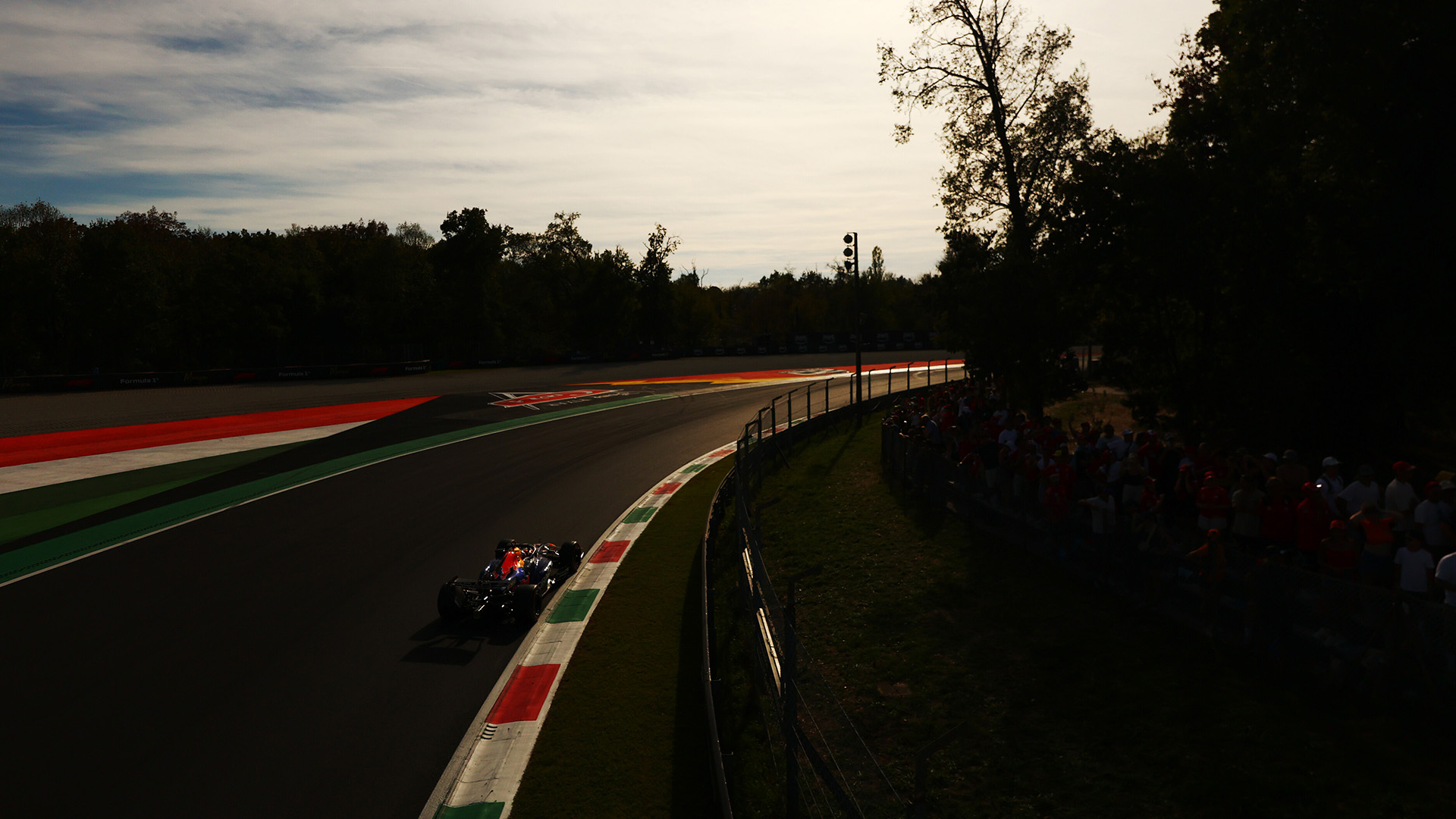
From fatal tragedy and abandoned banking to Formula 1’s closest finish, chaotic qualifying and one of the Halo’s starkest demonstrations, Monza’s history extends far beyond outright speed.
Autodromo Nazionale Monza has always dealt in extremes. Formula 1’s Italian Grand Prix is synonymous with minimal downforce, huge braking zones, slipstream battles and some of the highest speeds on the calendar, but the circuit’s reputation has been built just as much by the extraordinary events that have unfolded around those long straights.
Since hosting the second round of the inaugural Formula 1 World Championship in 1950, Monza has produced races that have altered careers, influenced safety debates and exposed the peculiarities of racing at a circuit where reducing drag can matter almost as much as generating downforce.
Its history also lives physically within the park. The remains of Monza’s old high-speed banking still sit beside the modern circuit, a reminder of an era when the pursuit of speed was considerably less restrained.
The banking that became a monument to another era
The most striking relic of old Monza is its concrete banking.
The high-speed oval was incorporated into versions of the circuit used during some of Formula 1’s earliest decades, creating a spectacular layout combining the road course with heavily banked sections. Cars could carry enormous speed around the banking, but the forces involved and the safety standards of the period made the configuration increasingly difficult to justify.
Formula 1 eventually abandoned the combined layout, yet much of the banking survived.
Today it remains one of motorsport’s most recognisable pieces of abandoned infrastructure, towering through the trees inside Monza’s royal park. It is less a forgotten circuit than a physical record of how radically Formula 1’s attitude towards risk has changed.
1961 remains Monza’s darkest chapter
No discussion of Monza’s history can avoid the 1961 Italian Grand Prix.
Ferrari driver Wolfgang von Trips arrived at Monza fighting for the Formula 1 World Championship, but his race ended in catastrophe following contact with Jim Clark. Von Trips’ Ferrari left the circuit and crashed into an area occupied by spectators.
Von Trips and 15 spectators were killed.
The accident remains one of the deadliest incidents in Formula 1 history and became part of a wider reckoning over circuit safety during an era when drivers competed at extraordinary speeds with limited protection for both themselves and those watching from trackside.
Phil Hill won the race for Ferrari and secured the 1961 world championship, but the scale of the tragedy overshadowed the sporting result.
Formula 1’s closest finish came at Monza
A decade later, Monza produced a very different kind of landmark.
The 1971 Italian Grand Prix became one of Formula 1’s greatest slipstream races. With the circuit still dominated by long straights and fast corners, cars repeatedly traded positions as drivers used the tow to attack.
The leading group reached the final metres almost together.
Peter Gethin emerged ahead for BRM, beating Ronnie Peterson by just 0.01 seconds. François Cevert, Mike Hailwood and Howden Ganley followed, with the first five cars covered by only 0.61 seconds.
It remains one of the tightest finishes Formula 1 has ever produced and perhaps the purest expression of old Monza: low drag, enormous speed and a race decided almost entirely by positioning in the slipstream.
The qualifying session where nobody wanted to lead
Monza’s dependence on the tow produced something far stranger in 2019.
During the closing stages of Q3, drivers deliberately slowed as they attempted to position themselves behind another car for their final qualifying laps. At a circuit where a well-timed slipstream can be worth a significant amount of lap time, nobody wanted to be the car punching the initial hole through the air.
The result was near farce.
Cars crawled around the circuit while the clock continued to run, leaving most of the leading contenders unable to begin their final flying laps before the chequered flag.
Charles Leclerc therefore retained pole position for Ferrari and went on to win the Italian Grand Prix the following day.
The episode became an extreme demonstration of how Monza’s aerodynamic characteristics can distort normal qualifying tactics. Drivers were competing for track position by trying not to be first on the road.
The Verstappen-Hamilton crash that put the Halo in focus
The 2021 Italian Grand Prix supplied another enduring Monza image.
Max Verstappen and Lewis Hamilton collided while fighting through the opening chicane after Hamilton emerged from the pits. Verstappen’s Red Bull climbed over the Mercedes, with one of its rear wheels passing across the cockpit area as the car came to rest on top of Hamilton’s W12.
The Halo took part of the impact.
Hamilton later credited the cockpit protection system with helping prevent a potentially far more serious outcome. The incident became another powerful real-world demonstration of a device that had faced considerable resistance before Formula 1 made it mandatory in 2018.
The championship protagonists both retired, adding another flashpoint to their intense 2021 title fight.
Pierre Gasly and Monza’s loneliest podium
Monza can produce unforgettable victories too, although few looked as unusual as Pierre Gasly’s in 2020.
A disrupted race opened the door for AlphaTauri, and Gasly capitalised to score his maiden Formula 1 victory after resisting Carlos Sainz in the closing stages.
For AlphaTauri, based at Faenza, it was effectively a home victory. It also arrived at the same circuit where the team, then racing as Toro Rosso, had taken its previous win with Sebastian Vettel in 2008.
Yet the celebration looked unlike almost any other Italian Grand Prix.
COVID-19 restrictions meant the grandstands were empty. Gasly stood above the start-finish straight without the enormous crowd that traditionally floods beneath Monza’s elevated podium.
At a circuit famous for the tifosi transforming the track into a sea of red after the chequered flag, the silence made one of Formula 1’s great underdog victories visually surreal.
Why Monza’s podium is different
When the spectators are present, that same podium produces one of Formula 1’s most distinctive celebrations.
Rather than sitting conventionally beside the pit building, Monza’s podium extends above the start-finish straight. Once the race is over, spectators pour onto the circuit and gather beneath it, placing the top three drivers directly above thousands of fans.
A Ferrari victory amplifies the spectacle further. Red flags fill the straight, the Italian anthem reverberates around the circuit and the podium effectively becomes suspended over the tifosi.
It is an architectural detail that has become part of the identity of the Italian Grand Prix itself.
Monza’s reputation as the Temple of Speed is therefore only part of its significance. The abandoned banking, the tragedy of 1961, the 1971 slipstream classic, the bizarre qualifying tactics of 2019, Gasly’s empty 2020 celebration and the Verstappen-Hamilton collision of 2021 all belong to the same circuit.
Few Formula 1 venues carry their history so visibly. At Monza, the past is not confined to statistics or archive footage. Much of it is still standing beside the track.