

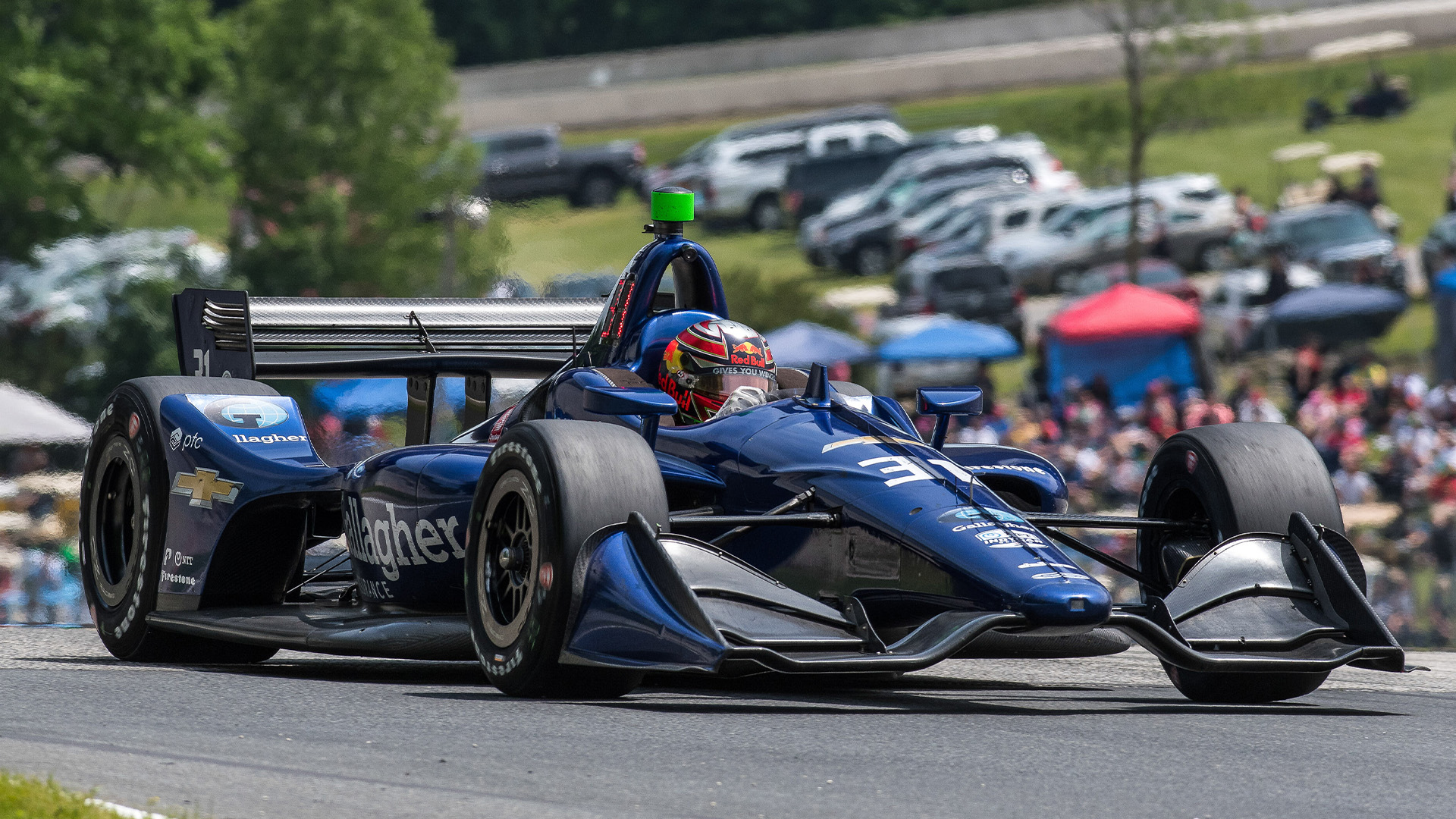
Formula 1 and IndyCar share the basic architecture of single-seater racing, but their cars, power units, circuits, overtaking systems and sporting philosophies create fundamentally different forms of competition.
Put a Formula 1 car and an IndyCar side by side and the resemblance is obvious: exposed wheels, open cockpits, enormous power and machinery designed around aerodynamic efficiency. Beyond that silhouette, the similarities begin to disappear quickly.
Formula 1 is fundamentally a constructors’ championship. Teams design and develop their own cars within an increasingly restrictive technical and financial framework, chasing fractions of a second through aerodynamics, suspension, packaging and power-unit integration.
IndyCar takes almost the opposite approach. Its common Dallara chassis and tightly controlled technical package deliberately reduce the scope for expensive development, shifting more of the competitive emphasis towards set-up, strategy and the driver.
That difference in philosophy explains much of what happens on track.
Formula 1 cars are constructors; IndyCars share their foundations
A modern Formula 1 team is responsible for designing its own chassis and aerodynamic package within the FIA technical regulations. The result is a grid of cars built to the same rulebook but developed independently.
That freedom is central to F1. Floor geometry, suspension architecture, cooling, bodywork and aerodynamic efficiency can all contribute to the performance hierarchy, while manufacturers also compete through different power-unit programmes.
IndyCar standardises considerably more of the car. Teams use a Dallara chassis, with Chevrolet and Honda supplying the championship’s engine packages.
The narrower technical window helps contain costs and limits the possibility of one constructor producing a fundamentally superior chassis. Engineering still matters enormously, but the competitive battleground is more heavily concentrated around mechanical and aerodynamic set-up, tyre management, strategy and execution.
F1 and IndyCar power units pursue different objectives
The contrast becomes even clearer beneath the bodywork.
Formula 1’s 2026 regulations retain the 1.6-litre turbocharged V6 architecture but place far greater emphasis on electrical power. The MGU-H has disappeared, while the MGU-K is capable of delivering up to 350kW – roughly 470bhp – as F1 moves towards a much more even split between combustion and electrical performance.
IndyCar uses a 2.2-litre twin-turbocharged V6 coupled to the hybrid system introduced during the 2024 season.
The result is not simply a question of which car produces the larger peak number. The two championships manage power and energy differently because they are designed around different race formats, circuits and technical regulations.
F1’s increasingly powerful electrical deployment has become a central part of its 2026 racing architecture. IndyCar’s hybrid adds another strategic tool to machinery that remains substantially more standardised.
Which is faster: Formula 1 or IndyCar?
There is no useful answer without specifying the circuit.
On a conventional road course, Formula 1 machinery is substantially quicker. The advantage comes primarily from aerodynamic load, braking performance and the ability to carry extraordinary speed through medium- and high-speed corners.
F1 cars are designed around generating enormous downforce while maintaining sufficient aerodynamic efficiency on the straights. Their carbon brakes and sophisticated aerodynamic platforms also allow drivers to brake exceptionally late.
IndyCars can reach spectacular speeds in oval specification. At the Indianapolis 500, qualifying runs can average well above 230mph over four laps – a very different performance requirement from threading an F1 car through Monaco, Suzuka or Silverstone.
That distinction matters. Top speed alone does not make one racing car “faster” in every meaningful sense.
Formula 1 is generally the quicker package around a road circuit; IndyCar’s superspeedway configuration is designed to sustain immense velocity for prolonged periods on banked ovals.
Ovals fundamentally change the IndyCar challenge
The calendar itself exposes another major divide.
Formula 1 competes on permanent road courses and street circuits, with layouts ranging from Monaco’s confined streets to the high-speed sweeps of Silverstone and Spa-Francorchamps.
IndyCar combines road courses and street circuits with short ovals and superspeedways.
Oval racing requires its own technical and tactical discipline. Aerodynamic configuration, traffic management, slipstream behaviour, tyre degradation and car placement operate differently when drivers are running at more than 220mph with walls only metres away.
It also demands versatility from the driver. A championship campaign can require the same competitor to master a technical road course, a bumpy temporary street circuit and Indianapolis Motor Speedway.
Overtaking is engineered differently
The two series also approach overtaking assistance from different directions.
Formula 1’s 2026 regulations have replaced the familiar DRS concept with active aerodynamics and a new energy-based racing framework. Drivers can use low-drag configurations on designated sections, while a chasing car within the required proximity can gain access to additional electrical deployment through Overtake Mode.
The principle is closely tied to energy management.
IndyCar’s push-to-pass system, used on eligible road and street circuits, gives drivers a finite reserve of additional engine performance. Crucially, it can become a tactical resource for both attacking and defending rather than simply functioning as a prescribed overtaking aid.
That changes the psychology of a battle. A driver must consider not only whether to use additional performance now, but how much a rival may still have available later in the race.
Why an F1 pit stop lasts two seconds and IndyCar stops take longer?
Formula 1’s ban on race refuelling means a conventional dry-weather pit stop is overwhelmingly about tyres.
With large crews permitted to work simultaneously around the car, a competitive four-tyre change can be completed in roughly two seconds. Tiny errors matter: a reluctant wheel nut or mistimed release can erase positions instantly.
IndyCar pit stops involve a different workload because refuelling remains part of race strategy. Fuel quantity, tyre choice and caution periods can therefore alter the strategic shape of an event far more dramatically.
The stopwatch comparison consequently misses the point. An F1 stop is engineered around an exceptionally rapid tyre change; an IndyCar stop forms part of a broader fuel-and-tyre strategy.
Qualifying reflects the championships’ different identities
Formula 1 uses its familiar knockout structure, with Q1 and Q2 eliminating drivers before the remaining 10 contest pole position in Q3.
IndyCar qualifying changes according to circuit type.
Road and street events use group and knockout elements, while oval qualifying sends cars onto the circuit individually. Indianapolis takes that concept further, with four-lap average speeds determining the order and separate sessions deciding the front rows and the vulnerable positions at the back of the field.
That makes Indianapolis qualifying a competition in its own right. Four consecutive laps have to be delivered with minimal aerodynamic drag, changing track conditions and little margin for error at speeds above 230mph.
Formula 1 spends more because development is part of the competition
The financial models underline the philosophical divide.
Formula 1 operates under a cost cap covering defined areas of team expenditure, while significant items sit outside that calculation. Even within those restrictions, teams maintain major design, manufacturing and development operations because building a faster car is an explicit part of the championship.
IndyCar’s extensive use of standardised hardware removes much of that development arms race.
That does not make IndyCar technically simple. Instead, it narrows where performance can be found. Teams have to extract lap time from a more closely defined package rather than designing an entirely new aerodynamic concept to beat their rivals.
The distinction is crucial to understanding both championships.
Formula 1 asks teams to build the fastest car they can within a complex set of restrictions, then asks drivers to extract its potential. IndyCar gives competitors much more closely related machinery and asks them to optimise it across one of the most varied collections of circuits in top-level single-seater racing.
Neither philosophy produces an inherently superior form of motorsport. They simply reward different skills, and that is precisely why a Formula 1 car and an IndyCar can look broadly similar while producing racing that feels so different.