

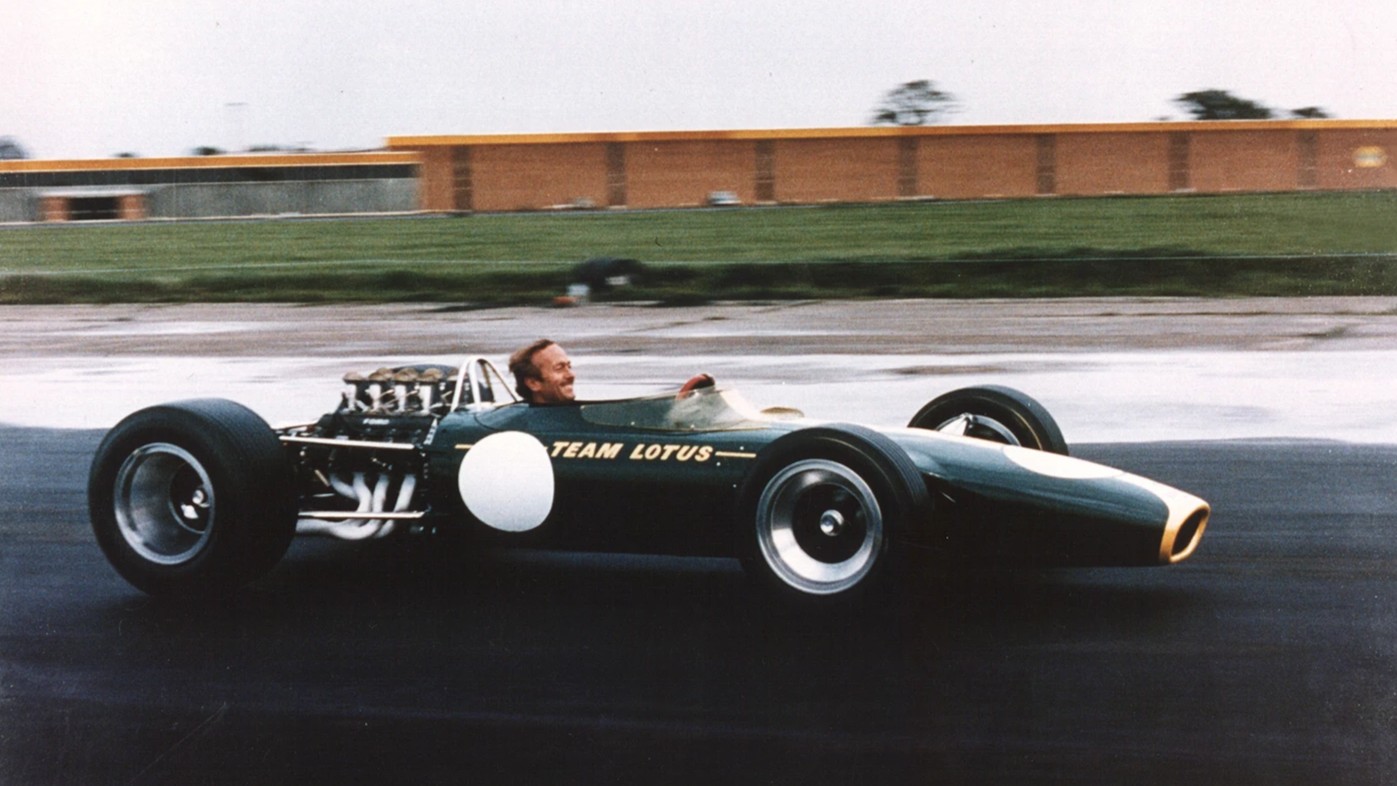
Few people have changed Formula 1 as fundamentally as Colin Chapman.
The Lotus founder did not build racing cars by simply chasing more horsepower. He questioned how a racing car should be constructed, how little it could weigh, how aerodynamics could be exploited and even how an F1 team could make money.
Some of his ideas were brilliant. Others pushed engineering to uncomfortable extremes. But look closely at a modern Formula 1 car and Chapman’s fingerprints are still everywhere.
So, who exactly was Colin Chapman, and why does Lotus still carry so much weight in Formula 1 history? Here are five details every motorsport fan should know.
1. Before Lotus, Colin Chapman Was an RAF Pilot
Chapman’s obsession with weight did not begin in a Formula 1 garage.
While studying engineering at University College London, he joined the University Air Squadron and learned to fly. In 1948, he entered the Royal Air Force as part of his National Service and served as a pilot.
He was reportedly offered the opportunity to continue his career with the RAF, but Chapman chose engineering instead.
That aviation background would become important.
Aircraft engineering revolves around achieving maximum structural performance with minimum mass, and Chapman carried much of that thinking into his cars. Components did not simply need to work; ideally, one component would perform several jobs while adding as little weight as possible.
It became one of the principles that defined Lotus.
2. The Lotus 25 Changed How Formula 1 Cars Were Built
One of Chapman’s biggest breakthroughs arrived in 1962 with the Lotus 25.
Formula 1 cars of the period generally relied on tubular spaceframe chassis. Chapman and Lotus moved in a radically different direction with an aluminium monocoque structure built around the driver.
The result was lighter and considerably more rigid than the conventional designs it replaced.
That improved much more than weight. A stiffer chassis gave engineers a more consistent platform for suspension development, while the compact construction helped create a smaller, more efficient racing car.
Jim Clark immediately demonstrated what the concept could do. The Lotus 25 became one of the defining F1 cars of the 1960s and helped establish monocoque construction as the direction the rest of the grid needed to follow.
Modern Formula 1 cars use vastly more sophisticated carbon-fibre survival cells, but the underlying philosophy can be traced directly back to this period.
3. Chapman Didn’t Just Want More Power. He Wanted Less Car.
Chapman’s engineering philosophy can be reduced to one obsession: weight.
While horsepower naturally mattered, Chapman understood that reducing mass could improve almost every area of a racing car simultaneously. A lighter car accelerates harder, changes direction more quickly and places less demand on its brakes and tyres.
For Lotus, weight was not simply another number on the technical sheet. It influenced virtually every engineering decision.
Chapman constantly looked for ways to make components perform more than one function. On the Lotus 25, for example, the monocoque structure incorporated fuel-carrying sections rather than treating the chassis and fuel storage as completely separate systems.
It was an aggressive approach to engineering efficiency and occasionally a controversial one, particularly as Lotus became known for pushing components close to their structural limits.
But it worked.
Lotus became synonymous with light, responsive racing cars, and that same philosophy later shaped the company’s road cars.
4. Lotus Helped Turn Formula 1 Cars Into Moving Billboards
Chapman’s influence was not limited to engineering.
He also understood the commercial potential of Formula 1 earlier than most.
For decades, Grand Prix cars had largely competed in colours associated with their countries: British cars in racing green, Italian machinery in red and French entries in blue.
Then Lotus changed the visual language of the grid.
In 1968, Team Lotus appeared in the red, white and gold colours of Gold Leaf following a major commercial agreement with the tobacco company. The racing car itself had become valuable advertising space.
The implications were enormous.
Corporate sponsorship rapidly became fundamental to Formula 1’s business model, giving teams access to revenue streams that extended far beyond manufacturers, prize money and wealthy private backers.
Lotus would later produce an even more recognisable commercial identity with the black-and-gold John Player Special cars.
Today, sponsorship liveries are inseparable from Formula 1. Chapman was one of the people who recognised just how valuable the bodywork could become.
5. Team Lotus Won 13 Formula 1 World Championships
All the experimentation ultimately had to deliver one thing: results.
It did.
Team Lotus won seven Formula 1 Constructors’ Championships, taking the title in 1963, 1965, 1968, 1970, 1972, 1973 and 1978.
Lotus drivers also secured six Drivers’ Championships.
Jim Clark won two of them, while Graham Hill, Jochen Rindt, Emerson Fittipaldi and Mario Andretti added four more. Rindt’s 1970 title remains particularly significant, as he became the only driver in Formula 1 history to be crowned World Champion posthumously.
The final Lotus drivers’ title of the Chapman era came with Andretti in 1978, driving the Lotus 79.
That car represented another major chapter in Chapman’s engineering legacy. By exploiting ground effect to generate enormous levels of downforce underneath the car, Lotus once again forced Formula 1’s engineers to rethink what was possible.
Colin Chapman’s Influence Is Still on the F1 Grid
Colin Chapman died in 1982, but many of the ideas associated with him never really left Formula 1.
Monocoque construction became standard. Aerodynamics became one of the sport’s biggest performance battlegrounds. Weight remains an obsession measured down to individual components. Sponsorship became a fundamental part of the commercial model.
And Lotus proved repeatedly that the fastest solution did not always require following what everyone else was already doing.
Thirteen world championships tell one side of the story. The stronger measure of Chapman’s influence is simpler: more than four decades after his death, Formula 1 is still developing ideas built around many of the same questions he was asking.