

A New Era Begins In Maranello
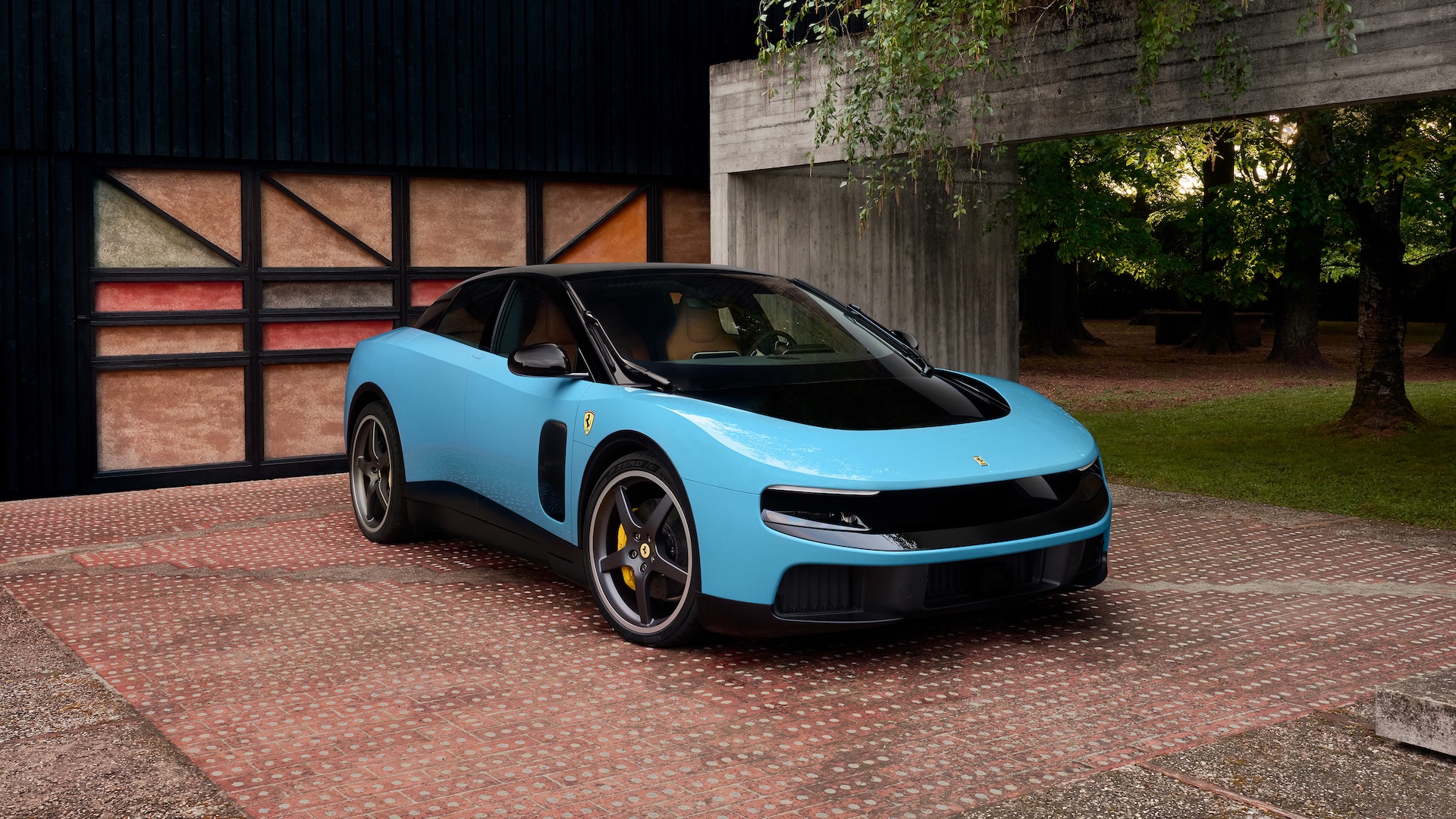
Ferrari has finally done it. After years of rumours, debates, and enough “Ferrari EV will never happen” comments to fill Monza’s grandstands, the Prancing Horse has officially unveiled its first fully electric production car: the Ferrari Luce.
And no, Ferrari didn’t just take an existing car, remove the V8, and shove batteries underneath it. The Luce is something entirely different. It is a clean-sheet Ferrari developed around electric architecture from day one. More importantly, it represents Ferrari’s biggest philosophical shift since the company moved from manual gearboxes to automatics in 1976!
This is not “the electric Ferrari.” Ferrari repeatedly insists the Luce is “an entirely new Ferrari.” That subtle distinction matters.
What Makes The Ferrari Luce So Important?
The Luce is more than just another high-performance EV entering an increasingly crowded ultra-luxury electric segment. It marks Ferrari’s entry into a completely new category while simultaneously proving that electrification does not mean abandoning driving emotion.
Ferrari’s leadership has made it clear that internal combustion engines are not disappearing. Hybrid Ferraris will continue, and ICE will stay alive for as long as regulations allow. But the Luce opens a new lane in Ferrari’s multi-energy strategy.
That’s significant because rivals are struggling to find the right EV formula. Lamborghini delayed its EV plans. Aston Martin pushed its electric ambitions further into the future. McLaren still sounds undecided. Ferrari, meanwhile, just showed up with a quad-motor 1,000+hp GT with over 530 km of range.
Also Read:
– New Mercedes-AMG GT 4-Door Coupé: 1,153hp EV Super-Saloon Fakes A V8
– Ferrari HC25 Revealed: One-Off V8 Roadster
– Ferrari Purosangue Handling Speciale: Sharper, Louder, Still A Proper V12-Powered Weapon
Ferrari Luce Design: Love It Or Hate It, You Can’t Ignore It
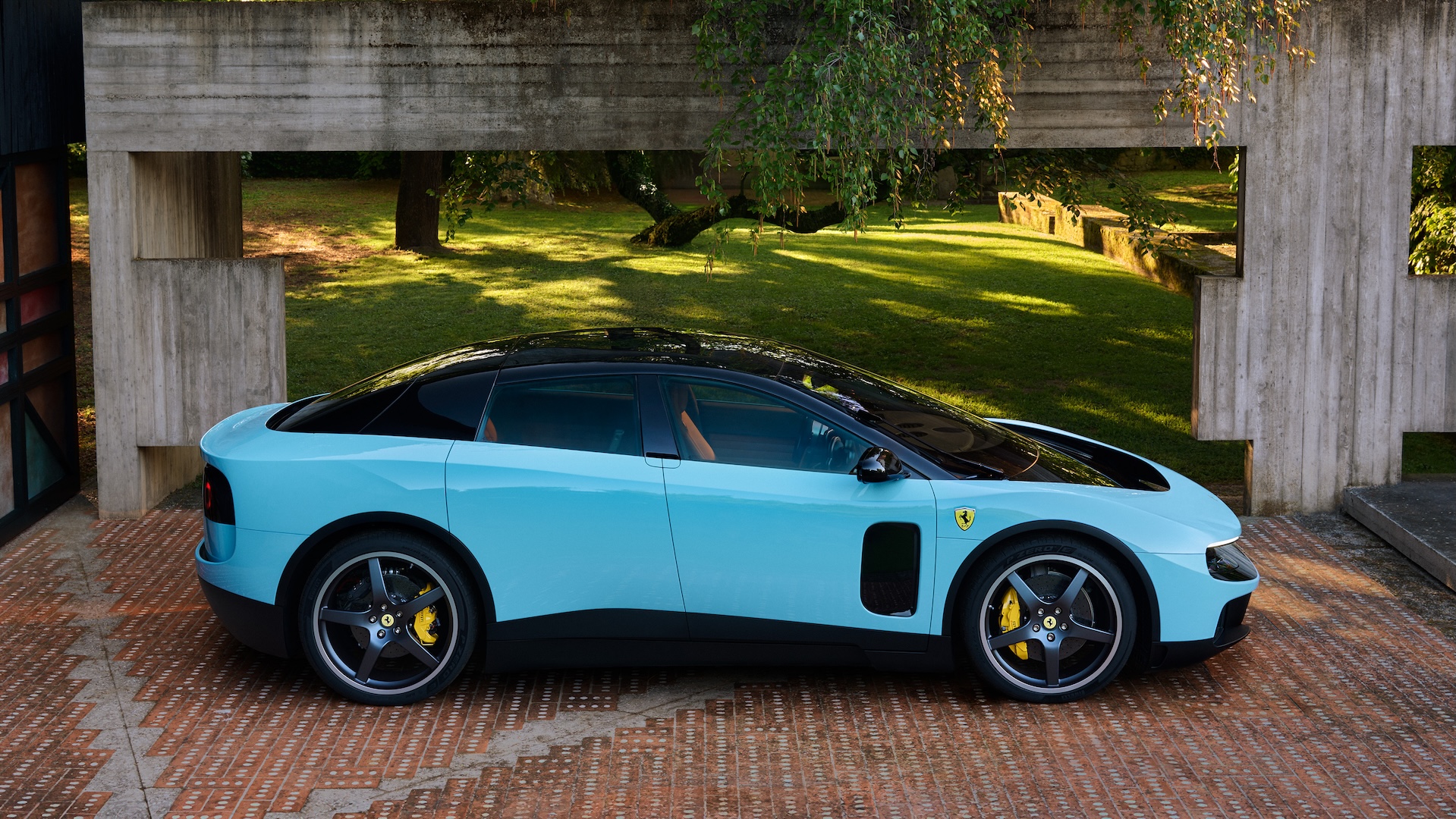
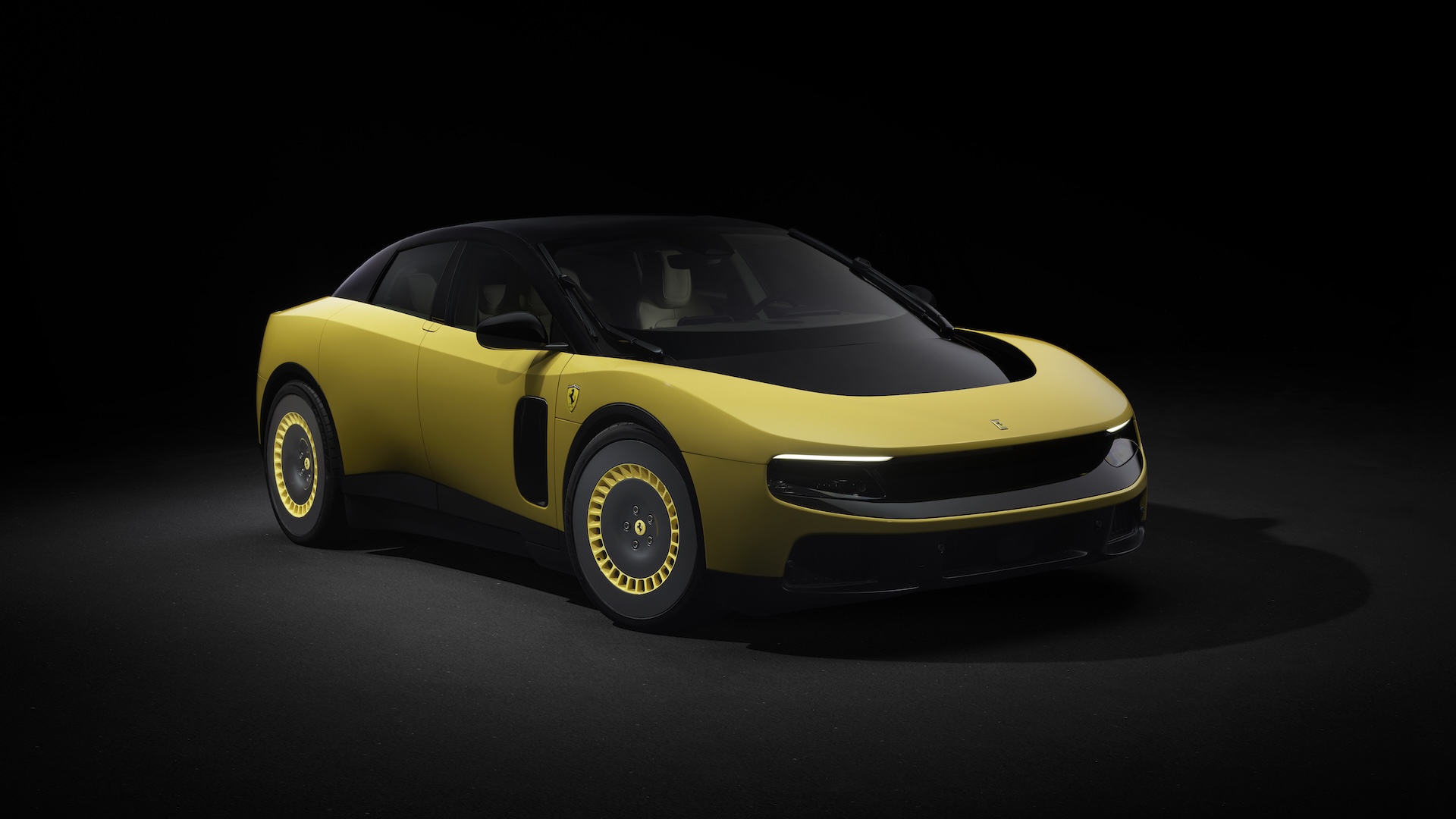
Let’s address the elephant in the room. The Luce does not look like a traditional Ferrari. There’s no long bonnet. No dramatic mid-engine proportions. No supercar silhouette. Ferrari collaborated with LoveFrom, the design collective led by legendary former Apple design chief Sir Jony Ive and Marc Newson.
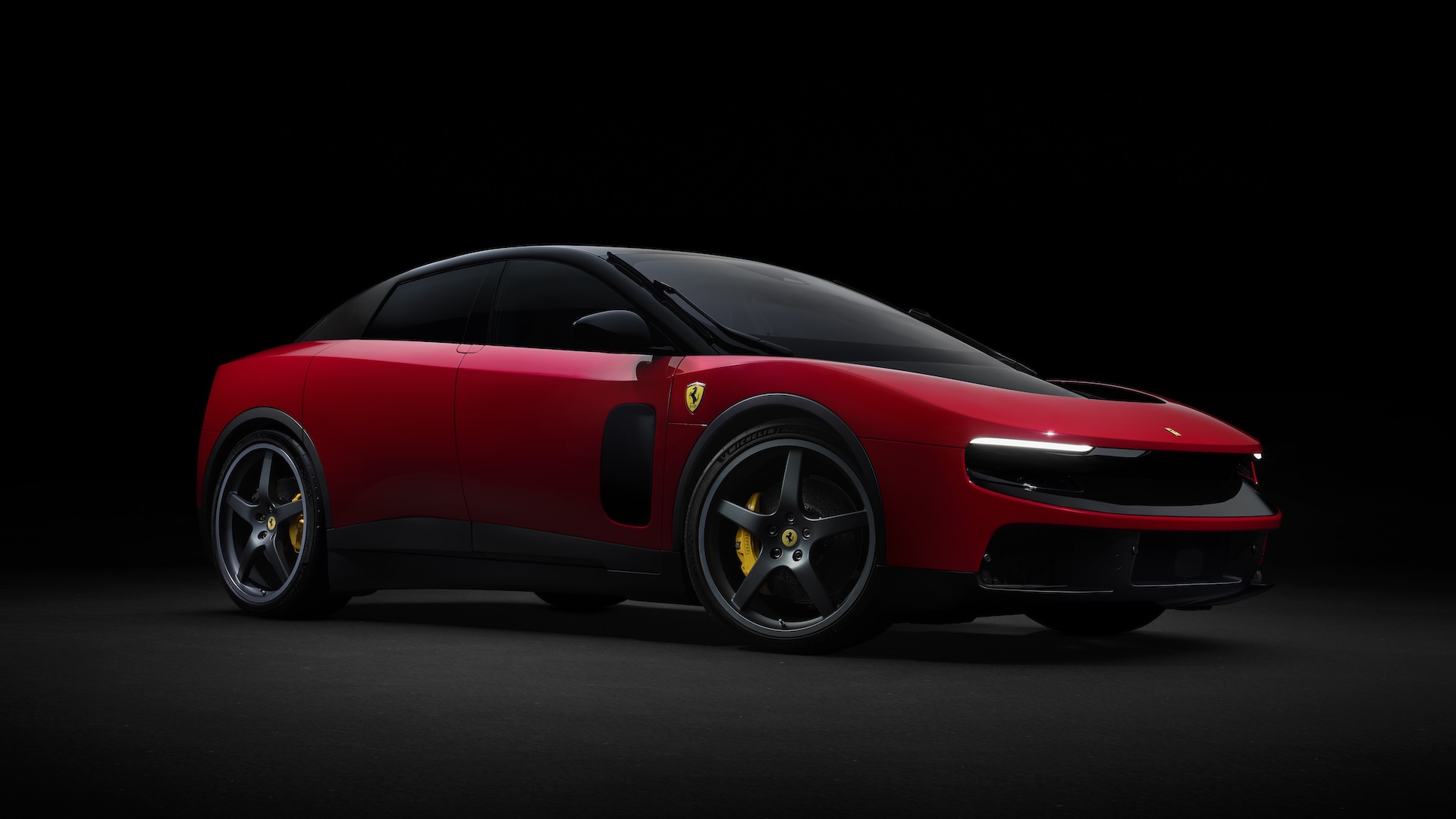
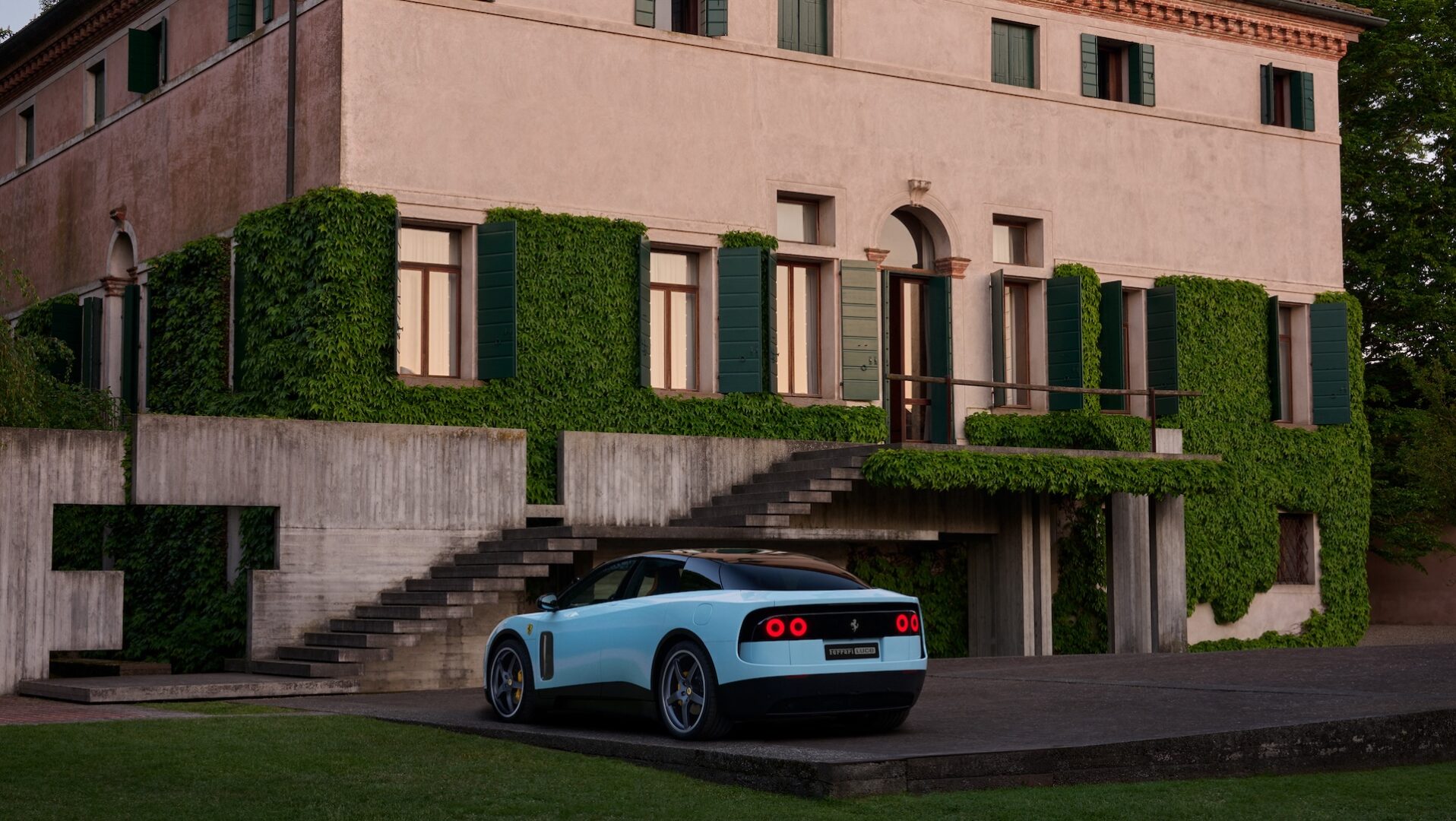
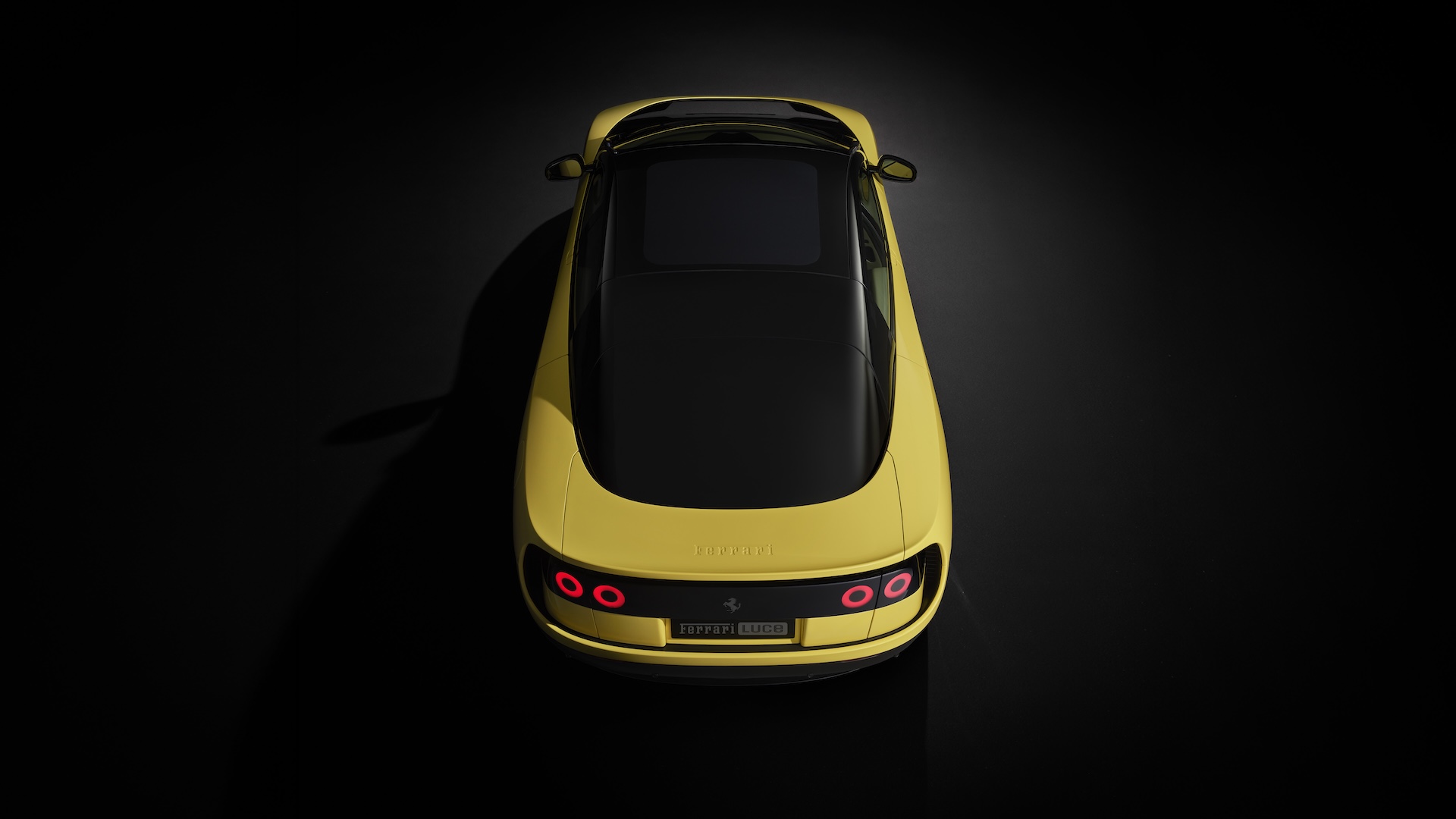
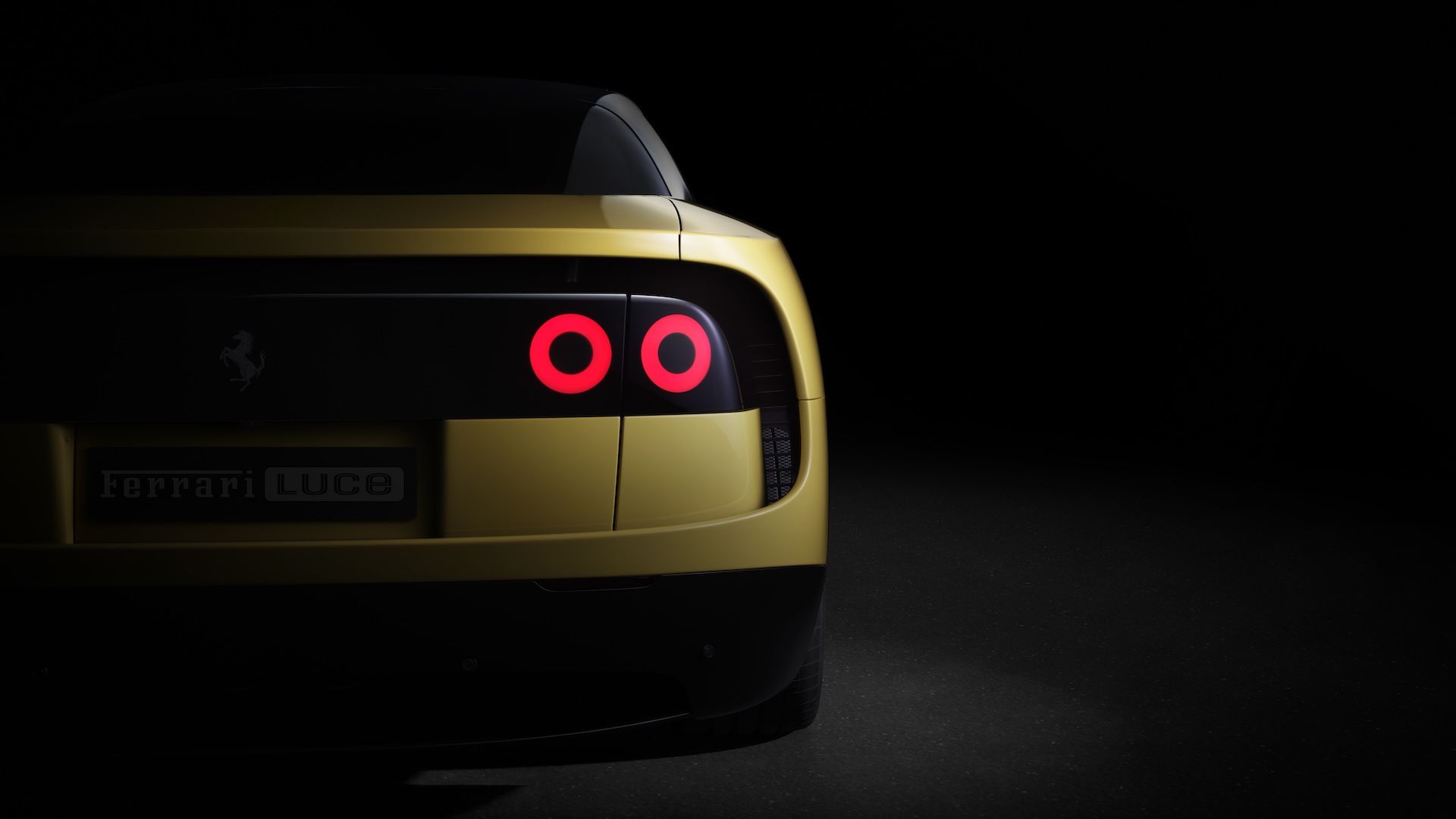
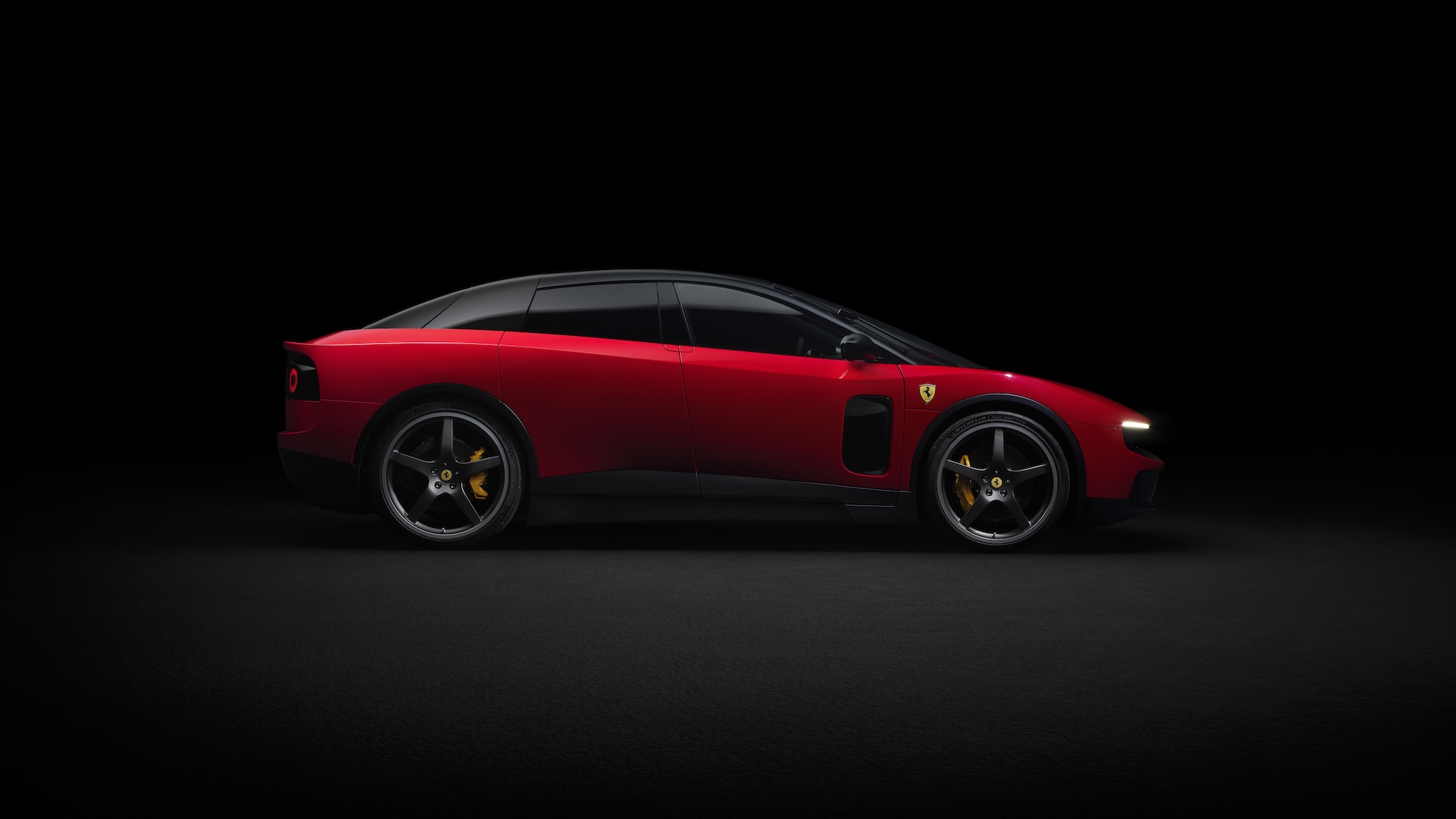
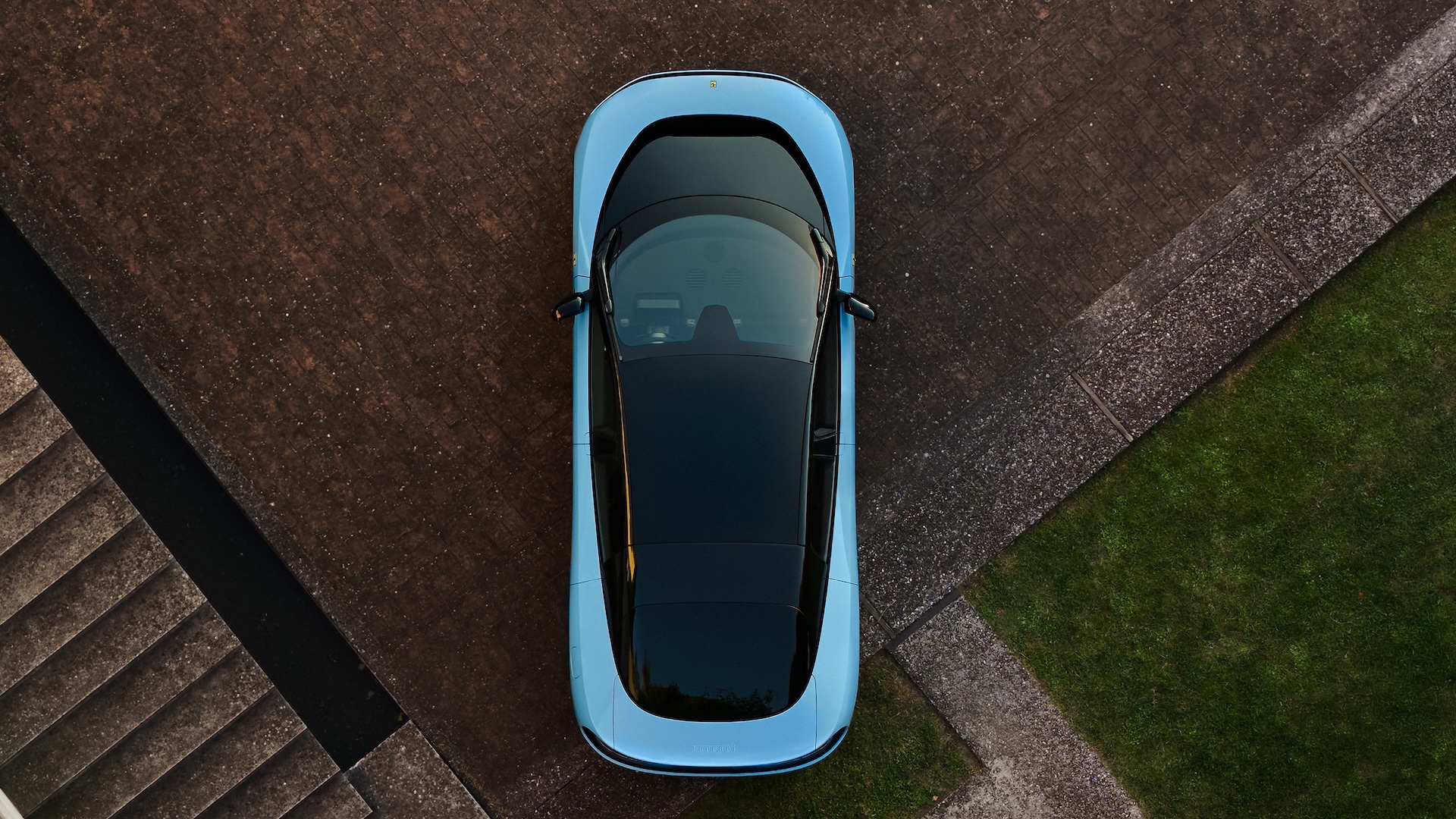
The entire design revolves around what Ferrari calls a “glass house” architecture. The blacked-out passenger cell appears wrapped inside floating aerodynamic wings. Surfaces are deliberately smooth and uninterrupted to minimise drag. Ferrari says this is the slipperiest road car it has ever produced.
The details are equally radical:
- Rear-hinged rear doors
- Transparent lighting panels
- Hidden aerodynamic elements
- Turbine-style aero wheels
- Offset and upright parked windscreen wipers
- Massive 23-inch front and 24-inch rear aero wheels
Those wheel sizes are enormous even by modern supercar standards, and underline just how radically different the Luce is from any previous Ferrari. Yet somehow, despite the unconventional shape, the Luce still carries some familiar Ferrari touches. The halo tail lights reference the 360 Modena and 458 Italia.
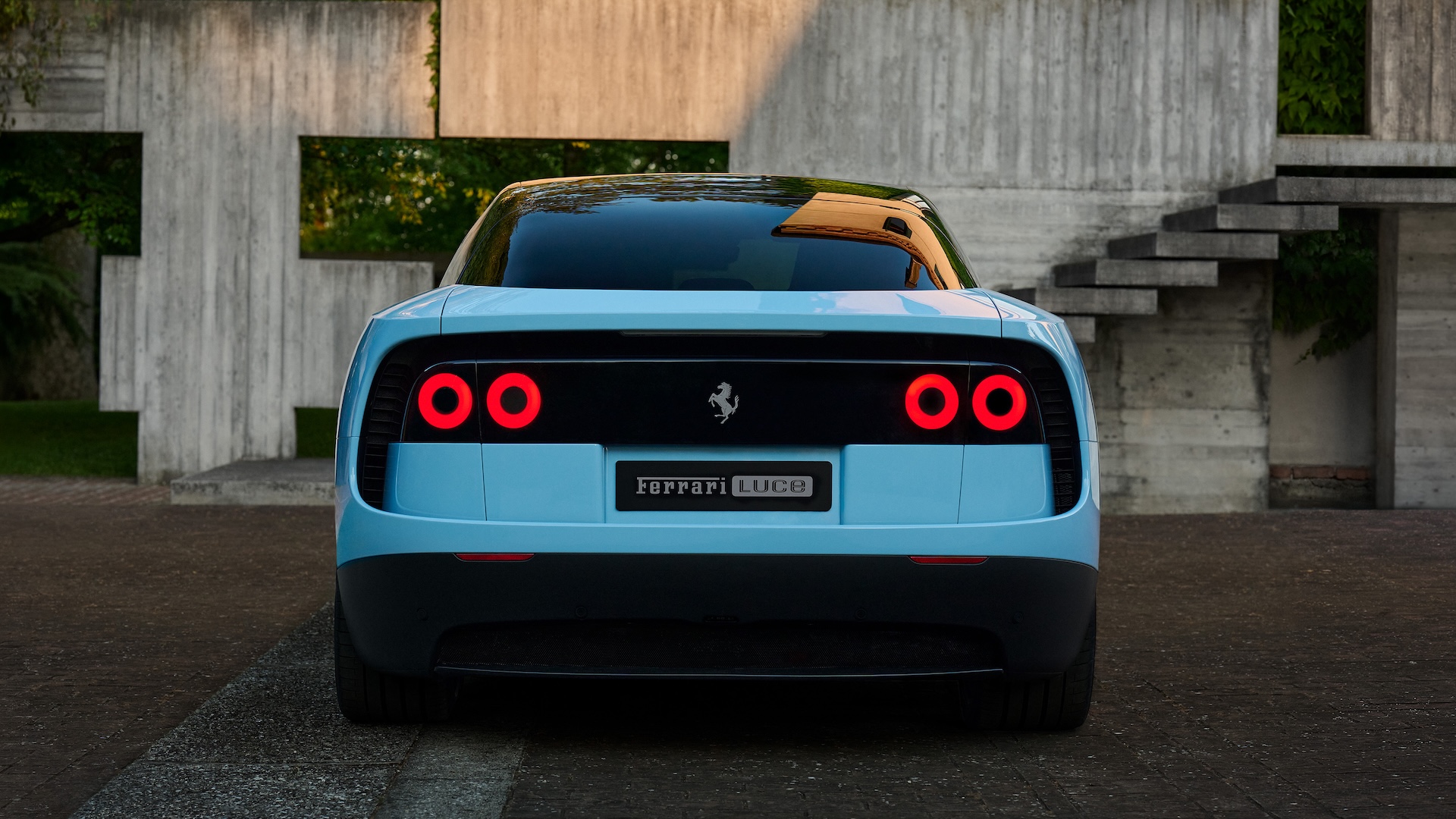
At about 50mm longer than the Ferrari Purosangue, the proportions still feel aggressive. It just expresses performance in an entirely new visual language.
Is The Ferrari Luce A Five-Seater?
This is also the first Ferrari ever with five seats. That became possible because the dedicated EV architecture eliminated the need for a central transmission tunnel and rear transaxle layout. The result is a spacious flat-floor cabin that Ferrari claims feels significantly larger inside than the exterior suggests.
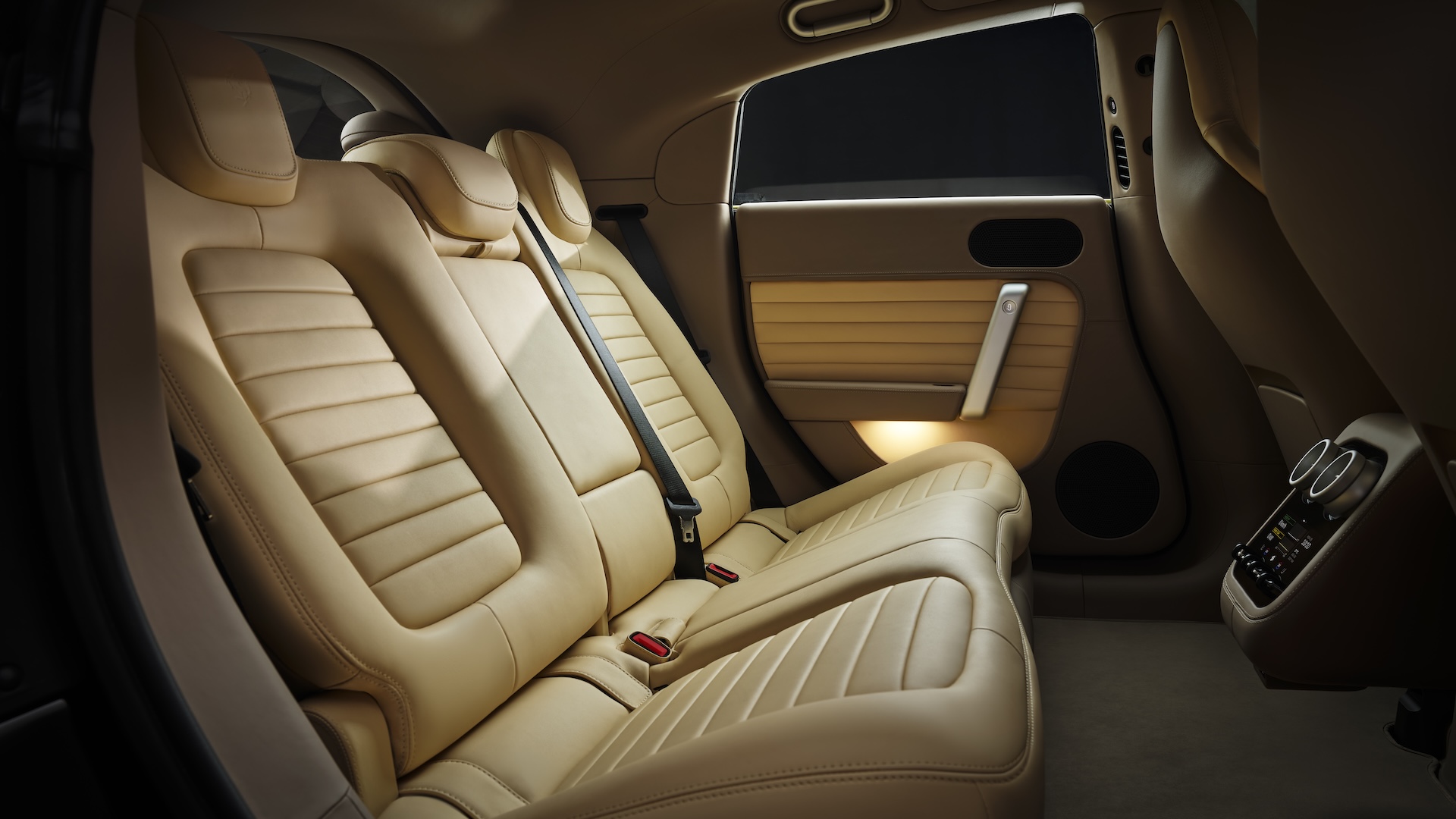
And unlike many modern EV interiors that prioritise minimalism at the expense of character, the Luce’s cabin still feels dramatic.
What Does The Interior Look Like?
Minimalistic, classy, and niche, the Ferrari Luce’s interior stands apart in a crowd of traditionally styled luxury-performance cabins. Ferrari combined tactile physical controls with OLED displays instead of going full touchscreen.
The steering wheel looks like a throwback to some classic racing Ferraris. It is machined from 100% recycled aluminium, features analogue toggles and controls, and houses both the traditional Manettino and new e-Manettino. Behind the steering wheel are brake regen and torque-control paddles instead of fake gearshift simulation.
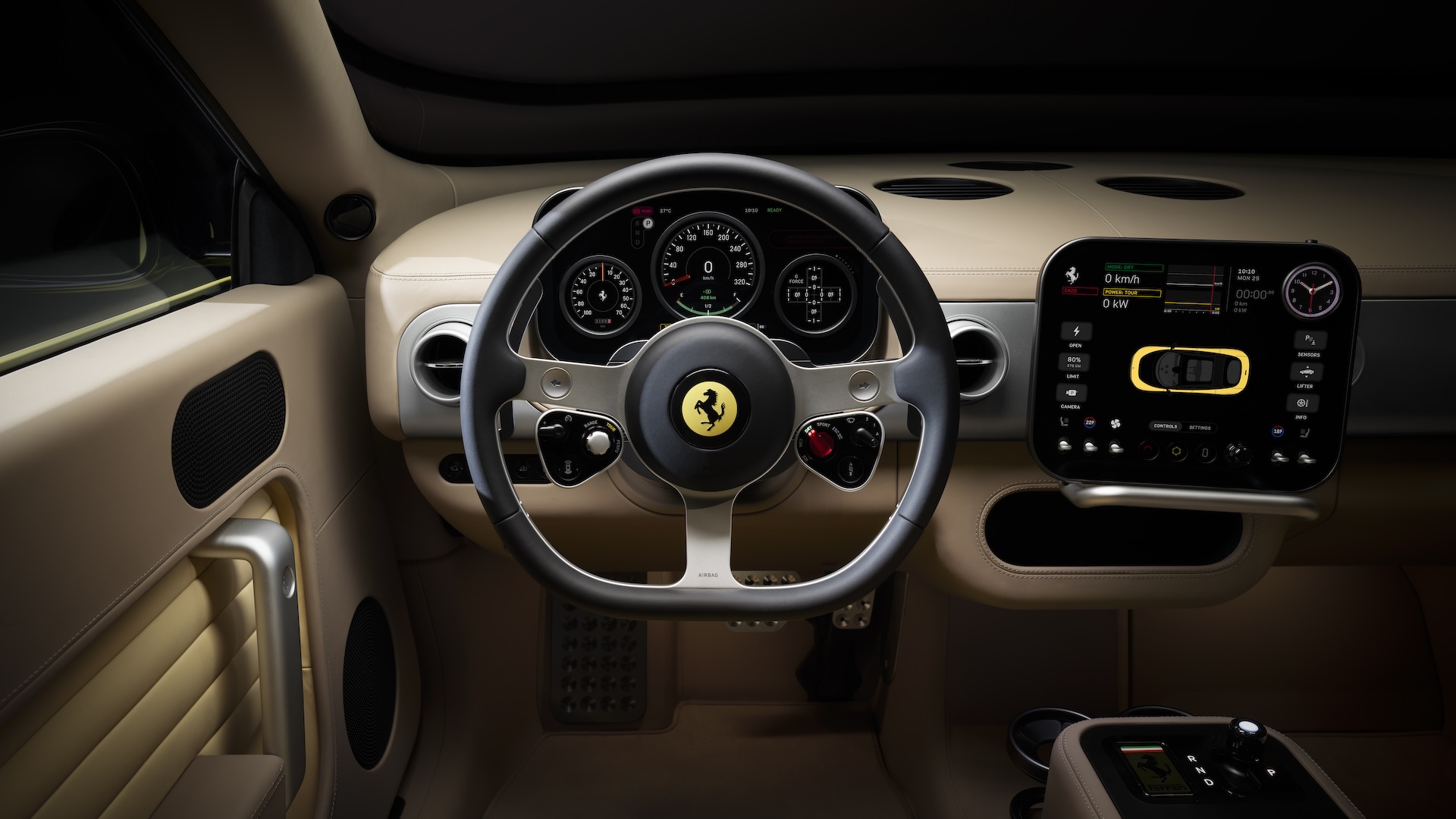
The dashboard features multiple OLED screens developed with Samsung Display, including:
- 12.9-inch driver display
- 12-inch central touchscreen
- 6.3-inch rear passenger display
The centre touchscreen can be moved to pivot toward the driver or passenger. Launch control is activated using a physical overhead pull handle inspired by helicopter controls. The key itself uses E Ink technology and docks into the console to start the car. Very dramatic indeed. The level of detail and experimentation throughout the cabin makes the Luce feel unusually close to a concept car brought faithfully into production.
How Powerful Is The Ferrari Luce?
The Ferrari Luce produces a staggering 1,036hp from four electric motors, one at each wheel. Performance figures are properly serious:
- 0–100 km/h: 2.5 seconds
- 0–200 km/h: 6.8 seconds
- Top speed: over 310 km/h
- Battery: 122kWh
- Range: over 530 km
- 800V architecture
- DC fast charging: up to 350 kW
To put the numbers into perspective, the fastest accelerating Ferrari, the SF90 XX Stradale is only 0.2 seconds faster to 100km/h than the Luce! The Luce’s front motors spin to 30,000 rpm. The rear motors reach 25,500 rpm. Ferrari says the system can go from zero to maximum rotational speed in under a second. The really clever part is how Ferrari handles torque delivery.
Is The Ferrari Luce Engaging For Drivers?
Modern high-performance EVs are already extraordinarily fast. The real challenge now is emotional engagement and driver connection. Ferrari seems obsessed with solving that problem.
The Luce introduces something called Torque Shift Engagement. Instead of simulating fake gear changes, the right paddle progressively unlocks torque delivery in five stages, while the left paddle adjusts regenerative braking intensity.
Rather than delivering a single uninterrupted surge of acceleration, the Luce introduces a more progressive and interactive approach to power delivery. That sounds far more Ferrari-like than fake V12 noises blasted through speakers. Although technically, the Luce still has its own soundtrack.
Does The Ferrari Luce Have Fake Engine Sounds?
Technically, it’s not fake. Ferrari’s approach to EV sound engineering is refreshingly technical. Instead of synthesising fake V8 noises, Ferrari uses precision accelerometers mounted inside the drivetrain to capture the real vibrations and harmonics generated by the electric motors and driveline. That sound is then processed and amplified naturally, quite like a guitar amplifier, but a lot more advanced.
The resulting sound changes depending on drive mode:
- Range mode prioritises silence
- Tour mode balances refinement
- Performance mode unleashes maximum sonic drama
Crucially, Ferrari says the sound remains authentic because it originates from the actual mechanical components. It’s an engineering-led solution to a problem most manufacturers address with synthetic soundtracks.
The Technology Underneath Is Wild
The Luce is powered by four independently controlled permanent magnet synchronous motors derived from Ferrari’s F80 hypercar programme. Each wheel effectively gets its own brain, with one actuator each to control traction and regeneration, steering angle, and vertical movement.
That means the Ferrari Luce can independently manage acceleration, braking, steering, torque vectoring, and suspension behaviour at each corner of the car in real time. At the centre of it all is a brand-new Vehicle Control Unit updating targets 200 times per second!
Ferrari claims the Luce achieves a centre of gravity 95mm lower than the Purosangue and a yaw inertia figure equivalent to a car roughly 400kg lighter. That matters because the Luce still weighs 2,260 kg. Which is heavy by Ferrari standards, but surprisingly restrained for a five-seat EV with a 122kWh battery.
How Comfortable Is The Ferrari Luce?
Despite all its performance claims, Ferrari says the Luce is also the most comfortable road car it has ever built. The car introduces Ferrari’s first elastically mounted rear subframe and active suspension derived from the F80. It also features extensive NVH optimisation, double-glazed surfaces, special aero-acoustic tuning, and advanced vibration filtering systems.
There’s also a 21-speaker, 3,000-watt audio system featuring Ferrari Audio Signature technology with multiple listening modes and seat-specific optimisation.
Is The Ferrari Luce Still A Real Ferrari?
This is the question every petrolhead is asking, and understandably so. Ferrari seems fully aware of the pressure and the intensity of this question. The folks at Maranello didn’t try to mimic an ICE Ferrari. It didn’t build an electric 812 Superfast clone. Instead, it used electrification to create something impossible with combustion architecture:
- Five seats
- Flat floor
- Lower centre of gravity
- Independent wheel control
- Massive cabin space
- Active aero integration
- Extreme torque vectoring
The Luce is not pretending to be yesterday’s or today’s Ferrari. It’s trying to define tomorrow’s Ferrari and will cater to a niche audience.
Ferrari enthusiasts have historically been resistant to major technological shifts. This includes automatic gearboxes starting with the Ferrari 400 in 1976, turbocharging on the Ferrari 208 GTB Turbo in 1982, DCTs on the Ferrari California in 2008, hybridisation with the LaFerrari in 2013, and now full electrification with the Ferrari Luce in 2026.
For those not interested, Ferrari will continue to produce petrol-powered supercars and hypercars. But for those looking to stand out and be unique, the Luce is here. It’s ambitious. Risky. Technically fascinating. And deeply engineered. Which, ironically, makes it feel very Ferrari indeed.