

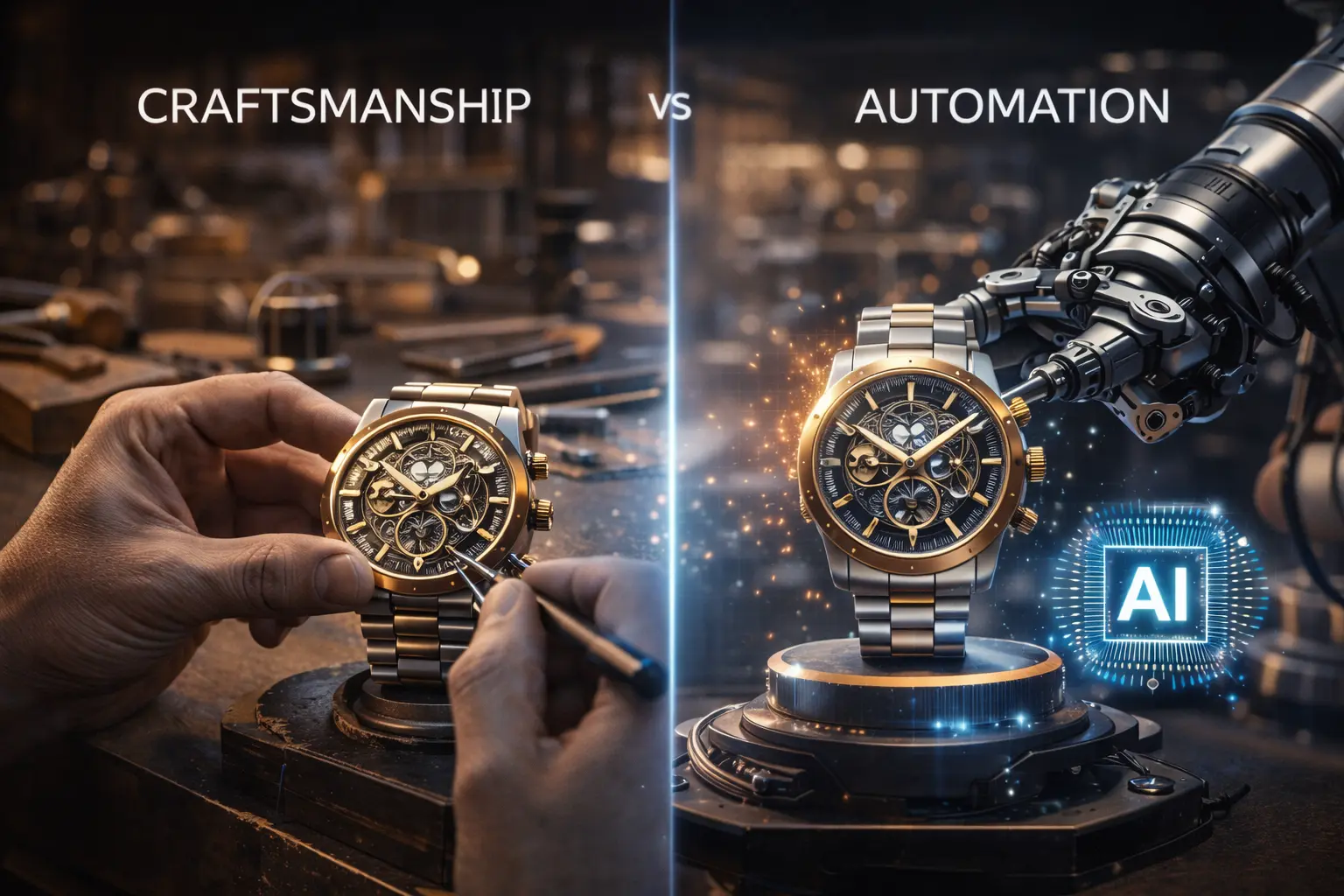
When a watchmaker spends 800 hours crafting a tourbillon by hand, does it matter if AI designed the movement? When a Ferrari’s aerodynamics are perfected by algorithms, does human artistry still exist? The luxury industry faces its most profound philosophical challenge in centuries.
The Fundamental Tension
Luxury has always been defined by three pillars:
- Human mastery – The irreplaceable skill of artisans
- Time investment – Hours, weeks, months of dedicated labour
- Scarcity – Limited production ensuring exclusivity
Artificial intelligence threatens-or enhances, depending on your perspective-all three.
The question isn’t whether AI will transform luxury production. It already has. The question is: at what point does optimisation become betrayal?
What We’re Really Asking
This debate touches something deeper than production methods. It forces us to confront uncomfortable questions about value, authenticity, and what makes something truly “luxury.”
The Core Dilemmas
Question 1: If AI designs a watch movement more accurate than any human could conceive, is it less valuable because no master watchmaker sketched it?
Question 2: If a craftsperson uses AI to perfect their work, eliminating errors that human hands would make, is the result more or less authentic?
Question 3: When machines can replicate artisanal techniques perfectly, does the human element still matter-or does it become mere theatre?
Question 4: If AI enables more people to access quasi-luxury goods, does true luxury become more exclusive or lose its meaning entirely?
There are no easy answers. But the conversation is essential.
The Case for Tradition: What We Risk Losing
The Romance of Human Imperfection
The Watchmaker’s Argument:
Philippe Dufour, legendary independent watchmaker, has said that each watch he creates carries his fingerprint-not literally, but spiritually. The microscopic irregularities, the subtle variations between pieces, and the knowledge that human hands shaped every component.
“When you look at my work under a microscope,” he explains, “you see humanity. AI sees optimisation. These are not the same thing.”
What’s at stake: The connection between maker and object. The story is embedded in every scratch, adjustment, and decision. The knowledge that what you own requires irreplaceable human expertise.
Heritage and Historical Continuity
Patek Philippe’s Philosophy:
The Geneva-based manufacturer emphasises “unbroken tradition since 1839.” Their craftspeople learn techniques passed down through generations. When AI enters the equation, does that chain break?
The concern isn’t irrational nostalgia-it’s about preserving knowledge systems that took centuries to develop. If AI replaces master craftspeople before apprentices learn their secrets, those skills die forever.
The broader risk: Entire craft traditions vanishing within a single generation. Once the knowledge is lost, no amount of AI can reconstruct the nuance of techniques learned through decades of practice.
The Job Displacement Crisis
The Human Cost:
Luxury industries employ millions globally:
- Italian leather craftspeople in Tuscany
- Swiss watchmakers in the Vallée de Joux
- British coachbuilders in Crewe
- Japanese master knife makers in Seki
AI-driven automation doesn’t just threaten jobs- it threatens entire communities built around centuries-old crafts.
The counter-argument often goes: “AI creates new jobs.” But tell that to a 55-year-old master leather worker whose skills become obsolete. Retraining isn’t always realistic, and the new roles rarely offer the same dignity, compensation, or satisfaction.
The Authenticity Question
What Makes Luxury “Real”?
Consumer psychology research shows luxury buyers pay premiums for:
- Perceived scarcity – “Only 50 made worldwide”
- Human touch – “Hand-finished by master craftspeople”
- Heritage – “Made the same way since 1895”
If AI handles design, optimisation, and quality control, with humans merely assembling components, has the fundamental value proposition changed?
The existential concern: When storytelling becomes marketing fiction-when “handcrafted” means “assembled by hand from AI-designed, machine-made components”-does the entire luxury contract break?
The Case for Innovation: What We Stand to Gain
AI as the Ultimate Tool
The Craftsperson’s Enhancement:
Not everyone sees AI as a threat. Many master artisans view it as the ultimate tool-like, enhancing carpentry without replacing carpenters.
Horst Münzlinger, master engraver at A. Lange & Söhne:
“AI helps me visualise complex designs before I commit to metal. It calculates how light will interact with surfaces. It prevents mistakes that would waste weeks of work. But the engraving? That’s still my hand, my eye, my decades of experience. AI makes me more ambitious, not less essential.”
The enhancement argument: AI doesn’t replace craftsmanship-it removes tedious parts, allowing artisans to focus on where human judgment matters most.
Democratizing Excellence
Breaking Down Barriers:
Historically, luxury was geographically constrained. Want to learn Swiss watchmaking? Move to Switzerland, apprentice for a decade, and hope a master accepts you.
AI changes this:
- Knowledge access – Techniques once guarded can be learned globally
- Simulation – Practice virtually before touching precious materials
- Collaboration – Master craftspeople in Tokyo can guide apprentices in Mumbai via AI-enhanced video
The democratization argument: AI makes excellence more accessible, increasing overall quality across the industry rather than hoarding knowledge among the elite.
Sustainability Through Optimisation
The Environmental Imperative:
Luxury production is often wasteful:
- Trial and error with expensive materials
- Inefficient manufacturing processes
- Over-production to ensure quality standards
- Transportation for multi-stage production
How AI helps:
- First-time-right design – Fewer prototypes, less waste
- Material optimisation – Use 30% less gold/platinum/carbon fibre
- Energy efficiency – Optimal production sequences
- Localised production – AI enables smaller, distributed facilities
Bugatti’s example: Their AI-optimised brake callipers use titanium 40% more efficiently while maintaining performance. That’s significant when titanium mining is environmentally destructive.
The sustainability argument: In an age of climate crisis, can we justify luxury production methods that waste resources simply to preserve tradition?
Superior Performance Through AI
When Excellence Requires Algorithms:
Some achievements are simply impossible without AI:
Koenigsegg’s topology-optimised parts – Stronger, lighter, more efficient than any human could design. The AI explores millions of configurations humans would never conceive.
Zenith’s AI-refined oscillators – Watch movements with timing accuracy beyond what manual adjustment achieves. Physics, not poetry.
Rolls-Royce’s AI-balanced engines – Vibration reduction that makes the cabin quieter than traditional methods allow.
The performance argument: If AI creates objectively superior products, isn’t rejecting it prioritising sentiment over excellence?
Preserving Craft Through Economic Viability
The Business Reality:
Many luxury houses face existential pressure:
- Rising labor costs
- Skills shortage (few young people entering traditional crafts)
- Competition from mass-market alternatives
- Economic pressures during downturns
The paradox: AI might be what keeps traditional crafts viable. By handling low-value tasks and improving efficiency, AI frees human craftspeople to focus on high-value work that justifies premium pricing.
MB&F’s experience: The independent watchmaker uses AI for movement design but employs traditional artisans for finishing. The AI enables them to remain profitable while paying master craftspeople fair wages. Without AI efficiency, they’d likely close.
The pragmatic argument: Reject AI and watch luxury brands go bankrupt, taking traditional jobs with them. Embrace AI and preserve space for human excellence.
Where the Industry Stands: Real Positions from Real Brands
The Purists
Brands maintaining traditional methods:
F.P. Journe: Minimal AI, maximum handwork. François-Paul Journe insists on traditional techniques, believing the soul cannot be coded.
Pagani: Horacio Pagani uses modern tools but maintains that “art cannot be computed.” Human designers lead, technology follows.
Hermès: Leather goods remain predominantly handcrafted. AI may optimise logistics, but not creation.
Their philosophy: Luxury exists in opposition to efficiency. The point is the human investment, not the optimal outcome.
The Hybrid Approach
Brands blending AI and craft:
Rolex: AI-powered precision manufacturing produces components to tolerances impossible by hand, then master watchmakers assemble and regulate. The brand calls it “superlative chronometer accuracy through harmonious integration.”
Porsche: AI designs aerodynamics and chassis; human designers refine aesthetics and driving feel. Engineers and AI collaborate throughout development.
Vacheron Constantin: AI assists in movement design; traditional craftspeople handle finishing, polishing, and decoration.
Their philosophy: AI and humans excel at different things. Combining both achieves results neither could alone.
The Innovators
Brands embracing AI fully:
Richard Mille: Aggressively adopts advanced manufacturing, AI design, and cutting-edge materials. The brand argues modern luxury should showcase contemporary human achievement, not just preserve past methods.
Rimac: The electric hypercar manufacturer treats AI as fundamental. Mate Rimac says, “We’re not building cars the way they were made in 1960 because that’s not excellence-it’s nostalgia.”
Czapek: The independent watch brand uses AI for movement optimisation while maintaining transparency with customers about their methods.
Their philosophy: Luxury should represent the pinnacle of human capability-and today, that includes AI.
The Philosophical Middle Ground
Can We Have Both?
Perhaps the answer isn’t choosing sides but redefining categories.
Tier 1 – Pure Tradition:
- Extremely limited production
- No AI involvement
- Premium pricing reflecting pure handwork
- Marketed to collectors valuing heritage above all
Tier 2 – Enhanced Craftsmanship:
- AI-assisted human work
- Transparency about which elements involve AI
- Balance of efficiency and artistry
- The majority of the luxury market
Tier 3 – Technology Showcase:
- AI-forward design and production
- Human oversight and quality control
- Celebrating contemporary innovation
- Appeals to tech-forward luxury consumers
The key: Honest labelling. Let consumers choose based on transparent information about production methods.
The Transparency Imperative
The Ethics of Disclosure
The current problem: Many luxury brands use AI extensively, but maintain traditional marketing language:
- “Handcrafted” when AI designs, and machines manufacture components
- “Master watchmaker” is mostly doing assembly and quality control
- “Traditional methods” when AI optimisation is fundamental
The ethical path forward:
Full disclosure: Brands should clearly communicate:
- Which aspects involve AI design or optimization
- Where traditional human craftsmanship applies
- What “handmade” actually means in their context
- How much human time investment does each piece requires
Czapek’s transparency: The brand openly discusses its hybrid approach, explaining precisely where AI assists and where human judgment dominates. Customer reception? Overwhelmingly positive. Honesty builds trust.
The principle: Consumers can accept AI in luxury. What they can’t accept is deception.
The Consumer’s Dilemma
What Should Buyers Value?
For the traditional collector:
- Prioritise brands transparent about traditional methods
- Accept higher prices and longer wait times
- Support independent makers maintaining craft heritage
- Your money votes for preserving traditional skills
For the performance-focused buyer:
- Embrace brands using AI for superior products
- Value measurable excellence over production methods
- Support innovation and technological advancement
- Your money votes for pushing boundaries
For the pragmatic buyer:
- Seek brands offering hybrid approaches
- Demand transparency about production methods
- Balance heritage with innovation
- Your money votes for thoughtful integration
The key: Know what you value and support brands aligning with those values.
Future Scenarios: Where This Could Go
Scenario 1: The Split (Likely)
The luxury market divides into distinct tiers:
- Ultra-luxury traditional – Pure handcraft, AI-free, extreme pricing
- Mainstream luxury – Hybrid AI-human production, transparent about methods
- Tech luxury – AI-forward, celebrating innovation
Outcome: Choice and clarity. Consumers select based on preferences.
Scenario 2: The Hybrid Victory (Optimistic)
Industry consensus emerges around ethical AI integration:
- Clear standards for labelling and transparency
- AI handling optimisation; humans handling artistry
- Traditional crafts preserved in educational institutions
- New appreciation for human-AI collaboration
Outcome: Evolution without losing heritage.
Scenario 3: The Automation Slide (Pessimistic)
Economic pressure drives full automation:
- Traditional crafts become extinct
- “Luxury” becomes pure marketing over substance
- Skilled artisans displaced with no alternative
- Loss of cultural heritage
Outcome: Efficiency wins; something precious is lost forever.
Scenario 4: The Rebellion (Possible)
Consumer backlash against AI creates a new premium on human-only production:
- Verified human-made certification becomes highly valuable
- AI-produced items considered inherently inferior
- Craft revival as younger generation rejects automation
- Luxury splits from technology entirely
Outcome: Return to fundamentals driven by market demand.
Actionable Principles: A Proposed Framework
For Luxury Brands
1. Radical transparency
- Disclose AI involvement clearly
- Define terms honestly (“handcrafted” means what?)
- Let customers make informed choices
2. Preserve knowledge
- Document traditional techniques
- Train apprentices even while using AI
- Maintain institutional craft expertise
3. Invest in people
- Retrain workers displaced by automation
- Create new roles combining AI and craft
- Protect communities built around traditional production
4. Define your position
- Choose your philosophy deliberately
- Communicate it consistently
- Stand by your choices
For Consumers
1. Know your values
- What matters most to you about luxury?
- Performance? Heritage? Story? Innovation?
2. Ask questions
- How was this made?
- What role did AI play?
- Where did human skill apply?
3. Vote with your wallet
- Support brands aligned with your values
- Reward transparency
- Reject deceptive marketing
4. Stay curious
- Learn about production methods
- Understand the craft
- Appreciate both tradition and innovation
For Society
1. Support craft education
- Fund apprenticeships
- Preserve traditional knowledge
- Value skilled trades
2. Demand ethical AI
- Transparent algorithms
- Human oversight
- Worker protections
3. Balance progress with preservation
- Innovation doesn’t require destruction
- Heritage has value beyond economics
- Some knowledge is worth protecting
The Verdict: Finding Wisdom in Nuance
There is no single answer to “AI vs. Craftsmanship” in luxury.
Both extreme positions, pure rejection or uncritical embrace, miss essential truths.
The wisdom lies in nuance:
- AI can enhance craftsmanship without replacing it
- Transparency matters more than purity
- Different approaches can coexist
- Economic viability enables cultural preservation
- Performance and heritage both have value
- Consumers deserve honest information
- Workers deserve dignity and protection
- Heritage deserves respect and preservation
The path forward: Thoughtful integration, honest communication, and respect for both innovation and tradition.
Luxury isn’t about choosing between past and future. It’s about honouring the best of both while building something worthy of the name.
The brands that thrive will be those that navigate this tension with wisdom, integrity, and transparency. The consumers who find satisfaction will be those who understand what they’re buying and why it matters to them.
And the craftspeople who flourish will be those who see AI not as enemy or saviour, but as a tool-powerful, transformative, but ultimately subordinate to human judgment, creativity, and soul.
The conversation isn’t over. It’s just beginning.
Key Takeaways
- AI in luxury creates tension between tradition, performance, and ethics
- Traditional craftsmanship risks job displacement and lost heritage
- AI enables superior performance, sustainability, and democratized access
- Most successful brands adopt hybrid approaches combining AI and human skill
- Transparency about production methods is an ethical imperative
- Consumer choices should be informed by clear understanding of what “luxury” means to them
- The future likely includes multiple tiers: pure tradition, hybrid, and AI-forward
- Preserving craft knowledge requires deliberate investment even while adopting technology
- No single answer exists-wisdom lies in thoughtful integration and honest communication