

The raging bull logo that Lamborghini has carried since its founding in 1963 has never been just a fancy symbol without a foundation to support. This bull—perhaps the most striking of all, past, present, and likely future—does not act rashly or randomly, as some might imagine. Over more than sixty years, Lamborghini has shaped it into a symbol of intelligence and purposeful strength, responding with absolute wisdom when faced with significant challenges.
 How could it be otherwise? When the newborn Sant’Agata factory succeeded in 1964 in creating a car capable of being a direct challenge to the “Red Queen” Ferrari.
Over the years, Lamborghini has never shied away from challenges. With each new model, the company has faced different circumstances and obstacles. Yet one thing has remained constant: every new Lamborghini surpasses its predecessor.
 After the 350 GTV came the Miura, followed by the Countach, Diablo, Murciélago, Gallardo, Aventador, Huracán—and now, Temerario.
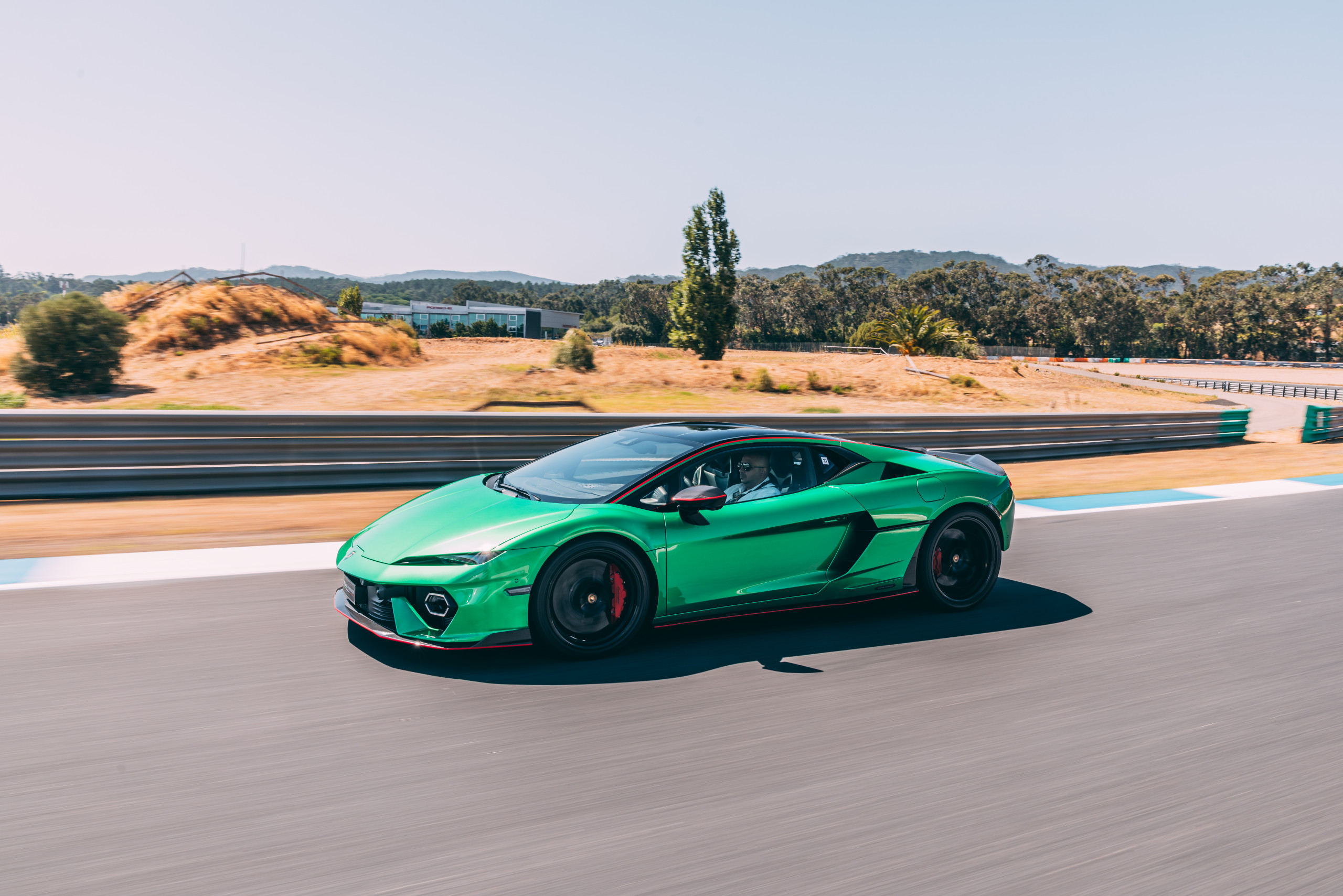
Today, we’re putting Lamborghini’s latest engineering masterpiece through its paces at the legendary Estoril Circuit in Portugal. Following the footsteps of Revuelto, the Temerario moves into a new electrified era while continuing to embody the visceral excitement that defines every Lamborghini.
 Like all Lamborghinis, the Temerario is unapologetically bold. While tightening global emissions regulations have led to the retirement of Lamborghini’s beloved naturally aspirated V10, the Temerario responds with a sophisticated hybrid powertrain that combines raw mechanical force with futuristic control. It combines a twin-turbocharged V8 engine with three electric motors to produce a staggering 920 horsepower, yet retains the brand’s hallmark driving engagement.
 The hybrid system is more than just a compliance tool—it’s a performance enhancer. With the rear axle delivering most of the power from the V8 and the front axle driven exclusively by two electric motors, the Temerario offers a handling experience that feels incredibly agile and connected. The front motors act as intelligent assistants, subtly enhancing cornering precision, stability, and traction. The result is a car that feels sharper, more composed, and more unified—whether you’re carving through back roads or pushing the limit on a closed circuit.
 Despite its advanced technology, the driving experience remains unfiltered. Lamborghini’s engineers have worked meticulously to ensure that the hybrid system doesn’t dull the emotional connection between the driver and the machine. The feedback from the chassis, the way power builds, and even the soundscape, all have been fine-tuned to maintain the brand’s iconic, almost primal, driving feel.
But make no mistake: while the electronics may quietly optimise every input, the Temerario still puts the driver at the centre of the action. In typical Lamborghini fashion, it’s engineered to give the impression that you are the one in control, even if a suite of intelligent systems is working behind the scenes. For purists and track-day enthusiasts, a complete electronic override mode is available, enabling skilled drivers to turn off the assistance systems and experience the Temerario as a raw, 900+ horsepower beast.
 Behind the driver’s seat is a 4.0-litre twin-turbo V8, capable of running past 10,000 rpm. It’s been engineered not just for output but for character. Lamborghini invested heavily in acoustics and exhaust tuning to ensure that the Temerario sounds as feral and unmistakable as its predecessors.
Mated to the V8 is a trio of electric motors. One is sandwiched between the engine and the dual-clutch transmission, while the other two independently power the front wheels for a Total system output of 920 hp.
Inside the Temerario, Lamborghini has adopted a jet cockpit approach, but with enhanced visibility and improved driver ergonomics. One of the common criticisms of the Huracán was the compromised visibility and rearward driver placement. In the Temerario, this has been addressed through a revised driving position and thinner A-pillars.
 The cabin blends futuristic tech with motorsport functionality. Carbon fibre is used extensively throughout, and buyers can choose between two seating configurations: Classic and Sport. Both feature ultra-slim, lightweight construction and integrated bolstering for high-performance driving, yet maintain surprising comfort for daily usability.
Three high-resolution screens dominate the dashboard. The primary digital cluster provides real-time telemetry and performance data. The central infotainment screen manages navigation, media, and drive modes, while a third screen, positioned in front of the passenger, creates a co-pilot experience, displaying performance metrics or entertainment controls.
The Lamborghini Temerario is not just a new model—it’s a manifesto. It proves that electrification doesn’t have to mean the end of excitement, drama, or soul. Instead, it can enhance them in ways previously impossible.