

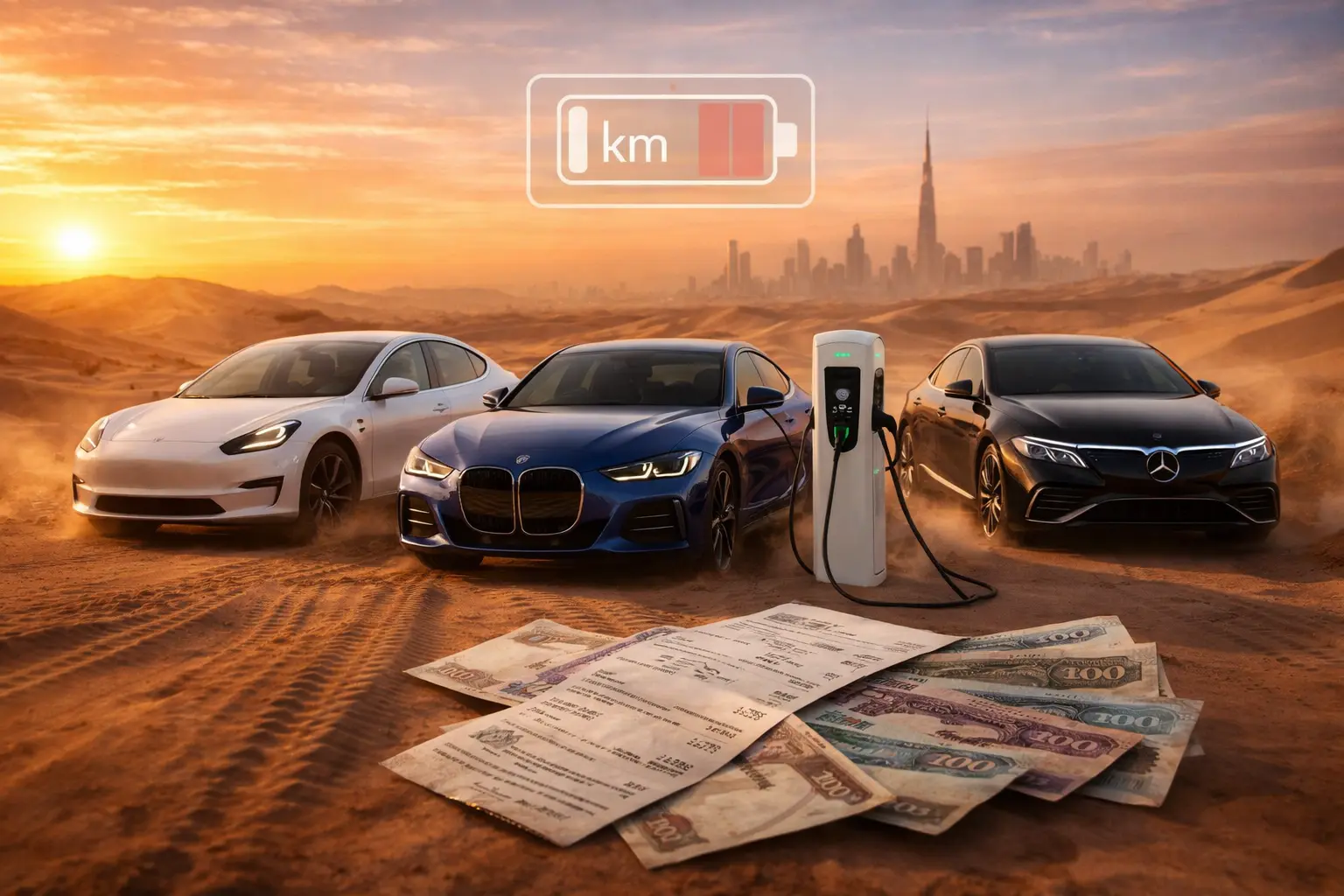
Owning an EV in the UAE in 2026 is genuinely practical – but only if you go in with accurate expectations. The range on the brochure is not what you will see in a UAE summer. The charging network is growing fast but still has real gaps. And there are government perks nobody tells you about that can save you thousands of dirhams a year. This guide covers all of it.
Why 2026 Is the Year to Actually Consider Going Electric in the UAE
For years, the honest answer to “should I buy an EV in Dubai?” was: maybe wait. Range anxiety was real. Charging infrastructure was thin. And the summer heat made battery performance deeply unpredictable.
That answer has changed.
The UAE’s EV landscape in March 2026 looks fundamentally different from even two years ago. Dubai’s DEWA Green Charger network has expanded to over 1,860 charging points across the emirate. ADNOC has launched what is now one of the world’s largest superfast EV charging hubs on the Abu Dhabi–Dubai corridor. Battery technology – particularly BYD’s Blade Battery and Hyundai’s 800V thermal architecture – has meaningfully improved heat resilience. And the government’s financial incentives continue to deliver real annual savings.
None of this means EVs are for everyone. But the honest picture in 2026 is more compelling than the narrative that EV sceptics are still using. Here is the full story – including the things most car review sites leave out.
The Real Range Question: What the Brochure Won’t Tell You
What You’re Quoted vs. What You Get
Every EV you consider in the UAE will carry a range figure – usually a WLTP number, sometimes a more optimistic CLTC figure if the car originates from China. Both are measured in controlled laboratory conditions. Neither is what you will experience on Sheikh Zayed Road in July with four people and the air conditioning running at full blast.
The truth: UAE summer conditions typically reduce real-world range by 10–18% compared to the official figure. The primary culprits are:
- Air conditioning load. Cooling a cabin from 50°C to 22°C is an enormous draw on the battery. This is the single biggest range factor in the UAE, far exceeding what drivers in European markets ever experience.
- Highway speeds. UAE motorways cruise at 120–140 km/h. Wind resistance increases exponentially with speed. A car rated at 500 km on a controlled test cycle at 90 km/h will lose 20–25% of that figure at sustained highway speeds.
- Battery temperature. Lithium-ion cells operate most efficiently between 15°C and 35°C. Parked cars in the UAE can reach internal temperatures of up to 70°C, accelerating chemical reactions inside the battery and reducing both immediate range and long-term capacity.
Which EVs Handle UAE Heat Best?
Not all thermal management systems are equal, and this distinction matters enormously in the Gulf. The models that hold up best in UAE conditions are those with active liquid cooling for their battery packs:
- Tesla Model 3 / Model Y – Tesla’s liquid-cooled battery management is among the most sophisticated available and has been validated in UAE conditions over several years of real-world ownership.
- BYD Seal / Atto 3 – BYD’s Blade Battery (LFP chemistry) is specifically designed for thermal resilience. It has demonstrated minimal degradation under extreme heat conditions in independent testing.
- Hyundai Ioniq 5 and Ioniq 6 / Kia EV6 – The 800V architecture on these models actively manages battery temperature under fast charging and high-speed driving, making them particularly well-suited to Dubai-to-Abu Dhabi style highway runs.
- Lucid Air – Arguably the most heat-engineered premium EV available in the UAE. The Lucid Air Grand Touring’s 830 km rated range drops to approximately 680–700 km in UAE summer conditions – still among the best real-world figures available.
Battery Degradation in the UAE: The Long-Term Reality
Across large 2024–2026 datasets, the normal EV battery degradation rate works out to roughly 1.5–2.5% capacity loss per year under average conditions globally. In the UAE, extreme heat can accelerate this – but modern battery chemistry has improved substantially.
A 2026 study published in Nature Climate Change found that newer battery technologies resist heat-induced degradation far better than older chemistries, with equatorial and Middle Eastern regions seeing some of the biggest lifespan gains from these improvements. The caveat is management: batteries subjected to frequent DC fast charging in peak afternoon heat, parked in direct sun, and regularly charged to 100% will degrade faster than the average.
Practical tips for UAE EV owners:
- Charge overnight or in the early morning, not during peak afternoon heat
- Keep daily charge limit at 80% unless you need full range that day
- Park in shaded or covered parking wherever possible – this matters more in UAE than in any other climate
- Avoid fast charging from near-empty to 100% repeatedly; this is harder on cells than moderate, regular top-ups
The UAE Charging Network in March 2026: What’s Actually There
Dubai: The Most Developed Network in the Region
Dubai’s charging infrastructure has reached a level where daily EV ownership is genuinely practical for most residents. Key figures as of March 2026:
- DEWA Green Charger network: Over 1,860 charging points across Dubai, with approximately 23,600 registered users. DEWA supplies four charger types – ultra-fast, fast, public AC, and wall-box units.
- Target: DEWA has announced a plan to expand to 10,000 stations by December 2026 as part of a AED 2 billion investment.
- Charging costs (current DEWA rates): AC charging at AED 0.29/kWh (approximately AED 20 for a full charge), DC fast charging at AED 0.48/kWh (approximately AED 35 for 80%), ultra-fast (150kW+) at AED 0.55/kWh.
- Home charging: Standard DEWA residential tariff of AED 0.23–0.38/kWh, making overnight home charging the most economical option by a significant margin.
- Location coverage: DEWA locations span residential areas, shopping malls, business districts, and transit hubs. The network is accessible via the DEWA Smart App and 14 integrated digital platforms including DubaiNow.
Abu Dhabi: The Highway Corridor Game-Changer
The most significant UAE infrastructure development of early 2026 happened on the E11 highway. ADNOC Distribution launched one of the world’s sixth-largest superfast EV charging hubs in January 2026 at Saih Shuaib, located directly between Abu Dhabi and Dubai. The hub has 60 high-speed charging points capable of charging most EVs from 0 to 80% in approximately 20 minutes.
ADNOC operates its charging infrastructure through E2GO, a joint venture with TAQA (Abu Dhabi National Energy Company), with over 400 charging points now installed across the UAE. ADNOC and TAQA have set an ambitious goal of 70,000 EV charging stations in Abu Dhabi by 2030.
New Players Expanding Coverage
ForEVo, a new ultra-fast charging provider under the A-100 Group, is deploying 180 kW DC chargers targeting malls, business centres, hotels, and transit points across the UAE. Their chargers deliver 0 to 80% in 15–20 minutes. 50 stations are planned by end of 2026, with the full 200-station network by 2027.
ENOC has partnered with DEWA to expand fast-charging across its service stations and is deploying ultra-fast DC chargers at high-traffic stations in Sharjah, with expansion plans across the emirate.
The Gaps That Still Exist (Being Honest)
Despite rapid progress, some real gaps remain in 2026:
- Inter-emirate driving (particularly to Ras Al Khaimah, Fujairah, and Al Ain) still requires planning. The charger density drops sharply outside Dubai and Abu Dhabi.
- Apartment building charging is improving but inconsistent. Villa owners with a home charger have a far smoother EV ownership experience than apartment residents relying on building or public infrastructure.
- Weekend desert destinations and mountain roads are largely uncharged. If you regularly drive to Hatta, Jebel Jais, or remote desert tracks, range planning becomes important.
Useful apps for UAE EV charging: DEWA Smart App, ADNOC Dist App (E2GO network), ENOC Pay, PlugShare (shows all UAE chargers combined).
The Real Costs: What You Actually Pay in 2026
Fuel Savings: The Clearest Win
The running cost comparison between petrol and electric in the UAE is clear-cut.
A petrol car averaging 12 km/L and covering 20,000 km annually spends approximately AED 4,300/year on fuel at Super 98 prices of AED 2.59/litre (March 2026). A comparable EV on UAE public charging spends approximately AED 1,000–1,500/year. Home charging overnight cuts that further.
On a per-km basis, EV owners spend roughly one-quarter of what petrol drivers pay, according to real-world UAE ownership data.
EV Insurance: The Cost Nobody Mentions
Here is the number that surprises most prospective EV buyers in the UAE: insurance premiums for EVs currently run approximately 10–15% higher than equivalent petrol cars, and some reports put the gap as high as 72% for certain models and insurers.
Why? Repair costs for EVs – particularly battery replacement and high-voltage system repairs – are significantly higher than for internal combustion vehicles, and UAE insurers are still calibrating their actuarial models for EVs. The good news: several UAE banks and insurers have begun competing aggressively for EV business, with tailored policies that cover battery damage, charging equipment, and roadside assistance for out-of-charge situations. Abu Dhabi Commercial Bank offers EV loans at a discounted rate of approximately 1.94%.
Shop around. The insurance premium gap is real, but it is narrowing as the market matures.
Maintenance: Where EVs Win Significantly
EVs have no oil changes, no transmission service, fewer brake replacements (regenerative braking reduces brake wear substantially), and fewer components that wear out under the UAE’s stop-start city driving conditions. This is not a marginal saving – it is a meaningful reduction in the total cost of ownership over three to five years.
The Upfront Cost Reality
The cheapest practical EV available in the UAE in 2026 – the MG ZS EV – starts at approximately AED 115,000. The BYD Atto 3 starts from AED 149,900. Both are significantly more expensive than their petrol-powered equivalents at the same segment.
At the volume end of the market (AED 150,000–220,000), the most compelling value options are the BYD Seal (from AED 149,900), Tesla Model 3 (from AED 170,000–200,000 depending on trim), and Tesla Model Y (from AED 174,900). The Korean options – Hyundai Ioniq 5 and Kia EV6 – offer arguably the best balance of range, charging speed, and real-world build quality, at approximately AED 180,000–220,000.
Government Incentives: Every Perk Available in 2026
Dubai
- Free Salik tag for all new EV registrations (the physical tag is free; standard AED 4 per gate toll applies when passing – the full toll exemption that ran until 2020 is no longer active)
- Free designated parking in specially marked green EV spaces across Dubai; maximum 4-hour limit applies; 14 key locations confirmed by RTA
- Registration fee waivers – approximately 15% discount on vehicle registration and renewal fees for EVs
- Home charger subsidy: AED 10,000 for villa owners, AED 5,000 for apartment buildings with 5+ EVs via DEWA
- Green Auto Loans: UAE banks compete for EV buyers; rates as low as 1.94% from select lenders
Abu Dhabi
- Free public charging available at select ADNOC stations (confirm current eligibility at point of purchase)
- Darb toll system exemptions for registered EVs (check current status with Abu Dhabi authorities, as specific programmes are periodically updated)
- Similar free parking designations at malls and key public locations following Dubai’s model
UAE Federal
- 0% import duty on EVs (confirm current status; applicable until at least late 2025 per previous announcements)
- UAE Net Zero 2050 Strategy and Dubai Green Mobility Strategy 2030 provide long-term policy certainty that these incentive programmes will continue in some form
Best EVs to Buy in the UAE Right Now (March 2026)
| Model | Starting Price (AED) | Rated Range | Best For |
| MG ZS EV | ~115,000 | 320 km | Entry-level, city driving |
| BYD Atto 3 | 149,900 | 410 km | Budget, good heat resilience |
| BYD Seal (FWD) | 149,900 | 570 km | Mid-range performance sedan |
| Tesla Model 3 (RWD) | ~174,900 | 491 km | Best software, Supercharger access |
| Tesla Model Y (RWD) | ~189,990 | 400+ km | Best family EV, cargo space |
| Hyundai Ioniq 5 | ~185,000 | 500 km | Best charging speed, design |
| Kia EV6 | ~220,000 | 528 km | Ultra-fast charging, sporty |
| Polestar 2 | ~200,000 | 540 km | Scandinavian design, performance |
| Lucid Air (base) | ~350,000 | 830 km | Best real-world UAE range |
Prices are approximate UAE market figures as of March 2026. Confirm with dealers for current offers.
Is Living in an Apartment a Problem?
This is the most underreported challenge for UAE EV ownership. Villa residents can install a home wall-box charger (cost: approximately AED 3,500–5,000 for installation plus DEWA approval), which transforms the EV experience. You start every morning with a full charge without ever visiting a public station.
Apartment residents in Dubai are in a more complex situation. Building charging infrastructure varies enormously – some newer developments have EV charging built in, many older buildings do not. Before committing to an EV purchase, verify:
- Whether your building has EV charging or is planning to install it
- Whether DEWA’s apartment building subsidy (AED 5,000 for buildings with 5+ EVs) applies to your building
- The distance to your nearest public DEWA or ADNOC charging point and whether its capacity is adequate
Residents in buildings without home charging who rely entirely on public infrastructure will spend more per km to charge and will need to factor public charging into their daily routine – not necessarily a dealbreaker, but a genuine lifestyle consideration.
The Things Nobody Tells You Before You Buy
1. Tint the glass roof immediately. Tesla’s panoramic glass roof is genuinely impressive but transmits significant heat. Multiple UAE Tesla owners flag this as an immediate post-delivery priority. Proper window tinting on the roof reduces interior temperature dramatically during parking and driving.
2. Pre-cool before you drive. Most 2025–2026 EVs support remote climate pre-conditioning via smartphone app while still plugged in. Use it. Pre-cooling the cabin while connected to the charger means the battery isn’t doing the cooling work during the first 20 minutes of your drive – and reduces the range hit from air conditioning.
3. Apartment building towing is a real issue. If you live in an apartment with no building charging and your battery runs low at night, your overnight option is a public charger or calling a recovery service. Know your nearest 24-hour charging point before you’re in that situation.
4. Resale values are stabilising, not great. Tesla retains approximately 60–65% of value after three years in the UAE – relatively strong. BYD and other Chinese brands are still establishing their resale track records. Budget EV brands can see more than 50% depreciation in five years. This is a meaningful difference in total cost of ownership.
5. The Dubai–Abu Dhabi intercity drive is now genuinely easy. With ADNOC’s Saih Shuaib Megahub on the E11, any EV with 400+ km of real-world range can handle a Dubai to Abu Dhabi return trip without charging. The psychological barrier of the intercity corridor has been largely removed.
Frequently Asked Questions
Is it worth buying an EV in Dubai in 2026?
For most residents with home charging access or a regular workplace charging option, yes. Fuel savings of approximately AED 3,000–4,500 per year, combined with lower maintenance costs and government incentives, make the economics increasingly compelling against mid-range petrol cars.
How much does it cost to charge an EV in the UAE?
At DEWA public stations, AC charging costs AED 0.29/kWh (approximately AED 20 for a full charge) and DC fast charging costs AED 0.48/kWh. Home charging on the DEWA residential tariff (AED 0.23–0.38/kWh) is the cheapest option. EV owners spend approximately one-quarter of what equivalent petrol drivers pay per kilometre.
Does UAE heat significantly affect EV range?
Yes – expect 10–18% range reduction in UAE summer conditions versus the rated figure, primarily due to air conditioning load and high-speed highway driving. EVs with active liquid cooling (Tesla, BYD Blade Battery, Hyundai/Kia 800V models) handle this best.
How many EV charging stations are in Dubai?
As of early 2026, Dubai has over 1,860 DEWA Green Charger points, with additional stations from private operators, ENOC, and mall-based providers. DEWA’s target is 10,000 stations by December 2026.
What EV incentives does Dubai offer in 2026?
Key incentives include: free Salik tag registration, free designated EV parking across 14+ Dubai locations, registration fee discounts (~15%), home charger subsidies (AED 10,000 for villas), and preferential financing from UAE banks at rates as low as 1.94%.
Can I drive an EV from Dubai to Abu Dhabi?
Yes. ADNOC’s new Saih Shuaib Megahub on the E11 (opened January 2026) has 60 fast charging points capable of 0–80% charge in 20 minutes. Any EV with 400+ km of real-world range can complete the round trip without stopping.
Which EV has the best real-world range in UAE conditions?
The Lucid Air leads by a wide margin with 680–700 km of real-world UAE range. For more mainstream pricing, the Tesla Model 3 Long Range (approximately 490–520 km real-world), Kia EV6 (480–500 km), and BYD Seal AWD Performance (500–520 km) are the strongest performers.