

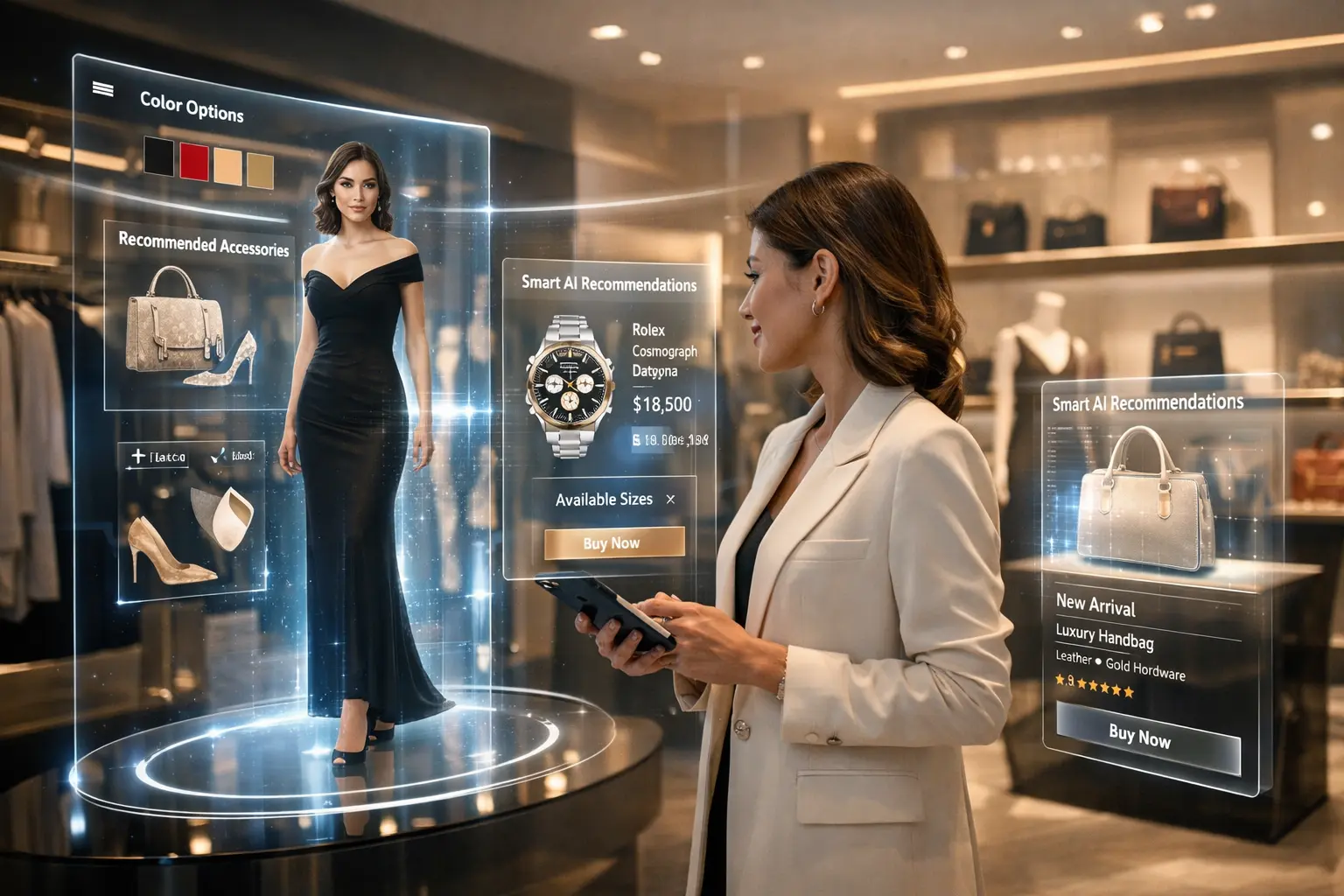
Imagine configuring your dream Lamborghini in your driveway, trying on a Rolex without visiting a boutique, or walking through a private jet’s cabin from your living room. This isn’t science fiction-it’s happening right now.
The Luxury Retail Transformation
The luxury shopping experience has always been about exclusivity, personalization, and sensory immersion. Crystal champagne flutes in automotive showrooms. White-gloved service in watch boutiques. Private viewings in hushed galleries.
But technology is rewriting the rules of luxury retail in ways that enhance rather than diminish the premium experience. The fusion of Artificial Intelligence and Augmented Reality is creating shopping journeys that are simultaneously more convenient and more magical than anything possible in physical stores alone.
What’s Driving This Revolution?
The Technology Convergence
AI-Powered Personalization: Machine learning algorithms analyze your preferences, purchase history, browsing behavior, and even social media activity to understand your taste better than any sales associate ever could.
Advanced AR Rendering: Today’s augmented reality isn’t the clunky, low-resolution overlays of five years ago. Modern AR creates photorealistic, physically accurate 3D models that respond to lighting, shadows, and spatial context in real-time.
5G Connectivity: Ultra-fast networks enable instant streaming of massive 3D assets, making AR experiences seamless even with complex models like full vehicle configurations.
Computer Vision: AI recognizes your environment, tracking surfaces, lighting conditions, and spatial dimensions to place virtual products convincingly in your real-world space.
Why Luxury Brands Are Investing
The numbers tell the story:
- 73% of luxury consumers want to visualize products in their space before purchasing (McKinsey)
- AR try-ons reduce return rates by up to 40% for luxury goods
- Virtual showrooms cost 90% less than physical flagship stores
- 86% of high-net-worth individuals value convenience as much as exclusivity (Deloitte Luxury Report)
But beyond metrics, there’s a strategic imperative: the next generation of luxury consumers grew up with smartphones and expects digital sophistication from premium brands.
Automotive: Your Personal Showroom, Anywhere
Virtual Car Configuration in Your Garage
Porsche AR Visualizer lets you place a full-scale 911 in your driveway. Not just see it-walk around it, peer inside, change colors, wheel designs, and interior specifications in real-time. The AI remembers your preferences, suggesting configurations based on your style.
Mercedes-Benz Virtual Showroom takes it further. Using your smartphone or AR glasses, you can:
- Open doors and examine interior details
- Start the virtual engine and hear authentic sound
- See how different paint colors look in your actual lighting conditions
- Compare two models side-by-side at full scale
Lamborghini’s Configurator combines AI and AR to solve a classic problem: most buyers never see their exact specification before delivery. Now, you configure your Huracán with specific paint, wheels, brake calipers, and interior trim, then view the precise result in AR before committing millions.
The AI Shopping Assistant
While you explore, an AI assistant learns your preferences:
“I notice you’ve spent time viewing the sports exhaust system. Based on your interest in the Carbon Ceramic Brakes, I’d recommend the Sport Chrono Package for the complete performance experience.”
It’s not pushy-it’s helpful. The AI analyzes thousands of configuration combinations to suggest harmonious packages you might not have considered.
Virtual Test Drives
Audi’s VR Experience (which integrates with AR visualization) lets you experience how a car drives before the test drive. The system simulates acceleration, handling characteristics, and even the sound system quality.
While not yet widespread, several manufacturers are developing AR-enhanced real test drives-overlay performance data, safety features activating, and technical specifications on your view while driving.
Luxury Watches: Try Before You Buy, Digitally
Virtual Try-On Technology
Rolex, Patek Philippe, and Audemars Piguet now offer AR try-on experiences through their apps and select retail partners:
- Hand Scanning: AI analyzes your wrist size, skin tone, and proportions
- Photorealistic Rendering: The watch appears on your wrist with accurate scale, lighting, and material textures
- Movement Simulation: See how the watch looks from different angles as you move your hand
- Personalization: Compare multiple models, straps, and variations instantly
The Game-Changer: You can try a $50,000 Richard Mille or a $500,000 Patek Philippe Grand Complication without scheduling a private appointment or traveling to a boutique.
AI-Powered Recommendations
“Based on your wrist size, style preferences, and the Speedmaster you viewed earlier, you might appreciate the Seamaster Aqua Terra. Here’s how it looks on you.”
The AI considers:
- Physical fit: Case diameter appropriate for your wrist
- Style compatibility: Formal vs. sport, based on your wardrobe and lifestyle cues
- Collection coherence: Complementing watches you already own
- Investment potential: Historical appreciation for specific references
Virtual Boutiques
Watches & Wonders Virtual: The prestigious watch fair now offers an AR component. Walk through virtual exhibition halls, examine timepieces in 3D with microscopic detail, and speak with brand representatives via integrated video chat-all without leaving home.
Vacheron Constantin’s Private Showroom: Select clients receive AR headsets for private viewings. The experience includes:
- Full-scale boutique environments
- Watches displayed on virtual pedestals you can walk around
- “X-ray mode” showing movement details inside the case
- Historical context and craftsmanship videos overlaid on each piece
Aviation: Tour Your Private Jet Before It’s Built
Cabin Configuration in AR
Gulfstream’s Design Studio allows buyers to configure their G700’s cabin in full-scale AR:
- Place virtual furniture layouts in your office
- Walk through different seating configurations
- Change materials, colors, and finishes in real-time
- View how natural light enters the cabin at different times of day
- Experience the cabin at actual size to judge spacing and flow
The Impact: Buyers make better decisions, change orders decrease by 60%, and satisfaction increases because expectations match reality.
Virtual Factory Tours
Bombardier offers AR factory tours where prospective buyers watch their aircraft being assembled:
- See your specific tail number at various production stages
- Examine quality control processes
- Meet craftspeople working on your interior
- Approve milestone inspections remotely via AR overlay
Pre-Delivery Inspections
Before taking delivery, buyers conduct AR-enhanced walkarounds:
- Verify every specification matches the order
- Inspect paint quality with AI-enhanced zoom
- Test cabin management systems virtually
- Review maintenance procedures and aircraft capabilities
Fashion & Accessories: The Digital Fitting Room
Eyewear Revolution
Ray-Ban and Cartier lead with AR try-on that’s indistinguishable from reality:
- Face mapping determines which frame shapes flatter your features
- AI suggests sizes based on facial measurements
- See how sunglasses look in different lighting conditions
- Compare your top choices side-by-side
Handbags and Luggage
Louis Vuitton’s app lets you:
- Place bags in your closet to visualize size
- See how different colors complement your wardrobe
- Customize monogramming and view results before ordering
- Match luggage sets in your actual home environment
Rimowa’s AR Configurator: Design your perfect luggage set, then place the full collection in your entryway to ensure it fits your space and lifestyle.
Real Estate: Virtual Property Tours Enhanced by AI
Smart Property Viewing
While not strictly “luxury shopping,” high-end real estate embraces AI + AR:
Sotheby’s International Realty offers:
- AR property tours with furniture staging that matches your taste
- AI analyzing which properties fit your lifestyle based on browsing behavior
- Virtual renovations showing how spaces could be modified
- Neighborhood overlays showing schools, restaurants, commute times
The Luxury Advantage: View properties globally without travel, schedule viewings at your convenience, and make confident decisions faster.
The Technology Behind the Magic
How It Actually Works
Step 1: 3D Asset Creation
- Luxury brands create photorealistic 3D models of products
- Every material, texture, and mechanical detail is captured
- Models contain hundreds of gigabytes of data for accuracy
Step 2: AI Processing
- Computer vision maps your environment
- Machine learning personalizes recommendations
- Neural networks render realistic lighting and shadows
Step 3: AR Display
- Your device’s camera captures real-world context
- AI places 3D models with correct scale and perspective
- Real-time rendering adjusts to lighting and movement
Step 4: Interaction
- Touch, gesture, or voice controls manipulate products
- Configuration changes happen instantly
- Share your customizations with advisors or friends
The Hardware Evolution
Current: Smartphone and tablet AR works remarkably well, requiring no additional equipment.
Emerging: Apple Vision Pro and Meta Quest 3 offer immersive AR/VR experiences that blend digital and physical seamlessly.
Future: Lightweight AR glasses from brands like Ray-Ban Meta and upcoming Apple Glasses will make the experience as natural as looking through windows.
The Human Touch: AI as Assistant, Not Replacement
Enhancing, Not Eliminating, Service
Luxury brands understand that technology should amplify, not replace, human expertise.
The Hybrid Model:
- AI handles: Product discovery, configuration, visualization, technical specifications
- Humans provide: Emotional connection, brand storytelling, nuanced advice, relationship building
Example: You’re exploring a Bentley Continental GT in AR. The AI shows you technical details and options. But when you have questions about the brand’s heritage, craftsmanship philosophy, or want to discuss financing, you’re connected to a dedicated Bentley specialist via integrated video chat.
Virtual Concierge Services
Personal Shopping AI + Human Expert:
- AI pre-qualifies options based on your profile
- Human stylist reviews AI recommendations
- Joint consultation via AR where both you and the specialist see the same products
- AI handles logistics while humans provide taste and judgment
Patek Philippe’s Approach: The AI helps you explore, but purchasing a Grand Complication still involves extensive dialogue with a brand specialist who understands both the watch and your collecting journey.
Privacy and Data: The Luxury Paradox
The Trust Question
Luxury consumers value privacy intensely. How do brands balance personalization with discretion?
Best Practices Emerging:
- Transparency: Clear disclosure of what data is collected and how it’s used
- Control: Customers choose their level of personalization
- Security: Encrypted data, limited retention, no third-party sharing
- Anonymization: AI learns from patterns without storing personal details
The Luxury Standard: Brands like Ferrari and Rolex treat digital data with the same confidentiality as financial information-it’s part of the service promise.
Challenges and Limitations
What’s Not Perfect Yet
Tactile Experience: You can’t feel the leather, hear the door close, or experience the weight of a watch on your wrist through AR.
Internet Dependency: Flawless AR requires robust connectivity. In markets with poor network infrastructure, experiences suffer.
Hardware Requirements: While smartphone AR works, the best experiences require recent high-end devices.
Learning Curve: Older high-net-worth customers may resist technology-first approaches.
The Uncanny Valley: When AR isn’t quite perfect, it can feel off-putting rather than impressive.
The Business Case: Why Luxury Brands Are All In
ROI That Makes Sense
Expanded Reach: A Pagani dealership serves maybe 50 people annually. Their AR configurator reaches thousands globally.
Higher Conversion: Customers who use AR are 40% more likely to purchase (Shopify data).
Reduced Returns: Accurate visualization means fewer “it’s not what I expected” disappointments.
Lower Overhead: Virtual showrooms cost pennies compared to prime retail space.
Data Insights: AI learns what customers want, informing product development and inventory decisions.
Competitive Necessity
When your competitor offers AR try-on and you don’t, you’re perceived as behind the times. For luxury brands, perception is everything.
The Next 5 Years: What’s Coming
Emerging Innovations
Haptic Feedback: Devices that simulate texture, weight, and resistance, letting you “feel” products in AR.
AI Avatars: Virtual shopping assistants with personalities that learn your preferences across multiple sessions and brands.
Persistent AR: Digital showrooms anchored to physical locations-walk into a luxury mall and AR overlays activate automatically.
Collaborative Shopping: Share your AR view with friends or family remotely, getting real-time opinions on configurations.
Predictive Shopping: AI that suggests products before you realize you want them, based on life events, season changes, or collection gaps.
Blockchain Authentication: NFTs linked to physical products, with AR displaying provenance and authenticity certificates.
The Metaverse Intersection
While “metaverse” became a buzzword, the underlying concept has merit for luxury:
- Virtual flagship stores in digital spaces
- Digital twins of physical products for gaming or digital collection
- Exclusive virtual products that complement physical purchases
- Immersive brand experiences impossible in physical reality
The Cultural Shift: From Ownership to Experience
Experience-First Luxury
The luxury industry is realizing that the shopping journey is as important as the product:
- Discovery should be exciting, not overwhelming
- Customization should be empowering, not confusing
- Decision-making should be confident, not anxious
AI and AR transform shopping from a transaction into an experience worthy of the products themselves.
Final Thoughts: The Best of Both Worlds
The future of luxury shopping isn’t digital OR physical-it’s an elegant blend of both.
The Ideal Journey:
- Discover via AI recommendation (at home, on your time)
- Explore through AR visualization (in your environment, risk-free)
- Refine with human expertise (via video or in-person)
- Experience at a physical showroom or boutique (when you’re ready to commit)
- Own with confidence, having eliminated doubt
Technology doesn’t diminish luxury; it democratizes access while preserving exclusivity. It expands possibility while respecting tradition. It adds convenience without sacrificing service.
The brands winning this revolution understand that AI and AR are tools to deliver what luxury customers have always wanted: products that perfectly match their vision, shopping experiences that respect their time, and service that anticipates their needs.
The future isn’t about choosing between digital convenience and physical luxury-it’s about having both, seamlessly integrated, whenever and wherever you want them.
Key Takeaways
- AI + AR create personalized luxury shopping experiences that blend digital convenience with premium service
- Automotive, watch, and aviation brands lead with full-scale AR configuration and virtual showrooms
- Virtual try-ons reduce returns by 40% and increase purchase confidence
- Technology enhances rather than replaces human expertise in luxury retail
- Next 5 years will bring haptic feedback, AI avatars, and persistent AR experiences
- The ideal luxury journey blends digital discovery with physical experience
- Privacy and data security remain paramount for high-net-worth consumers
- Brands investing in AR/AI gain competitive advantage and expanded global reach